Cleveland Cavaliers
The Cleveland Cavaliers are an NBA franchise founded in 1970, winners of the 2016 title through LeBron James and now Donovan Mitchell's Eastern contender.
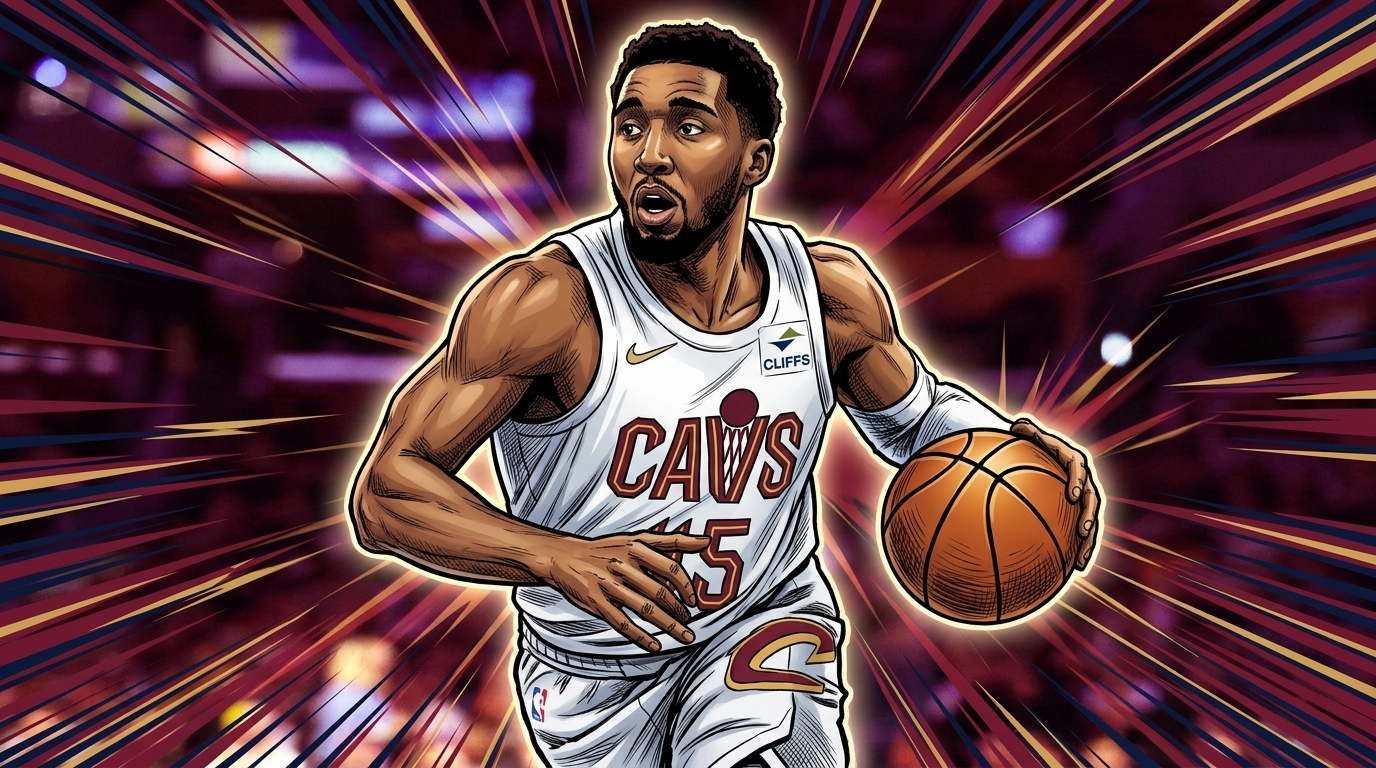
The Cleveland Cavaliers are a National Basketball Association franchise based in Cleveland, Ohio, competing in the Eastern Conference’s Central Division. Founded as an expansion team in 1970, the Cavaliers spent their first three-plus decades as one of the league’s hard-luck outfits before becoming, in the LeBron James years, the vehicle for the defining moment in modern Cleveland sports: the 2016 NBA championship, the city’s first major professional title since 1964 and the only one in franchise history. Across 56 completed seasons the club has compiled a 2,148–2,369 regular-season record with 26 playoff appearances, and, revived under Donovan Mitchell, has returned to the front rank of the Eastern Conference.
| Vitals | |
|---|---|
| Founded | 1970 (NBA expansion) |
| League / conf. / div. | NBA — Eastern Conference, Central Division |
| Arena | Rocket Arena, Cleveland, Ohio |
| Owner | Dan Gilbert (since 2005) |
| Head coach | Kenny Atkinson (as of Sep. 28, 2026) |
| Titles | 1 NBA championship (2016); 5 Eastern Conference titles (2007, 2015, 2016, 2017, 2018) |
Origins: the 1970 expansion
The Cavaliers entered the NBA in 1970 as one of three expansion clubs, joining the Portland Trail Blazers and Buffalo Braves under founding owner Nick Mileti. The name, chosen in a fan contest, evoked a band of daring, resourceful men — an aspiration the early rosters could not meet. Coached by future Hall of Famer Bill Fitch, Cleveland opened its history with 15 straight losses and finished 15–67 in 1970-71, the worst mark in the league that year.
The building blocks arrived slowly. Guard Austin Carr, taken first overall out of Notre Dame in the 1971 draft, and forward Bobby “Bingo” Smith gave the team its first identifiable stars, both eventually earning retired numbers. The Cavaliers played their early seasons at the aging downtown Cleveland Arena before moving in 1974 to the new Richfield Coliseum, a barn in the countryside between Cleveland and Akron that would host the franchise’s first great memory.
The Miracle of Richfield
In 1975-76 the Cavaliers won 49 games and reached the playoffs for the first time. Bolstered by the midseason acquisition of veteran center Nate Thurmond, Fitch’s team captured the Central Division and drew the Washington Bullets in the conference semifinals. The seven-game series, immortalized as the Miracle of Richfield, swung on a run of late-game heroics and climaxed with Dick Snyder’s driving basket in the closing seconds of Game 7 in April 1976, sending a delirious Coliseum crowd onto the floor.
The dream ended one round short. Center Jim Chones broke a foot in practice before the Eastern Conference Finals, and a depleted Cleveland lost to the Boston Celtics. Fitch was named Coach of the Year, and the Cavaliers returned to the playoffs in both 1977 and 1978. It remains the touchstone of the pre-LeBron era.
The Stepien years
The franchise nearly collapsed under Ted Stepien, who bought the team in 1980 and set about trading first-round draft picks so freely that the NBA intervened. The league adopted what became known as the “Stepien Rule,” barring clubs from dealing first-round picks in consecutive future years. Cleveland bottomed out at 15–67 in 1981-82, attendance cratered, and the team’s very survival in Cleveland was in doubt.
Gordon Gund’s 1983 purchase steadied the ship. To help the franchise recover from Stepien’s picks-for-nothing trades, the NBA awarded Cleveland bonus first-round selections — draft capital that would soon rebuild the roster from the ground up.
The Price–Daugherty–Nance core
The 1986 draft transformed the Cavaliers. With Gund’s restocked picks, Cleveland selected center Brad Daugherty first overall, added guard Ron Harper, and acquired sharpshooting point guard Mark Price. A 1988 trade brought forward Larry Nance from Phoenix, completing a deep, skilled nucleus under coach Lenny Wilkens. Cleveland won 57 games in 1988-89 and looked poised for a long run of contention.
Then came Michael Jordan. On May 7, 1989, in Game 5 of a first-round series, Jordan hit a buzzer-beating jumper over Craig Ehlo — “The Shot” — to eliminate the favored Cavaliers, the first of several playoff heartbreaks Chicago would inflict. Cleveland again won 57 games in 1991-92 and reached the Eastern Conference Finals, only to fall to Jordan’s Bulls in six. The Price-Daugherty-Nance teams were among the best the franchise ever fielded, yet they never broke through against the era’s dynasty.
The wilderness years
Injuries and age dismantled the core by the mid-1990s. Under coach Mike Fratello the Cavaliers leaned on grinding, low-scoring defense, squeezing out playoff berths in 1994-95, 1995-96 and 1997-98 but never advancing past the first round. Lithuanian center Zydrunas Ilgauskas, drafted in 1996, emerged as the enduring star of the period despite chronic foot problems.
The slide ended in tanking. Cleveland stumbled to 17–65 in 2002-03, the worst record in the East, and won the draft lottery — an outcome that delivered the most consequential player in franchise history, an Akron-born, St. Vincent–St. Mary prodigy already anointed as a generational talent.
LeBron James, Act One
LeBron James went first overall in the 2003 draft and won Rookie of the Year in 2004. He dragged a modest supporting cast upward year by year, reaching the playoffs in 2006 and, in 2007, authoring a 48-point closeout of the Detroit Pistons in the Eastern Conference Finals to carry Cleveland to its first NBA Finals, where the San Antonio Spurs swept them 4–0.
The peak came in 2008-09. James won back-to-back MVP awards in 2009 and 2010 and led the Cavaliers to a franchise-best 66–16 record, but a stunning conference-finals loss to the Orlando Magic and a second-round exit to Boston the following spring left the title drought intact. With James’s contract expiring, the franchise’s future hung on a single decision.
The Decision and the fall
On July 8, 2010, James announced on a live ESPN special that he would “take his talents to South Beach,” signing with the Miami Heat. Owner Dan Gilbert answered with a furious open letter, and the fan backlash was ferocious. Stripped of its superstar, Cleveland collapsed to 19–63 in 2010-11.
The rubble did yield lottery luck. The Cavaliers landed the No. 1 pick three times in four years, selecting point guard Kyrie Irving in 2011, Anthony Bennett in 2013 and Andrew Wiggins in 2014 — a haul that, however uneven, positioned the team for an improbable reunion.
LeBron James, Act Two, and the 2016 title
James came home in July 2014, and Cleveland flipped Wiggins to Minnesota for All-Star forward Kevin Love, forming a “Big Three” with Irving. After a Finals loss to the Golden State Warriors in 2015 — with Irving and Love injured — the 2016 rematch became legend. Trailing the 73–9 Warriors three games to one, Cleveland won three straight, capped by a 93–89 Game 7 at Oracle Arena on June 19, 2016.
Two plays defined the night. James’s chase-down block of Andre Iguodala and Irving’s go-ahead three-pointer over Stephen Curry with 53 seconds left secured the first championship in franchise history and ended Cleveland’s 52-year major-title drought. James was named unanimous Finals MVP, and coach Tyronn Lue — elevated from David Blatt midseason — held the trophy. The Cavaliers returned to the Finals in both 2017 and 2018, losing each time to Golden State, before James departed for the Los Angeles Lakers in July 2018.
The rebuild and the Mitchell era
James’s second exit sent Cleveland back to the lottery, and another 19–63 season in 2018-19 restocked the roster: point guard Darius Garland in 2019, forward Evan Mobley third overall in 2021, and center Jarrett Allen via trade. In September 2022 the front office made its statement move, acquiring guard Donovan Mitchell from Utah for Collin Sexton, Lauri Markkanen and a package of first-round picks.
Cleveland became a contender again without James. The Cavaliers won 51 games in 2022-23 and reached the conference semifinals in 2023-24. Hired in the summer of 2024, coach Kenny Atkinson then delivered the finest regular season of the post-LeBron age: a 64–18 mark in 2024-25, the No. 1 seed in the East and the second-most wins in franchise history behind only 2008-09. Atkinson was named Coach of the Year and Mobley became the first Cavalier to win Defensive Player of the Year. Yet the season ended in disappointment: after sweeping Miami, Cleveland lost the semifinals to the Indiana Pacers, 4–1.
In 2025-26 the Cavaliers went the distance in the East. Seeded fourth at 52–30, they beat the Toronto Raptors 4–3, then rallied from an 0–2 hole to eliminate the top-seeded Detroit Pistons 4–3 and reach the Eastern Conference Finals — their first since 2018 and, notably, their first without LeBron James on the roster since 1992. There the eventual champion New York Knicks swept them, 4–0. The home floor, meanwhile, took its current name in February 2025, when the arena that opened in 1994 as Gund Arena — later Quicken Loans Arena and Rocket Mortgage FieldHouse — was rebranded Rocket Arena.
Retired numbers
Cleveland has retired seven numbers, spanning the expansion-era stars who built the franchise’s identity through the beloved Price-Daugherty-Nance core and the Ilgauskas years. No coach or executive banner hangs among them.
| No. | Player | Pos. | Team tenure | Retired |
|---|---|---|---|---|
| 7 | Bobby “Bingo” Smith | G/F | 1970–1979 | Dec. 4, 1979 |
| 11 | Zydrunas Ilgauskas | C | 1996–2010 | Mar. 8, 2014 |
| 22 | Larry Nance | F/C | 1988–1994 | Jan. 30, 1995 |
| 25 | Mark Price | G | 1986–1995 | Nov. 13, 1999 |
| 34 | Austin Carr | G | 1971–1980 | Jan. 3, 1981 |
| 42 | Nate Thurmond | C | 1975–1977 | Dec. 18, 1977 |
| 43 | Brad Daugherty | C | 1986–1996 | Mar. 1, 1997 |
Season by season
The complete franchise record, folded by decade, newest first.
The 2020s 281–201 · 4 playoff berths · 1 Conf. Finals
| Season | W–L | Result |
|---|---|---|
| 2025-26 | 52-30 | Lost E. Conf. Finals (NYK 0-4) |
| 2024-25 | 64-18 | Lost E. Conf. Semis (IND 1-4) |
| 2023-24 | 48-34 | Lost E. Conf. Semis |
| 2022-23 | 51-31 | Lost E. Conf. First Round |
| 2021-22 | 44-38 | No playoffs (lost play-in) |
| 2020-21 | 22-50 | No playoffs |
The 2010s 346–441 · 4 playoff berths · 4 Finals · 1 title
| Season | W–L | Result |
|---|---|---|
| 2019-20 | 19-46 | No playoffs |
| 2018-19 | 19-63 | No playoffs |
| 2017-18 | 50-32 | Lost NBA Finals |
| 2016-17 | 51-31 | Lost NBA Finals |
| 2015-16 | 57-25 | Won NBA Finals |
| 2014-15 | 53-29 | Lost NBA Finals |
| 2013-14 | 33-49 | No playoffs |
| 2012-13 | 24-58 | No playoffs |
| 2011-12 | 21-45 | No playoffs |
| 2010-11 | 19-63 | No playoffs |
The 2000s 425–395 · 5 playoff berths · 1 Finals
| Season | W–L | Result |
|---|---|---|
| 2009-10 | 61-21 | Lost E. Conf. Semis |
| 2008-09 | 66-16 | Lost E. Conf. Finals |
| 2007-08 | 45-37 | Lost E. Conf. Semis |
| 2006-07 | 50-32 | Lost NBA Finals |
| 2005-06 | 50-32 | Lost E. Conf. Semis |
| 2004-05 | 42-40 | No playoffs |
| 2003-04 | 35-47 | No playoffs |
| 2002-03 | 17-65 | No playoffs |
| 2001-02 | 29-53 | No playoffs |
| 2000-01 | 30-52 | No playoffs |
The 1990s 424–364 · 6 playoff berths · 1 Conf. Finals
| Season | W–L | Result |
|---|---|---|
| 1999-00 | 32-50 | No playoffs |
| 1998-99 | 22-28 | No playoffs |
| 1997-98 | 47-35 | Lost E. Conf. First Round |
| 1996-97 | 42-40 | No playoffs |
| 1995-96 | 47-35 | Lost E. Conf. First Round |
| 1994-95 | 43-39 | Lost E. Conf. First Round |
| 1993-94 | 47-35 | Lost E. Conf. First Round |
| 1992-93 | 54-28 | Lost E. Conf. Semis |
| 1991-92 | 57-25 | Lost E. Conf. Finals |
| 1990-91 | 33-49 | No playoffs |
The 1980s 331–489 · 4 playoff berths
| Season | W–L | Result |
|---|---|---|
| 1989-90 | 42-40 | Lost E. Conf. First Round |
| 1988-89 | 57-25 | Lost E. Conf. First Round |
| 1987-88 | 42-40 | Lost E. Conf. First Round |
| 1986-87 | 31-51 | No playoffs |
| 1985-86 | 29-53 | No playoffs |
| 1984-85 | 36-46 | Lost E. Conf. First Round |
| 1983-84 | 28-54 | No playoffs |
| 1982-83 | 23-59 | No playoffs |
| 1981-82 | 15-67 | No playoffs |
| 1980-81 | 28-54 | No playoffs |
The 1970s 341–479 · 3 playoff berths · 1 Conf. Finals
| Season | W–L | Result |
|---|---|---|
| 1979-80 | 37-45 | No playoffs |
| 1978-79 | 30-52 | No playoffs |
| 1977-78 | 43-39 | Lost E. Conf. First Round |
| 1976-77 | 43-39 | Lost E. Conf. First Round |
| 1975-76 | 49-33 | Lost E. Conf. Finals |
| 1974-75 | 40-42 | No playoffs |
| 1973-74 | 29-53 | No playoffs |
| 1972-73 | 32-50 | No playoffs |
| 1971-72 | 23-59 | No playoffs |
| 1970-71 | 15-67 | No playoffs |
By the numbers
Franchise marks
Ranks
- 15th NBA franchise valuation, $4.8 billion (2025)
- 1st Eastern Conference regular season, 2024-25 (64–18)
- 4th Eastern Conference seed, 2025-26 (reached Conf. Finals)
Honors
- 2016 NBA champion
- 5× Eastern Conference champion (2007, 2015, 2016, 2017, 2018)
- LeBron James — 2016 Finals MVP
- 2× MVP: LeBron James (2009, 2010)
- LeBron James — 2004 Rookie of the Year
- Evan Mobley — 2025 Defensive Player of the Year
- Kenny Atkinson — 2025 Coach of the Year
Per Basketball-Reference and CNBC/Forbes, through the 2025-26 season.
The arguments
Was the 2016 title Cleveland’s or LeBron’s? Supporters of the franchise note that the championship required Irving’s shotmaking, Love’s rebounding and Lue’s in-series adjustments, and that no title comes down to one man. Skeptics counter that James recruited the roster, engineered the trades and produced the two signature plays of Game 7, and that the team reverted to the lottery the moment he left — twice. Both readings are grounded in the record.
Should the Cavaliers have kept the pre-Mitchell rebuild longer? One camp argues that trading three first-round picks and two rotation players for Mitchell in 2022 short-circuited the organic growth of Garland and Mobley and mortgaged the future for a team that has not escaped the second round with him until 2026. The other holds that Mitchell’s arrival made Cleveland relevant immediately, drew a 64-win season and an Eastern Conference Finals berth, and that draft picks are worth little to a team already good enough to contend.
Where do the Wilkens-era teams rank? The 1988–1993 clubs won 57 games twice and are remembered fondly, but they never reached a Finals and were repeatedly eliminated by Chicago. Whether they were genuinely great or merely good in a Jordan-shadowed era remains a live debate among longtime fans.
Why it matters
The Cavaliers are the franchise through which a city defined by championship near-misses finally won. For nearly half a century Cleveland’s story was Richfield miracles that ended a round short, superstars who left, and lottery balls that never quite paid off — until James returned and delivered, in 2016, the title that broke a 52-year civic drought. That the club has since rebuilt into an Eastern Conference finalist without him, behind Mitchell, Mobley and Garland, is the strongest evidence yet that Cleveland basketball is no longer defined solely by one man’s comings and goings. The Cavaliers matter because they are the rare team whose history is inseparable from its city’s longing — and its release.