
Why would a league that spent a full year building toward a Super Bowl rematch bury the champions’ opening night on a Wednesday? We’ve been staring at the Week 1 schedule since it dropped back in March, and that’s the detail that never quite settled. Seattle beat New England 29-13 in Super Bowl LX, and on Sept. 9 the Seattle Seahawks host the New England Patriots at Lumen Field to open the 2026 season. Seahawks-Patriots Week 1 2026 is the rematch the schedule-makers dream about: a defending champion opening the year against the team it just dethroned. The date is what doesn’t fit the occasion. Kickoff is 8:20 p.m. ET on NBC and Peacock, and it’s happening on a Wednesday, not the Thursday-night stage the league usually reserves for exactly this kind of moment.
That’s not a scheduling accident. It’s a downstream effect of a decision made an ocean away, and untangling it says more about where the NFL’s priorities sit in 2026 than the rematch itself does.
Why Is Seahawks-Patriots Only the Third Week 1 Rematch Ever?
A Super Bowl LX rematch in Week 1 is rare enough on its own. It’s only the third time in NFL history the previous season’s two Super Bowl teams have met in Week 1, and just the second time they’ve done it in the season opener specifically. The last one came in 2016, when the Denver Broncos hosted the Carolina Panthers to open that season. Defending champions have generally fared well in these early rematches, though the exact all-time record shifts depending on which era you start counting from, and I’d rather leave that vague than hand you a number I can’t stand behind.
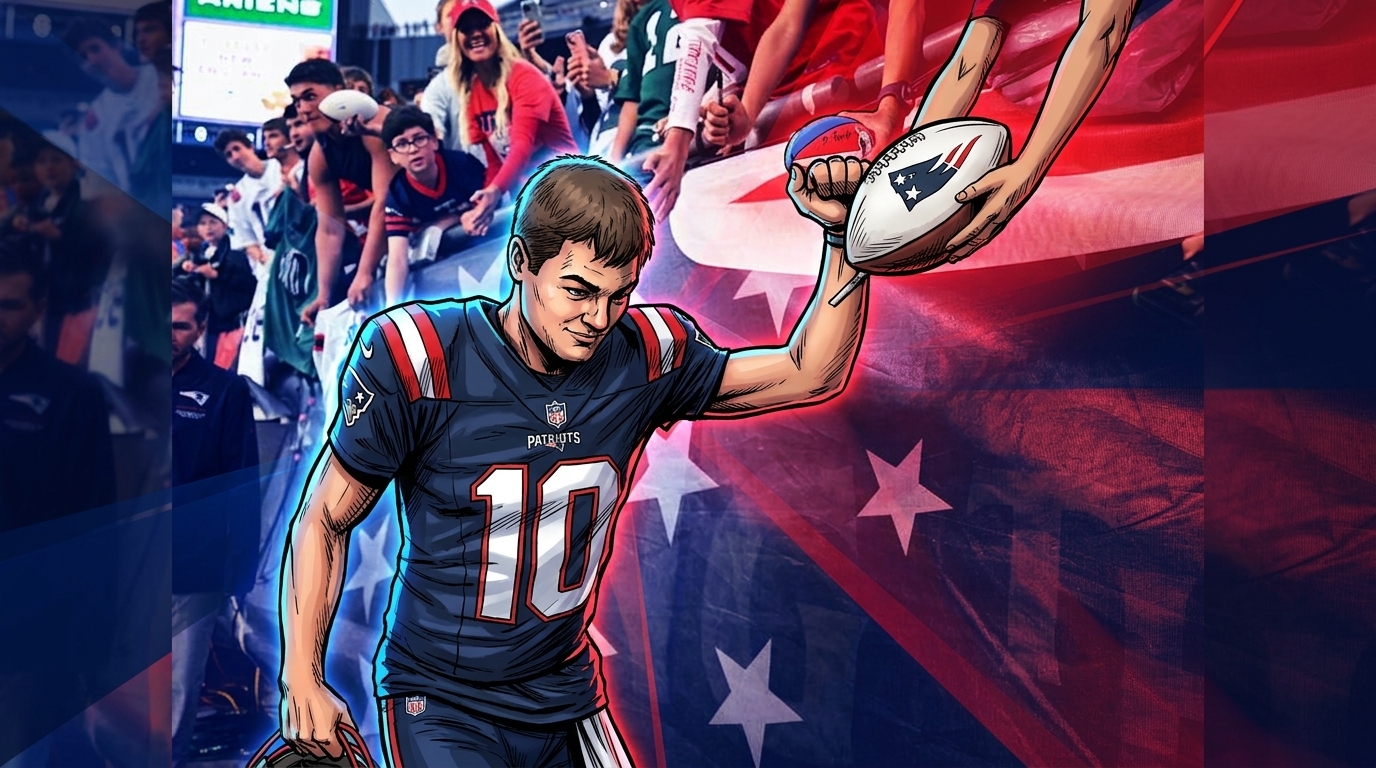
What sharpens this particular rematch is Drake Maye. He went 27-of-43 for 295 yards, two touchdowns and three turnovers in the Super Bowl LX loss, then spent the offseason collecting hardware for the season that got him there: PFWA Most Improved Player, the Bert Bell Award, FedEx Air Player of the Year, and a finalist nod for NFL MVP in just his second full season. New England didn’t stand pat afterward, either. The Patriots made a win-now bet on AJ Brown this offseason (a move covered in more depth here), the clearest signal yet that the front office believes the roster around Maye is closer to finished than it is to rebuilding. Seattle didn’t sit still, either. Devon Witherspoon’s record-setting extension locked up the best cornerback on a defense that just won a title, a deal broken down here. The market has noticed the gap regardless: Seattle opens as just 3.5-point favorites in its own building, against the team it beat by 16 points in February.
Mike Macdonald returns for his third season as Seattle’s head coach, which in a league that fires coordinators mid-rebuild is its own quiet statement. The continuity is the unremarkable part of this story. The Wednesday is the interesting one.
Why Is the 2026 NFL Season Opening on a Wednesday?
The Sports Broadcasting Act of 1961 blocked the Melbourne opener from airing on its usual Friday, which pushed that game to Thursday instead. That shift is what bumped the champions’ night backward to Wednesday.
A 65-year-old broadcast law is the mechanism underneath that. The Sports Broadcasting Act of 1961 bars professional football from airing on Fridays and Saturdays from the second Friday in September through mid-December, a protection Congress built for high school and college football that the league still routes around every fall. Week 1 of 2026 falls inside that window, in the second week of September, which meant the international opener in Australia couldn’t use the Friday slot the league leans on for its other overseas games. It got pushed to Thursday. Rather than stack two marquee openers into one 24-hour stretch (the champions’ night and the international spectacle running back to back), the league moved the Seahawks-Patriots Wednesday kickoff up a full day, into a slot it has used exactly once since 2012.
That one prior instance is a small piece of trivia worth knowing. The 2012 Wednesday opener between the Cowboys and Giants existed only because the league needed to dodge Barack Obama’s Democratic National Convention acceptance speech. This is just the second Wednesday season opener in more than 75 years. Fourteen years later, the conflict isn’t a political convention. It’s Melbourne.
https://twitter.com/TomPelissero/status/2036882154932613412
Pelissero’s framing puts the Seahawks first and the day-of-week oddity second, which is the right order for an announcement and the wrong order for understanding why the date exists at all.
What the Melbourne Game Actually Bumped
On Thursday, Sept. 10, the Los Angeles Rams and San Francisco 49ers play the first regular-season NFL game ever held in Australia, at the Melbourne Cricket Ground, streamed on Netflix. That’s a genuinely new frontier for the league, and treating it as one is fair. What deserves more scrutiny is what the league was willing to move to protect that Thursday. Seattle’s championship season didn’t get canceled or diminished. It got rescheduled around a broadcast window that didn’t exist for this league a decade ago.
I think that’s the real headline sitting underneath the rematch storyline. The NFL has treated its season-opening night (the ring ceremony, the champions under the lights, the closest thing pro football has to a coronation) as a fixed point on the calendar for as long as most fans have been watching. This year it wasn’t fixed. It was negotiable, and it lost.
None of this is a knock on Melbourne, or on the international package the league has spent a decade building (I’ve tracked enough of these broadcast carve-outs, mostly leftover instinct from an old media-research job where the on-air analysts never credited the notes, to recognize a scheduling quirk that’s actually a policy signal). Given the choice between protecting the traditional slot for its own defending champions and protecting the runway for global expansion, the league picked expansion, and didn’t visibly agonize over it. Watching the Rams and the 49ers headline a Netflix broadcast from the Southern Hemisphere the very next night makes that priority hard to miss.
Watch what happens the next time a marquee date collides with an international window, because this won’t be the last collision. This year it cost the champions a day. The precedent that matters isn’t the day itself — it’s that the league now treats its most tradition-coded night as the one with the most give in it.