Seattle Seahawks
The Seattle Seahawks are an NFL franchise founded in 1976, winners of Super Bowls XLVIII and LX, home of the Legion of Boom and the 12th Man.
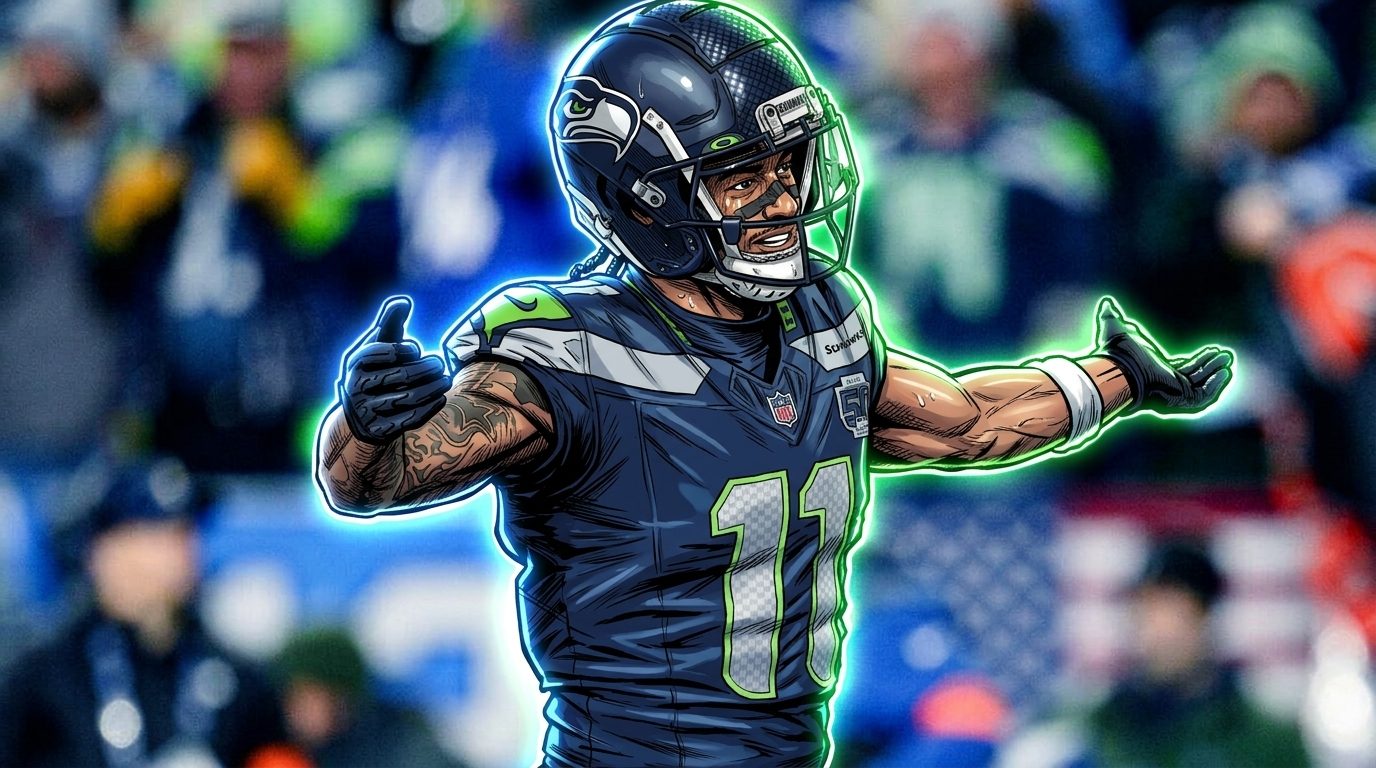
The Seattle Seahawks are the National Football League franchise of the Pacific Northwest, an expansion club born in 1976 that spent three decades chasing a championship before winning two inside a single generation. They are the team of Steve Largent and the Kingdome, of Shaun Alexander and a heartbreaking Super Bowl, of the Legion of Boom and the loudest building in American sport, and — after the 2025 season — of a second Lombardi Trophy under one of the youngest head coaches the league has ever employed. No franchise has been more defined by its crowd: the “12th Man” is a retired number, a trademark, and the organizing idea of the whole enterprise.
| Vitals | |
|---|---|
| Founded | 1976 (franchise awarded June 1974) |
| League / conference / division | NFL — National Football Conference, NFC West |
| Stadium | Lumen Field, Seattle, Washington (opened 2002) |
| Owner | Neeru Khosla, control owner (Khosla family, since Sept. 3, 2026) |
| Head coach | Mike Macdonald (as of Oct. 20, 2026) |
| Titles | Super Bowl XLVIII (2013 season), Super Bowl LX (2025 season) |
Expansion and the Jack Patera years (1976–1982)
Seattle was awarded an NFL franchise in June 1974, with a Nordstrom-family-led ownership group, and began play in 1976 alongside fellow expansion team Tampa Bay. Housed in the Kingdome and coached by Jack Patera, the Seahawks spent a single season in the NFC West before shifting to the AFC West in 1977, where they would remain for a quarter century. The first team went 2-12, and quarterback Jim Zorn and receiver Steve Largent became the faces of the young club.
Largent was the franchise’s founding star and its first legend. Drafted by the Houston Oilers and traded to Seattle in 1976 for an eighth-round pick, the undersized receiver retired after 14 seasons as the NFL’s all-time leader in receptions (819), receiving yards (13,089) and touchdown catches (100). He became the first Seahawk elected to the Pro Football Hall of Fame, in 1995.
Patera delivered the expansion era’s high notes and its collapse. Seattle posted back-to-back 9-7 seasons in 1978 and 1979 — the franchise’s first winning campaigns — and Patera was named a coach of the year for 1978. The team then slid, and after a 4-5 start to the strike-shortened 1982 season he was dismissed, closing the first chapter without a playoff appearance.
Ground Chuck: the Chuck Knox era (1983–1991)
Chuck Knox arrived in 1983 and took the Seahawks to the postseason for the first time. As a 9-7 wild card, Seattle won playoff games over Denver and Miami before falling in the AFC Championship Game to the Los Angeles Raiders. Rookie running back Curt Warner, quarterback Dave Krieg and safety Kenny Easley formed the core of a team that suddenly mattered in January.
The 1984 squad was the best of the AFC West years. Seattle went 12-4 — its finest record to that point — with Easley earning NFL Defensive Player of the Year honors, though the season ended in a divisional loss to Miami. The Seahawks returned to the playoffs as a wild card in 1987 and finally captured their first division title in 1988 at 9-7, losing in the divisional round to Cincinnati.
Largent’s 1989 retirement closed the decade. Knox’s teams never broke through to a Super Bowl, and after the 1991 season he departed, leaving behind the franchise’s first sustained run of contention and its first signature January memories.
Cortez Kennedy and the lean 1990s (1992–1998)
The 1990s were the hardest stretch in franchise history. Under Tom Flores, the 1992 team went 2-14 with one of the least productive offenses of the modern era — and, remarkably, that same defense produced a Defensive Player of the Year in tackle Cortez Kennedy, whose individual brilliance on a two-win team became one of the sport’s enduring oddities. Kennedy would enter the Hall of Fame in 2012.
The franchise’s Seattle future was briefly in doubt. A 1993 No. 2 overall pick spent on quarterback Rick Mirer did not pan out, Dennis Erickson’s four seasons (1995–1998) hovered around .500 without a playoff berth, and owner Ken Behring moved to relocate the club to Southern California in 1996. Microsoft co-founder Paul Allen purchased the team in 1997 and kept it in Seattle, stabilizing the franchise for the era to come.
The Mike Holmgren era and Super Bowl XL (1999–2008)
Mike Holmgren came from Green Bay in 1999 with full control of football operations. He won the AFC West in his first year, acquired quarterback Matt Hasselbeck in 2001, and oversaw the 2002 move into a new downtown stadium and a realignment back to the NFC West. Behind an offensive line anchored by Hall of Famers Walter Jones and Steve Hutchinson, Seattle became a perennial division contender.
The 2005 team reached the first Super Bowl in franchise history. Running back Shaun Alexander was named NFL Most Valuable Player after rushing for 1,880 yards and a then-record 27 rushing touchdowns, powering a 13-3 season. In Super Bowl XL on Feb. 5, 2006, the Seahawks lost 21-10 to the Pittsburgh Steelers in a game whose officiating became a lasting grievance in Seattle.
Holmgren’s Seahawks won four straight division titles (2004–2007). They followed the Super Bowl run with divisional-round appearances in 2006 and 2007, then declined sharply in Holmgren’s farewell 4-12 season of 2008. His decade restored the franchise to relevance and delivered its first conference championship.
The Jim Mora interlude (2009)
The post-Holmgren handoff lasted one season. Jim L. Mora, promoted from the staff, went 5-11 in 2009 and was dismissed after a single year, setting up the most transformative hire in franchise history.
The Pete Carroll rebuild (2010–2012)
Pete Carroll and general manager John Schneider took over in January 2010 and remade the roster at speed. That first team won the NFC West at 7-9 — the first sub-.500 team ever to make the playoffs — then stunned the defending champion New Orleans Saints 41-36 in the wild-card round. Marshawn Lynch’s 67-yard, tackle-shedding touchdown in that game, the “Beast Quake,” registered on a nearby seismograph on Jan. 8, 2011, and announced the team’s new identity.
The 2012 draft reshaped the franchise. Seattle selected quarterback Russell Wilson in the third round (75th overall), a pick that outstripped every projection, and surrounded him with young defenders drafted in the preceding classes — Earl Thomas, Kam Chancellor and Richard Sherman among them. The 2012 team went 11-5 and pushed Atlanta to the final seconds of a divisional-round loss, signaling that a contender had fully arrived.
The Legion of Boom and back-to-back Super Bowls (2013–2015)
The “Legion of Boom” secondary — Sherman, Thomas, Chancellor and a rotating fourth corner — became one of the great defenses of the Super Bowl era. The 2013 team led the league in scoring defense, won the NFC title over San Francisco, and then dismantled Peyton Manning’s record-setting Denver Broncos 43-8 in Super Bowl XLVIII on Feb. 2, 2014, with linebacker Malcolm Smith named Most Valuable Player. It was the first championship in franchise history.
The 2014 team came within a yard of a dynasty. Seattle went 12-4, rallied past Green Bay in an overtime NFC Championship Game, and led New England late in Super Bowl XLIX on Feb. 1, 2015. Trailing 28-24 with the ball at the 1-yard line and 26 seconds remaining, the Seahawks threw a pass that Malcolm Butler intercepted — the defining what-if of the era.
The crowd made the era loud, literally. On Sept. 15, 2013, Seahawks fans set a Guinness World Record for the loudest crowd roar at a sports stadium, at 137.6 decibels, a measurable extension of the 12th Man mystique; the Kansas City Chiefs broke the mark with 142.2 decibels at Arrowhead Stadium on Sept. 29, 2014, and have held the record since. The 2015 team returned to the divisional round, the fifth straight season of double-digit contention, before the championship window began to narrow.
The later Carroll years and the Wilson trade (2016–2023)
Carroll kept Seattle in the playoff hunt even as the Legion of Boom dispersed. The Seahawks won the division in 2016 and 2020 and returned to the postseason in 2018, 2019 and 2020, but never recaptured the dominance of the title years as Sherman, Thomas and Chancellor departed between 2018 and 2019.
The defining decision of the late Carroll era was trading Russell Wilson. On March 8, 2022, Seattle dealt Wilson to Denver for a haul of players and premium draft picks. Geno Smith stepped in and was named 2022 Comeback Player of the Year, guiding a surprise playoff team. After a 9-8 season in 2023, Carroll and the club parted ways in January 2024; across 14 seasons he was the winningest coach in franchise history, with the team’s first Super Bowl title to his name.
The Mike Macdonald era (2024–present)
Seattle hired Baltimore defensive coordinator Mike Macdonald on Jan. 31, 2024, at age 36 the youngest head coach in the NFL. His first team went 10-7 and narrowly missed the playoffs, but the defensive identity he installed set up a rapid rise.
The 2025 season produced the franchise’s second championship. Seattle signed quarterback Sam Darnold, watched receiver Jaxon Smith-Njigba break out for 1,793 receiving yards and Offensive Player of the Year honors, and finished a franchise-best 14-3 as the NFC’s No. 1 seed. The Seahawks routed San Francisco 41-6 in the divisional round and edged the Los Angeles Rams 31-27 for the NFC title at Lumen Field, then defeated the New England Patriots 29-13 in Super Bowl LX on Feb. 8, 2026 at Levi’s Stadium — a rematch of Super Bowl XLIX — with Kenneth Walker running for 135 yards.
The title triggered a historic change in ownership. After the Super Bowl, the Paul G. Allen Estate agreed to sell the franchise to the Khosla family; NFL owners approved the deal on Aug. 26, 2026 at a reported league-record $9.612 billion, and it closed Sept. 3, 2026, with Neeru Khosla installed as control owner.
Entering the fall of 2026, the roster paired Darnold with an aggressive defense and new skill-position pieces. In 2026 free agency Seattle added receiver Rashid Shaheed and cornerbacks Trevon Diggs and Josh Jobe while losing running back Kenneth Walker III and cornerback Riq Woolen; receiver Cooper Kupp, signed in 2025 free agency, remained alongside Jaxon Smith-Njigba. Through the game of Oct. 15, 2026, the Seahawks sat 3-3, second in the NFC West; Darnold missed time with a glute injury, with Drew Lock filling in, and the most recent result was a 17-14 overtime loss to Denver, Seattle’s first defeat to the Broncos since 2018.
Retired numbers
The Seahawks retire numbers sparingly, reserving the honor for franchise cornerstones — and, uniquely, for their fans. No. 12 was retired in 1984 for the “12th Man,” the home crowd whose noise became a competitive weapon and, for a time, a world record. Four players round out the list, from the founding era through the Holmgren years.
| No. | Player | Pos. | Team tenure | Retired |
|---|---|---|---|---|
| 12 | The “12th Man” (fans) | — | — | 1984 |
| 45 | Kenny Easley | S | 1981–1987 | 2017 |
| 71 | Walter Jones | LT | 1997–2008 | Dec. 5, 2010 |
| 80 | Steve Largent | WR | 1976–1989 | 1992 |
| 96 | Cortez Kennedy | DT | 1990–2000 | 2012 |
Season by season
Every Seahawks season since the 1976 expansion year, folded by decade, newest first.
The 2020s 61–40 · 3 playoff berths · 1 Super Bowl title (through 2025)
| Season | W–L | Finish | Playoffs |
|---|---|---|---|
| 2020 | 12-4 | 1st (NFC West) | Lost Wild Card (LAR 20-30) |
| 2021 | 7-10 | 4th (NFC West) | — |
| 2022 | 9-8 | 2nd (NFC West) | Lost Wild Card (SF 23-41) |
| 2023 | 9-8 | 3rd (NFC West) | — |
| 2024 | 10-7 | 2nd (NFC West) | — |
| 2025 | 14-3 | 1st (NFC West) | Won Super Bowl LX (NE 29-13) |
The 2010s 100–59–1 · 8 playoff berths · 2 Super Bowls, 1 title
| Season | W–L | Finish | Playoffs |
|---|---|---|---|
| 2010 | 7-9 | 1st (NFC West) | Lost Divisional (CHI 24-35) |
| 2011 | 7-9 | 3rd (NFC West) | — |
| 2012 | 11-5 | 2nd (NFC West) | Lost Divisional (ATL 28-30) |
| 2013 | 13-3 | 1st (NFC West) | Won Super Bowl XLVIII (DEN 43-8) |
| 2014 | 12-4 | 1st (NFC West) | Lost Super Bowl XLIX (NE 24-28) |
| 2015 | 10-6 | 2nd (NFC West) | Lost Divisional (CAR 24-31) |
| 2016 | 10-5-1 | 1st (NFC West) | Lost Divisional (ATL 20-36) |
| 2017 | 9-7 | 2nd (NFC West) | — |
| 2018 | 10-6 | 2nd (NFC West) | Lost Wild Card (DAL 22-24) |
| 2019 | 11-5 | 2nd (NFC West) | Lost Divisional (GB 23-28) |
The 2000s 82–78 · 5 playoff berths · 1 Super Bowl
| Season | W–L | Finish | Playoffs |
|---|---|---|---|
| 2000 | 6-10 | 4th (AFC West) | — |
| 2001 | 9-7 | 2nd (AFC West) | — |
| 2002 | 7-9 | 3rd (NFC West) | — |
| 2003 | 10-6 | 2nd (NFC West) | Lost Wild Card (GB 27-33 OT) |
| 2004 | 9-7 | 1st (NFC West) | Lost Wild Card (STL 20-27) |
| 2005 | 13-3 | 1st (NFC West) | Lost Super Bowl XL (PIT 10-21) |
| 2006 | 9-7 | 1st (NFC West) | Lost Divisional (CHI 24-27 OT) |
| 2007 | 10-6 | 1st (NFC West) | Lost Divisional (GB 20-42) |
| 2008 | 4-12 | 3rd (NFC West) | — |
| 2009 | 5-11 | 3rd (NFC West) | — |
The 1990s 70–90 · 1 playoff berth
| Season | W–L | Finish | Playoffs |
|---|---|---|---|
| 1990 | 9-7 | 3rd (AFC West) | — |
| 1991 | 7-9 | 4th (AFC West) | — |
| 1992 | 2-14 | 5th (AFC West) | — |
| 1993 | 6-10 | 5th (AFC West) | — |
| 1994 | 6-10 | 5th (AFC West) | — |
| 1995 | 8-8 | 3rd (AFC West) | — |
| 1996 | 7-9 | 5th (AFC West) | — |
| 1997 | 8-8 | 3rd (AFC West) | — |
| 1998 | 8-8 | 3rd (AFC West) | — |
| 1999 | 9-7 | 1st (AFC West) | Lost Wild Card |
The 1980s 78–74 · 4 playoff berths · 1 conference title game
| Season | W–L | Finish | Playoffs |
|---|---|---|---|
| 1980 | 4-12 | 5th (AFC West) | — |
| 1981 | 6-10 | 5th (AFC West) | — |
| 1982 | 4-5 | 10th (AFC) | — |
| 1983 | 9-7 | 2nd (AFC West) | Lost AFC Championship |
| 1984 | 12-4 | 2nd (AFC West) | Lost Divisional |
| 1985 | 8-8 | 3rd (AFC West) | — |
| 1986 | 10-6 | 3rd (AFC West) | — |
| 1987 | 9-6 | 2nd (AFC West) | Lost Wild Card |
| 1988 | 9-7 | 1st (AFC West) | Lost Divisional |
| 1989 | 7-9 | 4th (AFC West) | — |
The 1970s 25–35 · no playoff berths
| Season | W–L | Finish | Playoffs |
|---|---|---|---|
| 1976 | 2-12 | 5th (NFC West) | — |
| 1977 | 5-9 | 4th (AFC West) | — |
| 1978 | 9-7 | 3rd (AFC West) | — |
| 1979 | 9-7 | 3rd (AFC West) | — |
By the numbers
Franchise marks
Per the franchise season record and Pro-Football-Reference, through the 2025 season.
Ranks
- 1st Most expensive franchise sale in NFL history — $9.612 billion (2026)
- Former Loudest crowd roar at a sports stadium, Guinness World Record — 137.6 dB (2013); surpassed by the Kansas City Chiefs' 142.2 dB in 2014, the current record
- 2nd Most rushing touchdowns in an NFL season — Shaun Alexander, 27 (2005)
Per NFL.com, Sportico, Guinness World Records and Pro-Football-Reference.
Honors
- Super Bowl XLVIII champion (2013)
- Super Bowl LX champion (2025)
- 4× NFC champion (2005, 2013, 2014, 2025)
- 12× division champion
- Shaun Alexander, NFL MVP (2005)
- Steve Largent, Pro Football Hall of Fame (1995)
- Cortez Kennedy, Pro Football Hall of Fame (2012)
- Walter Jones, Pro Football Hall of Fame (2014)
- Kenny Easley, Pro Football Hall of Fame (2017)
Per Wikipedia and Pro-Football-Reference, through the 2025 season.
The arguments
The goal-line call in Super Bowl XLIX. With the game and a possible dynasty a yard away, Seattle called a pass rather than handing to Marshawn Lynch, and Malcolm Butler’s interception ended it. Pete Carroll and offensive coordinator Darrell Bevell defended the decision as a clock- and matchup-driven choice against New England’s goal-line personnel; critics across the sport have called it the most costly play call in Super Bowl history. Both readings have persisted in the years since.
The Russell Wilson trade. When Seattle dealt its franchise quarterback to Denver in March 2022, some observers framed it as a front office prematurely dismantling a contender, while others argued the return of players and picks accelerated the rebuild that produced the 2025 title around Sam Darnold and a dominant defense. Reports of friction between Wilson and the organization in his final Seattle seasons were acknowledged by both camps but characterized differently by each.
The officiating in Super Bowl XL. Seattle fans and a number of analysts have long contended that several calls in the 21-10 loss to Pittsburgh went against the Seahawks at pivotal moments; the game’s referee later said publicly he had missed calls he wished he could change. The NFL did not alter the result, and the debate over how much the officiating decided the outcome remains unsettled.
Why it matters
The Seahawks matter because they turned an expansion afterthought into one of the NFL’s most distinctive institutions — a franchise whose crowd is a retired number, whose stadium once held the world noise record, and whose two championships bracket a defense remembered as among the best ever and a modern team that rebuilt itself without its star quarterback. From Steve Largent to the Legion of Boom to Super Bowl LX, Seattle’s history is the story of a region that adopted a team as its own and made the 12th Man the loudest argument in the sport.