Toronto Raptors
The Toronto Raptors are the NBA's only Canadian franchise and its 2019 champions, the first NBA title won by a team based outside the United States.
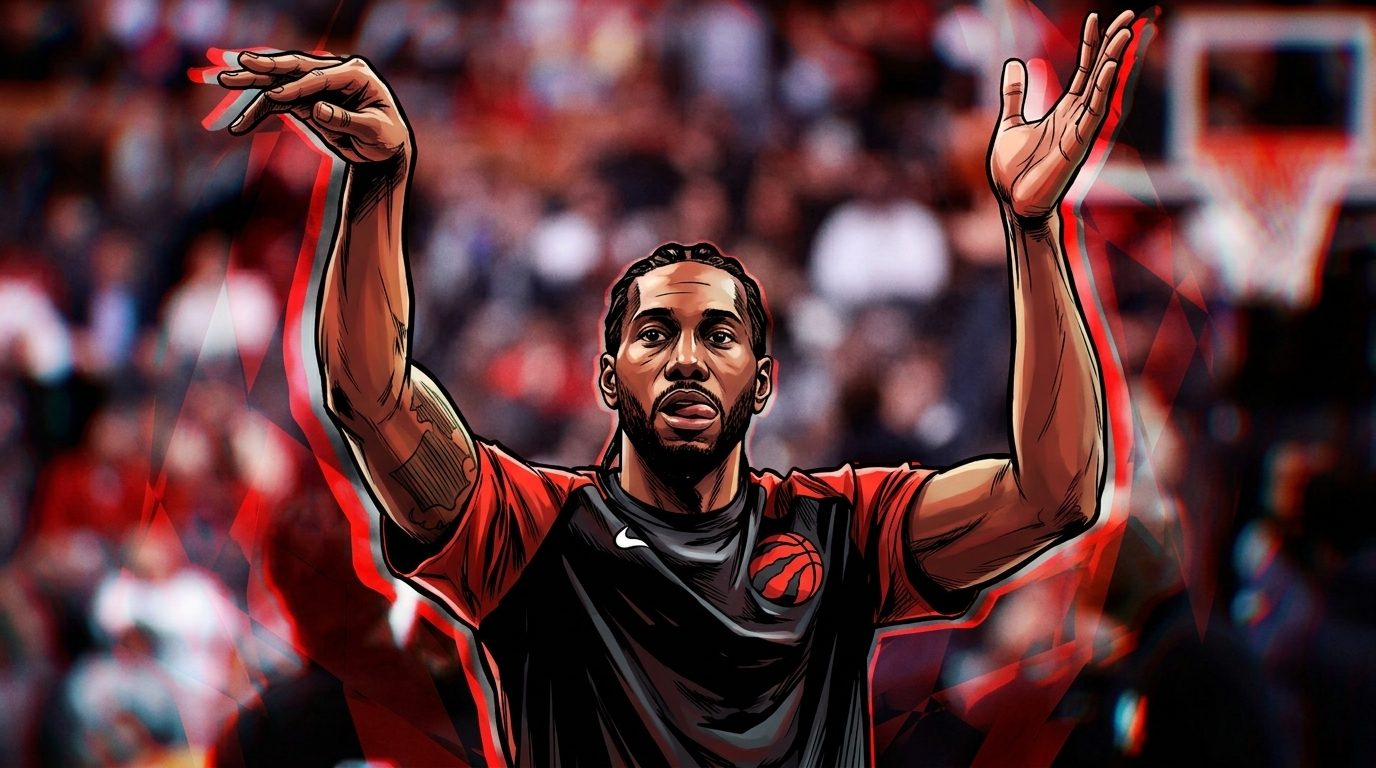
The Toronto Raptors are the National Basketball Association’s only Canadian franchise and, since June 2019, its first champion based outside the United States. Born as an expansion team in 1995 with a dinosaur name and a cartoon logo, the Raptors spent two decades oscillating between dunk-contest spectacle and playoff heartbreak before Masai Ujiri’s one-year gamble on Kawhi Leonard delivered a title that belonged to a whole country. They play at Scotiabank Arena in the Eastern Conference’s Atlantic Division, and their history divides cleanly into the stars who defined it: Vince Carter, Chris Bosh, the DeMar DeRozan and Kyle Lowry “We The North” core, the 2019 champions, and the Scottie Barnes rebuild that followed.
| Vitals | |
|---|---|
| Founded | 1995 (franchise awarded Nov. 4, 1993) |
| League / conference / division | NBA · Eastern Conference · Atlantic Division |
| Arena | Scotiabank Arena, Toronto |
| Owner | Rogers Communications (via Maple Leaf Sports & Entertainment) |
| Head coach | Darko Rajaković (as of Oct. 29, 2026) |
| Titles | 1 NBA championship (2019) |
Expansion and the first seasons (1995–1998)
A franchise built from scratch. The NBA awarded Toronto its 28th team on November 4, 1993, and a nationwide naming contest drawing more than 2,000 entries settled on a name unveiled on national television on May 15, 1994, riding the popularity of the film Jurassic Park. Isiah Thomas ran basketball operations and took an ownership stake; Brendan Malone coached the first team. The Raptors and the expansion Vancouver Grizzlies joined the league together, giving the NBA its first Canadian outposts.
Damon Stoudamire set the tone. Toronto used the seventh pick of the 1995 draft on the point guard nicknamed “Mighty Mouse,” and he won 1995-96 NBA Rookie of the Year on a team that went 21-61. The early Raptors played in the cavernous SkyDome and competed in the Central Division, finishing last in each of their first three seasons, including a 16-66 low in 1997-98 that remains the worst record in franchise history.
Vinsanity: the Vince Carter years (1998–2004)
A star arrived by trade. On draft night in 1998 the Raptors sent the fourth pick, Antawn Jamison, to Golden State for the fifth, Vince Carter. Carter won Rookie of the Year for the lockout-shortened 1998-99 season and turned Toronto into appointment viewing. The franchise opened the Air Canada Centre in February 1999, and Carter’s 2000 Slam Dunk Contest title, a perfect-50 showcase in Oakland, made him the most electric highlight act in the sport.
The first playoff breakthroughs. The 1999-00 team went 45-37 for the franchise’s first winning record and first postseason berth, though the New York Knicks swept the first round. A year later the 47-35 Raptors won the first playoff series in team history, beating New York, before falling to the Philadelphia 76ers in a Game 7 of the conference semifinals on May 20, 2001, when Carter’s jumper at the buzzer rimmed out in an 88-87 loss.
The era ended in acrimony. Tracy McGrady departed in free agency in 2000, and after years of losing around him Carter was traded to the New Jersey Nets on December 17, 2004 for a package that Raptors fans long considered lopsided, souring the relationship between the city and its first superstar for years.
The Chris Bosh era (2003–2010)
A franchise cornerstone at center. Toronto drafted Chris Bosh fourth overall in 2003, and he grew into the steadiest All-Star the team had yet produced. Under general manager Bryan Colangelo, hired in February 2006, and coach Sam Mitchell, the Raptors used the first pick of the 2006 draft on Italian forward Andrea Bargnani, the first European selected No. 1.
The first division banner. The 2006-07 team went 47-35 to win the Atlantic Division, the first division title in franchise history, with Mitchell named NBA Coach of the Year. The Raptors lost in the first round to New Jersey that spring and again to Orlando in 2008, never advancing past the opening round during Bosh’s tenure.
Bosh left for a superteam. After the 2009-10 season, Bosh joined Dwyane Wade and LeBron James in a sign-and-trade to the Miami Heat, finalized on July 10, 2010. His 4,776 rebounds remain the most in Raptors history, and his departure left Toronto without a star and facing a reset.
The post-Bosh rebuild (2010–2013)
The lean years. The Raptors bottomed out at 22-60 in 2010-11 under Jay Triano and missed the playoffs for five straight seasons. Dwane Casey took over as head coach in 2011 and began installing the defensive identity that would later define the franchise’s best teams.
The quiet roster-building. DeMar DeRozan, drafted ninth in 2009, developed into a nightly scorer, and the arrival of Kyle Lowry in a 2012 trade with Houston gave Casey a backcourt to build around. The pieces for a decade of contention were in place, even as the losses continued and attendance sagged.
”We The North”: the DeRozan and Lowry era (2013–2018)
Masai Ujiri changed the trajectory. Hired as president in May 2013, Ujiri made the move that turned the franchise when he traded Rudy Gay to Sacramento on December 9, 2013. Freed to run their offense, DeRozan and Lowry surged into the playoffs, and the spring 2014 “We The North” campaign reframed the Raptors as the team of an entire country rather than a lone city.
Heartbreak against the East’s best. The 2013-14 season ended with a 104-103 Game 7 loss to Brooklyn when Paul Pierce blocked Lowry at the buzzer, and the 2014-15 team was swept in the first round. The breakthrough came in 2015-16, when a 56-26 club reached the first Eastern Conference Finals in franchise history before losing to LeBron James and Cleveland in six games.
A ceiling named Cleveland. The Raptors kept winning in the regular season, peaking at a franchise-best 59-23 in 2017-18 and claiming the East’s top seed, only to be swept by Cleveland in the conference semifinals for the second straight year. Days after being voted 2017-18 Coach of the Year, Casey was fired on May 11, 2018, the franchise’s winningest coach but one who could not get past James. DeRozan left as the franchise’s all-time leader in points (13,296) and games, and Lowry remains its career leader in assists (4,277) and three-pointers (1,518).
The 2019 championship
The gamble. Ujiri traded the beloved DeRozan, Jakob Poeltl, and a first-round pick to San Antonio on July 18, 2018 for Kawhi Leonard and Danny Green, betting a championship window on one year of a disgruntled superstar. Nick Nurse was promoted to head coach, and a midseason trade for Marc Gasol on February 7, 2019 completed the roster. Toronto finished 58-24.
The shot. After eliminating Orlando, the Raptors met Philadelphia in the conference semifinals, where Leonard ended Game 7 on May 12, 2019 with a corner jumper over Joel Embiid that bounced on the rim four times before dropping for a 92-90 win, the first Game 7 buzzer-beater in NBA history. In the conference finals the Raptors fell behind the Milwaukee Bucks 0-2, then won four straight.
The title. In the NBA Finals the Raptors beat the two-time defending champion Golden State Warriors four games to two, clinching with a 114-110 road win in Game 6 on June 13, 2019. It was the first NBA championship for a team based outside the United States. Leonard was named Finals MVP, the second of his career; Pascal Siakam, who emerged that season as Most Improved Player, scored 26 in the clincher alongside Lowry, VanVleet, Gasol, and Serge Ibaka. Weeks later, Leonard signed with the Los Angeles Clippers in free agency, making Toronto a champion that never got to defend its title at full strength.
After the title: the champions dismantled (2019–2023)
One last strong run. Without Leonard, the Raptors still won 53 games in 2019-20, a stretch that included a franchise-record 15-game winning streak in early 2020, before losing a seven-game conference semifinal to Boston inside the Orlando bubble. The 2020-21 team, forced by pandemic border rules to play its home games in Tampa, Florida, went 27-45 and missed the playoffs.
The core aged out. Toronto returned to the postseason at 48-34 in 2021-22 but lost in the first round to Philadelphia. Fred VanVleet departed for Houston in free agency in 2023, and after a 41-41 play-in exit, Nurse was dismissed on April 21, 2023, closing the championship chapter.
The rebuild around Scottie Barnes (2023–present)
A new foundation. Toronto had drafted Scottie Barnes fourth overall in 2021, and he won 2021-22 Rookie of the Year, the third Raptor to take the award after Stoudamire and Carter. Jakob Poeltl was reacquired from San Antonio on February 9, 2023, and Darko Rajaković was hired as the 10th head coach in franchise history in June 2023.
A full teardown. The front office committed to the reset by trading OG Anunoby to New York on December 30, 2023 for RJ Barrett and Immanuel Quickley, then dealing Siakam to Indiana on January 17, 2024. Brandon Ingram arrived from New Orleans at the 2025 trade deadline and signed an extension, rounding out a young core of Barnes, Ingram, Barrett, Quickley, and Poeltl.
New ownership and a new front office. Masai Ujiri, the architect of the title, was let go on June 27, 2025, with general manager Bobby Webster promoted to head of basketball operations and no president named above him. Above them, Rogers Communications became the sole owner of Maple Leaf Sports & Entertainment on October 1, 2026. On the floor, the young group went 46-36 in 2025-26, fifth in the Eastern Conference, returning to the playoffs for the first time since 2022 before a seven-game first-round loss to Cleveland.
Retired numbers
The Raptors retired the first number in franchise history only in 2024, honoring the player who put the team on the map. Vince Carter’s No. 15 went to the rafters at Scotiabank Arena on November 2, 2024, during a game against Sacramento. As of October 29, 2026 it is the only player number the franchise has retired.
Retired numbers
| No. | Player | Pos. | Team tenure | Retired |
|---|---|---|---|---|
| 15 | Vince Carter | G-F | 1998–2004 | Nov. 2, 2024 |
Season by season
Every season in franchise history, folded by decade, newest first.
The 2020s 217–265 · 2 playoff berths
| Season | W–L | Finish | Playoffs |
|---|---|---|---|
| 2020-21 | 27-45 | 5th (Atlantic) | Missed |
| 2021-22 | 48-34 | 3rd (Atlantic) | L 1st Rd (PHI 2-4) |
| 2022-23 | 41-41 | 5th (Atlantic) | L Play-In |
| 2023-24 | 25-57 | 5th (Atlantic) | Missed |
| 2024-25 | 30-52 | 3rd (Atlantic) | Missed |
| 2025-26 | 46-36 | 3rd (Atlantic) | L 1st Rd (CLE 3-4) |
The 2010s 453–341 · 7 playoff berths · 1 NBA title (2019)
| Season | W–L | Finish | Playoffs |
|---|---|---|---|
| 2010-11 | 22-60 | 5th (Atlantic) | Missed |
| 2011-12 | 23-43 | 4th (Atlantic) | Missed |
| 2012-13 | 34-48 | 5th (Atlantic) | Missed |
| 2013-14 | 48-34 | 1st (Atlantic) | L 1st Rd (BKN 3-4) |
| 2014-15 | 49-33 | 1st (Atlantic) | L 1st Rd (WAS 0-4) |
| 2015-16 | 56-26 | 1st (Atlantic) | L Conf. Finals (CLE 2-4) |
| 2016-17 | 51-31 | 2nd (Atlantic) | L Conf. Semis (CLE 0-4) |
| 2017-18 | 59-23 | 1st (Atlantic) | L Conf. Semis (CLE 0-4) |
| 2018-19 | 58-24 | 1st (Atlantic) | Won NBA Finals (GSW 4-2) |
| 2019-20 | 53-19 | 1st (Atlantic) | L Conf. Semis (BOS 3-4) |
The 2000s 367–453 · 4 playoff berths · 1 division title
| Season | W–L | Finish | Playoffs |
|---|---|---|---|
| 2000-01 | 47-35 | 2nd (Central) | L Conf. Semis (PHI 3-4) |
| 2001-02 | 42-40 | 3rd (Central) | L 1st Rd (DET 2-3) |
| 2002-03 | 24-58 | 7th (Central) | Missed |
| 2003-04 | 33-49 | 6th (Central) | Missed |
| 2004-05 | 33-49 | 4th (Atlantic) | Missed |
| 2005-06 | 27-55 | 4th (Atlantic) | Missed |
| 2006-07 | 47-35 | 1st (Atlantic) | L 1st Rd (NJN 2-4) |
| 2007-08 | 41-41 | 2nd (Atlantic) | L 1st Rd (ORL 1-4) |
| 2008-09 | 33-49 | 4th (Atlantic) | Missed |
| 2009-10 | 40-42 | 2nd (Atlantic) | Missed |
The 1990s 135–243 · 1 playoff berth
| Season | W–L | Finish | Playoffs |
|---|---|---|---|
| 1995-96 | 21-61 | 7th (Central) | Missed |
| 1996-97 | 30-52 | 8th (Central) | Missed |
| 1997-98 | 16-66 | 8th (Central) | Missed |
| 1998-99 | 23-27 | 6th (Central) | Missed |
| 1999-00 | 45-37 | 3rd (Central) | L 1st Rd (NYK 0-3) |
By the numbers
Franchise marks
Per Basketball-Reference, through the 2025-26 season; win streak per Yahoo Sports.
Ranks
- 1st Longest win streak by a Canadian major-pro team (15 games, 2020)
- 12th NBA franchise valuation ($5.9B, 2026)
- 11th NBA total home attendance (2024-25)
Valuation per Forbes; attendance per the 2024-25 season record, through Oct. 2026.
Honors
- 2019 NBA champion
- Kawhi Leonard, 2019 Finals MVP
- 2019 Eastern Conference champion
- 7× Atlantic Division champion (2007, 2014, 2015, 2016, 2018, 2019, 2020)
- Pascal Siakam, 2019 Most Improved Player
- 3× Rookie of the Year (Stoudamire 1996, Carter 1999, Barnes 2022)
- 2× Coach of the Year (Mitchell 2007, Casey 2018)
- Bryan Colangelo, 2007 Executive of the Year
Per franchise records and Basketball-Reference, through the 2025-26 season.
The arguments
Did the 2019 title count as a foundation or a rental? Because Leonard left after one season, some observers frame the championship as a mercenary run that bought a single banner rather than a lasting contender. Raptors supporters answer that a title is a title, that the franchise is one of fewer than a dozen to win this century, and that no asterisk attaches to a Finals won over a healthy-start Golden State dynasty.
Was trading DeRozan worth it? DeRozan had been the loyal face of the franchise and said he felt blindsided by the deal, and critics argued Ujiri spent the team’s soul on an uncertain one-year bet. Defenders note the trade produced the only title in team history and that DeRozan, for all his scoring, had never carried the Raptors past Cleveland.
Did Ujiri wait too long to rebuild? One camp holds that Toronto clung to the aging Lowry-VanVleet core for too long after 2019, delaying the reset and the draft capital it could have fetched; another argues the front office owed its champions a dignified exit and still extracted strong returns for Anunoby and Siakam once it committed to the teardown.
Why it matters
The Raptors are the NBA’s lone Canadian team and the only franchise ever to win the league’s championship from outside the United States, a result that turned a 1995 expansion novelty into a national institution. “We The North” became shorthand for a basketball culture that now exports stars across the continent, and the 2019 banner gave a country its first major-league title in a generation. For a franchise that began last in its division three years running, the arc from Carter’s dunks to Leonard’s four-bounce jumper is the rare expansion story that ends with a parade.