NFL All-Time Rushing Yards
Emmitt Smith leads the NFL all-time rushing yards list with 18,355 yards, a record set in 2002, and Derrick Henry is the lone active back still climbing it.
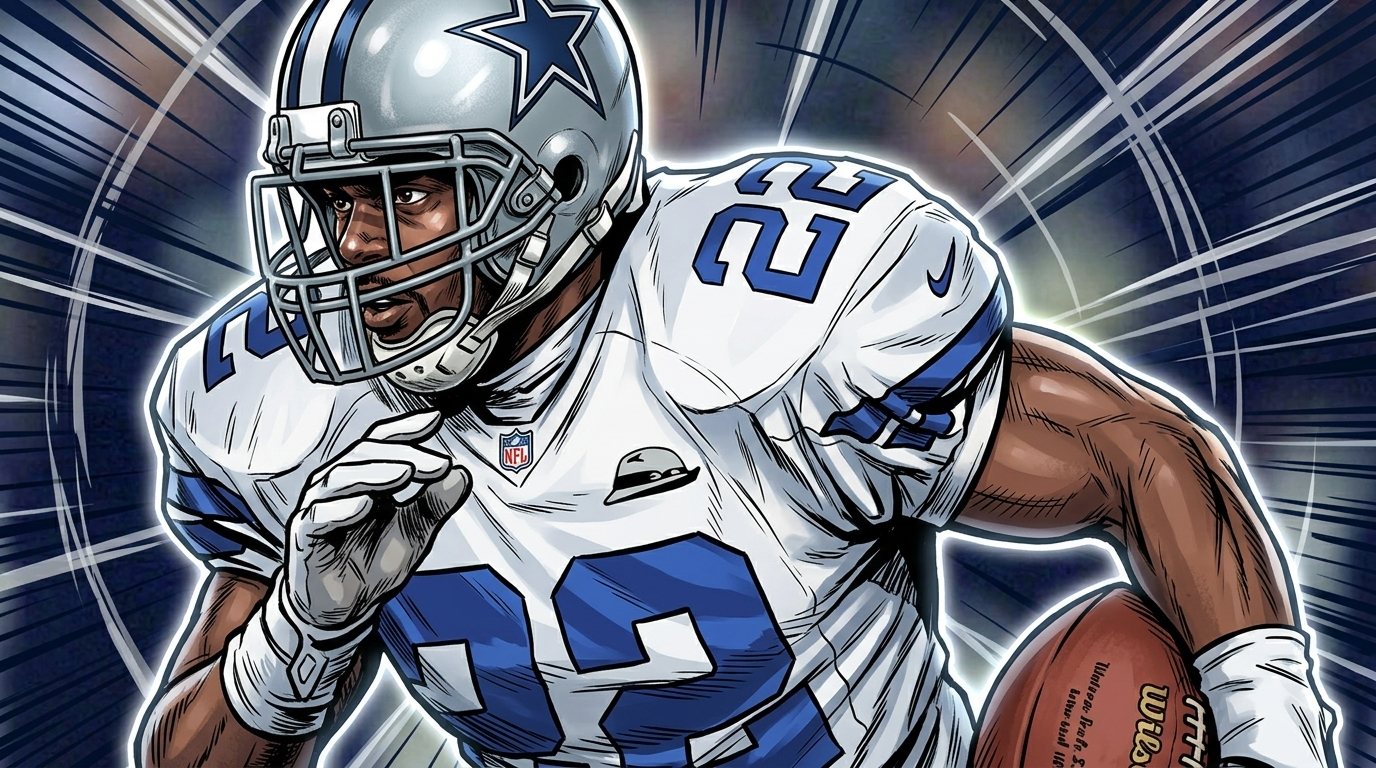
Emmitt Smith is the NFL’s all-time leader in career rushing yards, and as of October 14, 2026 no one is close. Smith retired after the 2004 season with 18,355 rushing yards, the most in league history, a mark he has held since the 2002 season. The list behind him is a near-complete roll call of the modern game’s great backs — Walter Payton, Frank Gore, Barry Sanders, Adrian Peterson — and almost all of them are long retired. Of the 15 most prolific rushers in NFL history, only Baltimore’s Derrick Henry is still playing, and he sits more than 4,800 yards short of the top.
The leaderboard
| Rank | Name | Rushing yards | Team(s), Years |
|---|---|---|---|
| 1 | Emmitt Smith | 18,355 | Cowboys, Cardinals (1990–2004) |
| 2 | Walter Payton | 16,726 | Bears (1975–1987) |
| 3 | Frank Gore | 16,000 | 49ers, Colts, Dolphins, Bills, Jets (2005–2020) |
| 4 | Barry Sanders | 15,269 | Lions (1989–1998) |
| 5 | Adrian Peterson | 14,918 | Vikings and others (2007–2021) |
| 6 | Curtis Martin | 14,101 | Patriots, Jets (1995–2005) |
| 7 | LaDainian Tomlinson | 13,684 | Chargers, Jets (2001–2011) |
| 8 | Jerome Bettis | 13,662 | Rams, Steelers (1993–2005) |
| 9 | Derrick Henry | 13,494 | Titans, Ravens (2016–active) |
| 10 | Eric Dickerson | 13,259 | Rams, Colts, Raiders, Falcons (1983–1993) |
| 11 | Tony Dorsett | 12,739 | Cowboys, Broncos (1977–1988) |
| 12 | Jim Brown | 12,312 | Browns (1957–1965) |
| 13 | Marshall Faulk | 12,279 | Colts, Rams (1994–2005) |
| 14 | Edgerrin James | 12,246 | Colts, Cardinals, Seahawks (1999–2009) |
| 15 | Marcus Allen | 12,243 | Raiders, Chiefs (1982–1997) |
At a glance
Per StatMuse and Wikipedia's career rushing list, through October 14, 2026.
The chase
The practical question with this record is not who will break it but whether anyone will ever again get within a season of it, and on October 14, 2026 the honest answer is no. The only active player in the top 15 is Derrick Henry, who entered play that day with 13,494 career rushing yards, good for ninth all time — a ranking he climbed into by passing a string of former greats across the 2025 season, as NFL.com documented. His near-term targets are other retired backs rather than Smith: he trailed No. 8 Jerome Bettis by 168 yards and No. 7 LaDainian Tomlinson by 190, both within a single productive stretch of games.
Catching Smith is a different order of problem. The gap between Henry and the top of the list is 4,861 yards — Smith’s 18,355 minus Henry’s 13,494. A back averaging a full 1,000-yard season would need roughly five more of them to erase it, and Henry, who entered the league in 2016, would be pushing deep into his thirties before the arithmetic even came into range. ESPN, in its examination of why the record has stood, framed the modern obstacle plainly: the position has shifted toward committee backfields and shorter primes, so sustained 1,500-yard volume across a decade-plus has become vanishingly rare. Frank Gore, the only player other than Smith and Payton to clear 16,000 yards, got there through sixteen seasons of durability rather than peak dominance — and still finished more than 2,300 short.
How it’s measured
The list counts regular-season rushing yards only. Playoff carries, however famous, do not appear in these totals, which is why a back’s postseason legend and his place on this leaderboard can diverge. The figures reflect official NFL records and include American Football League production for players whose careers predate or straddle the 1970 merger.
The reason totals from different eras do not compare cleanly is schedule length. Jim Brown built his 12,312 yards across seasons of 12 and then 14 games; Payton and Dorsett ran in a 16-game era that only became standard in 1978; and backs active from 2021 onward play a 17-game regular season, one additional opportunity every year to add to the pile. Rule changes that opened up passing offenses, improved field conditions and sports science that extended careers all tilt the raw counting stat toward more recent and longer-lasting players. A number on this list measures accumulated production under the specific rules of its time, not a fixed test every runner faced equally.
The arguments
The central debate over this leaderboard is the one that attends every counting stat: longevity versus peak. Advocates for the list as written point out that staying elite — or merely available — for a decade and a half is itself a skill, and that Smith’s record reflects an extraordinary marriage of talent and durability behind great Dallas lines. Critics counter that the leaderboard rewards accumulation over brilliance, and they point to Barry Sanders, who walked away after the 1998 season with 15,269 yards while still at or near his peak, and to Brown, whose per-game and per-carry rates tower over the field. By rate statistics rather than totals, the order of this list would scramble considerably.
A second argument is era adjustment. Those who favor normalizing for schedule length note that a 17-game season hands modern backs a structural edge over the 14-game runners of Brown’s day, and that comparing raw totals across those eras flatters the recent names. Defenders of the unadjusted list reply that every record is set under its own era’s conditions and that retroactively discounting yards a player actually gained introduces more subjectivity than it removes. There is comparatively little dispute over the accuracy of the numbers themselves: unlike some early-era statistics, NFL rushing yardage is well documented back to the 1950s, so the arguments here are about interpretation, not bookkeeping.
Leaderboard figures per StatMuse and Wikipedia; record context per ESPN and NFL.com. Smith passed Payton on October 27, 2002, per ESPN.
Why it matters
Career rushing yards is the longest-running measure of grinding, down-after-down value at football’s most physically punishing position, and the top of the list has barely moved in a generation. Smith took the record from Payton in 2002 and has held it through more than two decades of rule changes, longer schedules and a parade of gifted runners who never came close. That durability is the point: the leaderboard is less a snapshot of who is fastest or most electric than a monument to who lasted, and in an era increasingly hostile to the workhorse back, 18,355 looks less like a number to be chased than a line drawn under a vanished style of play.