Atlanta Falcons
The complete history of the Atlanta Falcons, from the 1966 expansion through Michael Vick, Matt Ryan's 28-3 Super Bowl LI loss, and the Michael Penix Jr. era.
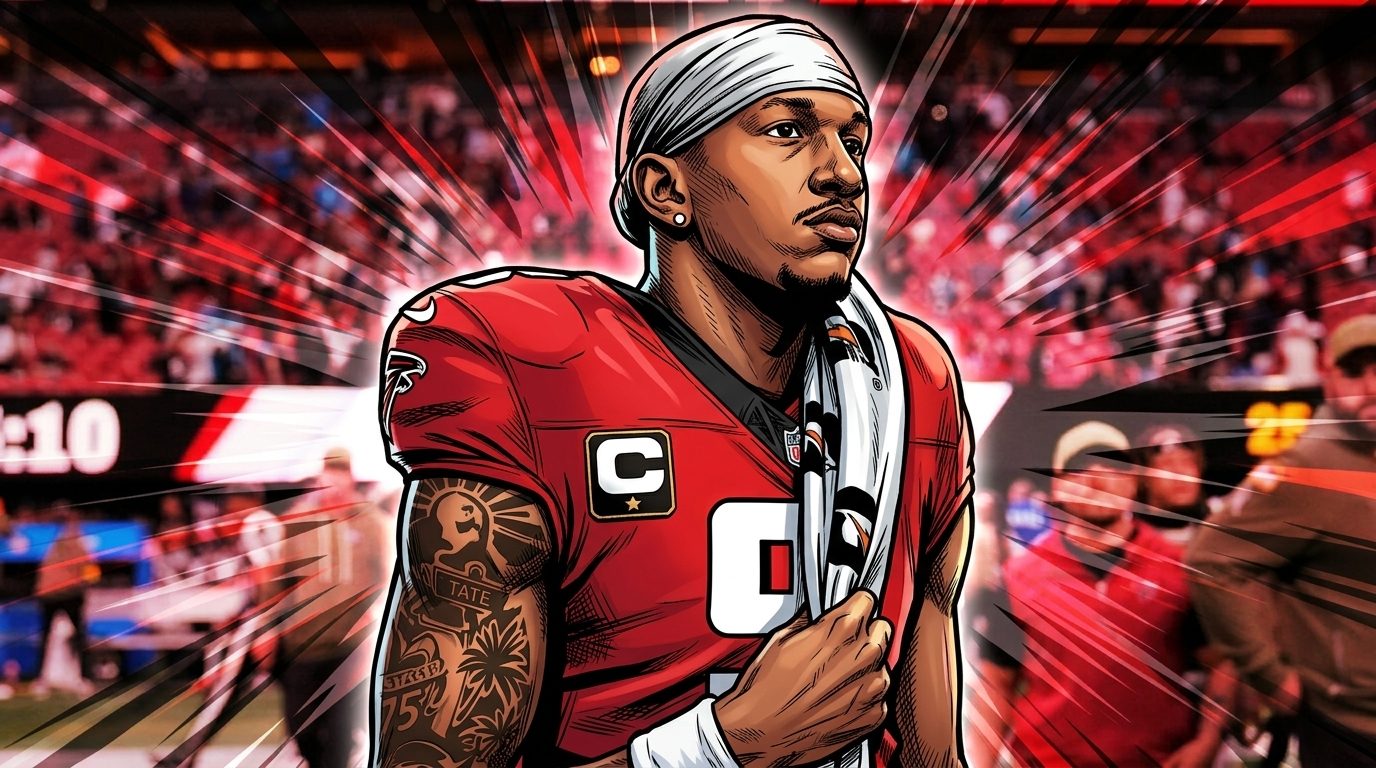
The Atlanta Falcons are the National Football League franchise of the American South’s largest city, born as an expansion team in 1966 and, for all six decades since, the most star-crossed operation in the league — a club that has produced some of football’s most electric players and two of its most painful defeats without ever winning a championship. The Falcons have reached the Super Bowl twice and lost both, the second in the manner that made “28-3” a permanent piece of NFL shorthand. They are, by the reckoning of their own historians, the oldest major professional sports franchise in America still chasing a first title. What follows is the whole of it: the Grits Blitz and the Dirty Birds, Prime Time and Matty Ice, Michael Vick’s 1,000-yard legs and Bijan Robinson’s record scrimmage season.
| Vitals | |
|---|---|
| Founded | 1966 (expansion) |
| League / conference / division | NFL · NFC · NFC South |
| Stadium | Mercedes-Benz Stadium (opened Aug. 26, 2017) |
| Owner | Arthur Blank (since 2002) |
| Head coach (Oct. 21, 2026) | Kevin Stefanski |
| NFL titles | None |
| Conference titles | NFC: 1998, 2016 |
The expansion years (1966–1977)
Atlanta got its team on June 30, 1965, when NFL commissioner Pete Rozelle awarded the franchise to 40-year-old insurance executive Rankin Smith Sr., who paid a then-record $8.5 million for the right to field an expansion club beginning in 1966. The Falcons played their home games at Atlanta–Fulton County Stadium from 1966 through 1991 and opened under head coach Norb Hecker.
The first player in franchise history set its tone. With the No. 1 overall pick of the 1966 NFL draft the Falcons chose Texas linebacker Tommy Nobis, a tackling machine so identified with the young team that he was nicknamed “Mr. Falcon.” No Falcon has worn his No. 60 since. The teams around Nobis were overmatched — Atlanta went 3-11 as a 1966 expansion club and lost at least ten games in three of its first seven seasons — but Nobis gave a rootless franchise an identity.
The 1977 defense briefly made Atlanta a league-wide story. Nicknamed the “Grits Blitz” for its relentless all-out pressure, the unit allowed just 129 points across the 14-game schedule — an average of roughly 9.2 per game that stood as the post-merger record for fewest points allowed in a season. The offense could not keep pace, and the Falcons finished 7-7, but the blueprint of a defense-first team that could terrorize opponents carried into the franchise’s first real contender.
Bartkowski and the first contender (1978–1982)
The arrival of a franchise quarterback changed the ceiling. Atlanta had made Steve Bartkowski the No. 1 overall pick of the 1975 draft, and by the late 1970s he was flanked by a genuine supporting cast: running back William Andrews, center Jeff Van Note, left tackle Mike Kenn, and receiver Alfred Jenkins. Under head coach Leeman Bennett the Falcons reached the playoffs for the first time in 1978, going 9-7 and winning a wild-card game before bowing out in the divisional round.
The 1980 season remains one of the best the franchise has produced. Atlanta started 3-3, then ripped off a nine-game winning streak to finish 12-4 and claim the NFC West — the first division title in team history. Bartkowski threw for 3,544 yards and a league-high 31 touchdowns, and Andrews, Van Note, Kenn and Jenkins all made the Pro Bowl.
It ended in the first of the franchise’s signature collapses. Holding home-field advantage and a fourth-quarter lead in the divisional round, the Falcons were overtaken by the Dallas Cowboys and lost 30-27 at Fulton County Stadium on Jan. 4, 1981. Atlanta would not win another division title until 1998, and the promise of the Bartkowski era dissolved into losing records through the mid-1980s.
Lean years and Prime Time (1983–1996)
The decade that followed was largely bleak. Between 1983 and 1996 the Falcons posted just two winning records in non-strike seasons — 1991 (10-6) and 1995 (9-7) — bottoming out at 3-13 in both 1989 and 1996. The one stretch of relevance arrived with one of the most magnetic figures in franchise history. Atlanta drafted cornerback Deion Sanders fifth overall in 1989, and “Prime Time” turned the Falcons into appointment viewing — a two-way threat who returned punts, intercepted passes and, for a time, played Major League Baseball on the side.
Jerry Glanville brought showmanship and one playoff run. Hired as head coach in 1990, Glanville paired Sanders with receiver Andre Rison and quarterback Chris Miller in a wide-open attack. The 1991 team went 10-6, won a wild-card game at New Orleans 27-20, and lost in the divisional round at Washington. Sanders left for San Francisco after the 1993 season — he was later inducted into the Falcons’ Ring of Honor in 2010 — and Atlanta slid back toward the bottom of the NFC West, a brief playoff cameo in 1995 aside.
The Dirty Birds and Super Bowl XXXIII (1997–1998)
Dan Reeves built the franchise’s first Super Bowl team almost overnight. Hired in 1997, the veteran head coach leaned on quarterback Chris Chandler, a punishing ground game, and a veteran defense anchored by linebacker Jessie Tuggle. The centerpiece was running back Jamal Anderson, whose touchdown celebration — the flapping-arms “Dirty Bird” — became the nickname for the whole team.
The 1998 Falcons went 14-2 and stunned the NFL. Reeves underwent quadruple-bypass heart surgery late in the season yet returned for the playoffs, and his team won its final nine regular-season games before heading to Minnesota for the NFC Championship Game. The Vikings had gone 15-1 and were among the highest-scoring teams in league history; the Falcons beat them 30-27 in overtime on Jan. 17, 1999, when kicker Morten Andersen drilled a 38-yard field goal to send Atlanta to its first Super Bowl.
Super Bowl XXXIII did not go the Falcons’ way. On Jan. 31, 1999, at Pro Player Stadium in Miami, Atlanta lost 34-19 to the defending-champion Denver Broncos in John Elway’s final game. It was the high-water mark of the Reeves era, and the franchise would spend the next several seasons searching for a quarterback worthy of the stage.
The Michael Vick era (2001–2007)
New ownership and a transcendent talent arrived within a year of each other. Home Depot co-founder Arthur Blank purchased the team in 2002 for a reported $545 million, and he inherited the most exciting player the franchise had ever drafted. Atlanta had taken Virginia Tech quarterback Michael Vick with the No. 1 overall pick in 2001, the first Black quarterback ever chosen first overall, and his blend of arm strength and open-field speed rewrote what the position could look like.
Vick delivered two of the franchise’s most memorable playoff moments — and one that got away. In January 2003 he led Atlanta to a 27-7 wild-card upset at Green Bay, handing the Packers their first home playoff loss in franchise history. Two years later, under head coach Jim Mora, the 2004 Falcons went 11-5, won the NFC South, and reached the NFC Championship Game before losing 27-10 to Philadelphia. In 2006 Vick became the first quarterback in NFL history to rush for more than 1,000 yards in a season, finishing with 1,039 at a record 8.4 yards per carry.
His Atlanta career ended in disgrace. In August 2007 Vick pleaded guilty to federal dogfighting charges, was suspended indefinitely by the league, and was sentenced that December to 23 months in federal prison. The Falcons released him in June 2009. The episode remains the sharpest break in the franchise’s history, collapsing a decade’s worth of promise in a single offseason.
Matty Ice and the rise (2008–2015)
Out of the wreckage came stability. With the third overall pick of the 2008 draft the Falcons selected Boston College quarterback Matt Ryan, nicknamed “Matty Ice,” who won Offensive Rookie of the Year and led Atlanta back to the playoffs in his first season. Under head coach Mike Smith the Falcons became a perennial contender, going 13-3 in 2010 before a jarring 48-21 divisional loss to the eventual-champion Green Bay Packers.
The 2012 team came within a half of the Super Bowl — and blew it. Atlanta went 13-3 again, earned the NFC’s top seed, and built a 17-0 lead in the NFC Championship Game against San Francisco on Jan. 20, 2013. The 49ers stormed back behind two Frank Gore touchdowns to win 28-24, the largest comeback in the game’s history and, for a franchise that already knew how to lose a lead, an ominous rehearsal.
Ryan threw to one of the great receiving duos of the era. Future Hall of Fame tight end Tony Gonzalez spent the twilight of his career in Atlanta, and the Falcons drafted receiver Julio Jones sixth overall in 2011. Jones became the franchise’s all-time leader in receiving yards (12,896) and receptions (848), led the NFL in receiving twice (2015 and 2018), and set the single-game receiving-yards standards that still define his résumé.
28–3 and Super Bowl LI (2016–2017)
The 2016 Falcons fielded one of the best offenses in NFL history. In their second season under head coach Dan Quinn, Atlanta scored a league-high 540 points — 33.8 per game, first of 32 teams and 71 points clear of the next-best offense. Ryan was named NFL MVP and Offensive Player of the Year after throwing for a franchise-record 4,944 yards, 38 touchdowns and just seven interceptions.
Then came the collapse that defined the franchise. In Super Bowl LI on Feb. 5, 2017, at NRG Stadium in Houston, the Falcons led the New England Patriots 28-3 midway through the third quarter — on a Devonta Freeman run, an Austin Hooper catch, a Robert Alford pick-six, and a Tevin Coleman touchdown. New England scored 31 unanswered points, forced the first overtime in Super Bowl history, and won 34-28 on the opening drive of the extra period. It was the largest blown lead in Super Bowl history and the most consequential defeat in the Falcons’ story.
The playoff drought and the Penix era (2018–2026)
The aftermath was a long descent. Atlanta reached the playoffs once more in 2017 but then missed the postseason for years, and after Quinn’s dismissal the Arthur Smith era produced three straight 7-10 seasons from 2021 through 2023. The one unambiguous win of that stretch came in the 2023 draft, when the Falcons selected Texas running back Bijan Robinson eighth overall.
The 2024 offseason produced the strangest quarterback sequence in team history. In March 2024 Atlanta signed veteran Kirk Cousins to a four-year, $180 million contract with $100 million guaranteed — and then, six weeks later, used the No. 8 overall pick on Washington quarterback Michael Penix Jr. The move stunned the league and set up an awkward succession: Cousins opened 2024 before Penix took over down the stretch, and the Falcons finished 8-9 under head coach Raheem Morris.
The 2025 season repeated the pattern. Penix opened as the starter and went 3-6 before a season-ending left-knee injury in a Week 11 overtime loss to Carolina, after which Cousins went 5-3 the rest of the way. Atlanta again finished 8-9 and missed the playoffs for an eighth straight year. On Jan. 4, 2026, owner Arthur Blank fired both Morris and general manager Terry Fontenot.
A new regime took over for 2026. The Falcons hired former Cleveland Browns coach Kevin Stefanski as head coach and Ian Cunningham as general manager, and brought franchise icon Matt Ryan — whose 59,735 passing yards and 367 touchdowns with Atlanta remain team records — back into the building in a front-office role.
The current roster is built around youth. Penix anchors the offense behind left tackle Jake Matthews and guard Chris Lindstrom, with receiver Drake London and tight end Kyle Pitts as the primary targets; Robinson is the offense’s engine. The defense features safety Jessie Bates III and cornerback A.J. Terrell Jr. Robinson, the headliner, piled up 2,298 scrimmage yards in 2025 — the most in a season in franchise history — on 1,478 rushing and 820 receiving yards, earning first-team All-Pro honors.
The 2026 season opened unevenly. Through six games, as of Oct. 21, 2026, the Falcons were 2-4, second in the NFC South, having beaten Green Bay and New Orleans but lost to Pittsburgh, Carolina, Baltimore and Chicago, with a Week 7 home date against San Francisco set for Oct. 25.
Retired numbers
The Falcons honor their greatest figures primarily through the Ring of Honor, but the organization has formally retired four jersey numbers over its history. The franchise has not published ceremony dates for all four; the dates below are those that are publicly documented. Each honoree is also a Ring of Honor inductee.
| No. | Player | Pos. | Team tenure | Retired |
|---|---|---|---|---|
| 10 | Steve Bartkowski | QB | 1975–1985 | Not publicly dated |
| 31 | William Andrews | RB | 1979–1983, 1986 | 2004 |
| 57 | Jeff Van Note | C | 1969–1986 | Dec. 14, 1986 |
| 60 | Tommy Nobis | LB | 1966–1976 | First number retired |
Per Wikipedia and franchise records, through Oct. 21, 2026.
Season by season
Every season in franchise history, folded by decade, newest first. Aggregate records are derived from the full year-by-year table.
The 2020s 41–60 (2020–25) · 0 playoff berths · 2026 in progress
| Season | W–L | Finish | Playoffs |
|---|---|---|---|
| 2026 | 2-4 | 2nd (NFC South) | In progress (through Oct. 21) |
| 2025 | 8-9 | 3rd (NFC South) | — |
| 2024 | 8-9 | 2nd (NFC South) | — |
| 2023 | 7-10 | 3rd (NFC South) | — |
| 2022 | 7-10 | 4th (NFC South) | — |
| 2021 | 7-10 | 3rd (NFC South) | — |
| 2020 | 4-12 | 4th (NFC South) | — |
The 2010s 89–71 · 5 playoff berths · 1 Super Bowl (LI)
| Season | W–L | Finish | Playoffs |
|---|---|---|---|
| 2019 | 7-9 | 2nd (NFC South) | — |
| 2018 | 7-9 | 2nd (NFC South) | — |
| 2017 | 10-6 | 3rd (NFC South) | Won Wild Card; Lost Divisional |
| 2016 | 11-5 | 1st (NFC South) | Won Divisional; Won NFC; Lost Super Bowl LI |
| 2015 | 8-8 | 2nd (NFC South) | — |
| 2014 | 6-10 | 3rd (NFC South) | — |
| 2013 | 4-12 | 3rd (NFC South) | — |
| 2012 | 13-3 | 1st (NFC South) | Won Divisional; Lost NFC Championship |
| 2011 | 10-6 | 2nd (NFC South) | Lost Wild Card |
| 2010 | 13-3 | 1st (NFC South) | Lost Divisional |
The 2000s 75–84–1 · 3 playoff berths · 1 division title
| Season | W–L | Finish | Playoffs |
|---|---|---|---|
| 2009 | 9-7 | 2nd (NFC South) | — |
| 2008 | 11-5 | 2nd (NFC South) | Lost Wild Card |
| 2007 | 4-12 | 4th (NFC South) | — |
| 2006 | 7-9 | 3rd (NFC South) | — |
| 2005 | 8-8 | 3rd (NFC South) | — |
| 2004 | 11-5 | 1st (NFC South) | Won Divisional; Lost NFC Championship |
| 2003 | 5-11 | 4th (NFC South) | — |
| 2002 | 9-6-1 | 2nd (NFC South) | Won Wild Card; Lost Divisional |
| 2001 | 7-9 | 4th (NFC West) | — |
| 2000 | 4-12 | 5th (NFC West) | — |
The 1990s 72–88 · 3 playoff berths · 1 Super Bowl (XXXIII)
| Season | W–L | Finish | Playoffs |
|---|---|---|---|
| 1999 | 5-11 | 3rd (NFC West) | — |
| 1998 | 14-2 | 1st (NFC West) | Won Divisional; Won NFC; Lost Super Bowl XXXIII |
| 1997 | 7-9 | 3rd (NFC West) | — |
| 1996 | 3-13 | 4th (NFC West) | — |
| 1995 | 9-7 | 2nd (NFC West) | Lost Wild Card |
| 1994 | 7-9 | 3rd (NFC West) | — |
| 1993 | 6-10 | 3rd (NFC West) | — |
| 1992 | 6-10 | 3rd (NFC West) | — |
| 1991 | 10-6 | 2nd (NFC West) | Won Wild Card; Lost Divisional |
| 1990 | 5-11 | 4th (NFC West) | — |
The 1980s 57–94–1 · 2 playoff berths · 1 division title
| Season | W–L | Finish | Playoffs |
|---|---|---|---|
| 1989 | 3-13 | 4th (NFC West) | — |
| 1988 | 5-11 | 4th (NFC West) | — |
| 1987 | 3-12 | 4th (NFC West) | — |
| 1986 | 7-8-1 | 3rd (NFC West) | — |
| 1985 | 4-12 | 4th (NFC West) | — |
| 1984 | 4-12 | 4th (NFC West) | — |
| 1983 | 7-9 | 4th (NFC West) | — |
| 1982 | 5-4 | 5th (NFC) | Lost First Round |
| 1981 | 7-9 | 2nd (NFC West) | — |
| 1980 | 12-4 | 1st (NFC West) | Lost Divisional |
The 1970s 60–81–3 · 1 playoff berth
| Season | W–L | Finish | Playoffs |
|---|---|---|---|
| 1979 | 6-10 | 3rd (NFC West) | — |
| 1978 | 9-7 | 2nd (NFC West) | Won Wild Card; Lost Divisional |
| 1977 | 7-7 | 2nd (NFC West) | — |
| 1976 | 4-10 | 4th (NFC West) | — |
| 1975 | 4-10 | 3rd (NFC West) | — |
| 1974 | 3-11 | 4th (NFC West) | — |
| 1973 | 9-5 | 2nd (NFC West) | — |
| 1972 | 7-7 | 2nd (NFC West) | — |
| 1971 | 7-6-1 | 3rd (NFC West) | — |
| 1970 | 4-8-2 | 3rd (NFC West) | — |
The 1960s 12–43–1 · 0 playoff berths
| Season | W–L | Finish | Playoffs |
|---|---|---|---|
| 1969 | 6-8 | 3rd (Coastal) | — |
| 1968 | 2-12 | 4th (Coastal) | — |
| 1967 | 1-12-1 | 4th (Coastal) | — |
| 1966 | 3-11 | 7th (Eastern) | — |
By the numbers
Franchise marks
Per StatMuse (all-time 408–525–6) and the franchise season record, through Oct. 21, 2026.
Ranks
- 1st NFL scoring offense, 2016 (540 points)
- 1st NFL receiving yards — Julio Jones, 2015 and 2018
- 19th NFL franchise valuation, 2025 ($6.35B)
Per FootballDB, the NFL annual receiving-yards leaders list, and Forbes.
Honors
- 2× NFC champion (1998, 2016)
- Matt Ryan — 2016 NFL MVP & Offensive Player of the Year
- 6× NFC division champion (1980, 1998, 2004, 2010, 2012, 2016)
- 2× Super Bowl appearance (XXXIII, LI)
- Matt Ryan — 2008 Offensive Rookie of the Year
- Michael Vick — first QB with a 1,000-yard rushing season (2006)
- Bijan Robinson — 2025 first-team All-Pro
Per Wikipedia and the Falcons, through Oct. 21, 2026.
The arguments
Is 28-3 the worst collapse in sports history, or just the most famous? Supporters of the former point to the stakes — a Super Bowl, with a stretch of the third quarter in which a title felt secured — and to the decision-making down the stretch, including the pass plays and penalties that pushed Atlanta out of field-goal range late. Others argue the 2016 team was simply beaten by an all-time quarterback in Tom Brady and that single-elimination variance, not Falcons failure, decided it. Both readings agree on the outcome; they disagree on whether Atlanta lost the game or New England won it.
Did the franchise mishandle Michael Vick? One camp holds that Vick’s own conduct — the 2007 federal dogfighting conviction — ended a career that the organization had built around him, and that the Falcons moved on responsibly. Another argues the franchise never surrounded its most gifted player with the coaching or the roster to maximize a talent who changed the sport, and that the partnership underdelivered even before it imploded.
Was drafting Michael Penix Jr. in 2024 vision or chaos? With Kirk Cousins freshly signed to a $180 million deal, spending the eighth overall pick on a quarterback struck many as an indefensible allocation of resources on a team with other holes. The counterargument, offered by the front office at the time, framed it as a succession plan at the game’s most important position — a bet that cheap, controllable quarterback play is worth almost any price. The question the Penix era is still answering is whether the bet was bold or merely expensive.
Why it matters
The Atlanta Falcons are the NFL’s great study in nearness — a franchise that has drafted first-overall icons, fielded a record-setting defense and a record-setting offense, reached two Super Bowls, and still, after sixty seasons, has never held the trophy. That history is not a record of irrelevance; it is a record of a team that keeps arriving at the threshold. For a city that adopted pro football in 1966 and never let go, the Falcons remain both the source of the deepest wound in modern sports shorthand and a standing argument that the next arrival could finally be the one that stays.