Tampa Bay Buccaneers
The Tampa Bay Buccaneers, an NFL franchise founded in 1976, won Super Bowls XXXVII and LV and play in the NFC South under quarterback Baker Mayfield.
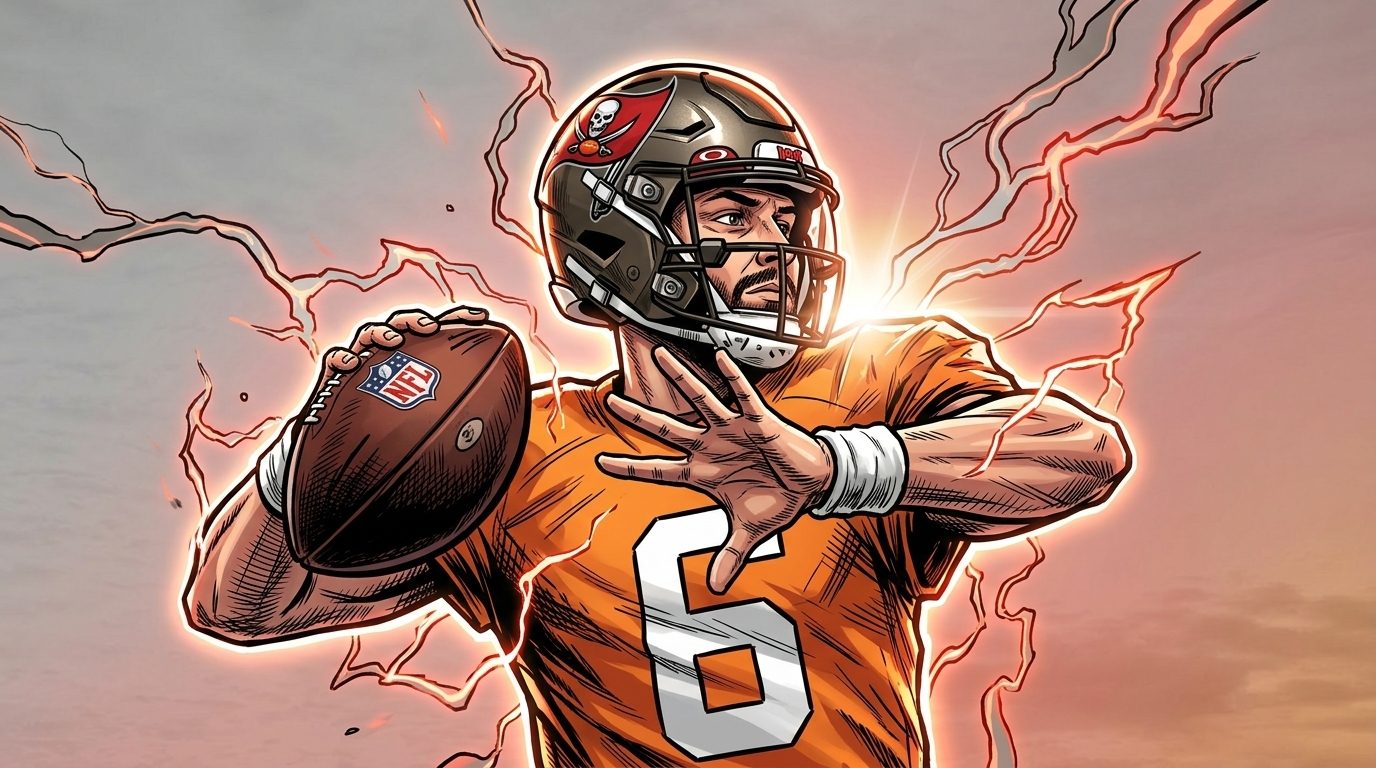
The Tampa Bay Buccaneers are a National Football League franchise that began play in 1976 and spent its first two decades as the league’s definitive hard-luck case before reinventing itself into a two-time champion. No franchise in NFL history pairs a longer stretch of losing with that kind of ceiling: the Buccaneers own the lowest all-time regular-season winning percentage in the league and yet have lifted the Lombardi Trophy twice, in Super Bowl XXXVII after the 2002 season and Super Bowl LV after the 2020 season. They play in the NFC South, at Raymond James Stadium in Tampa, Florida, and enter the 2026 season led by quarterback Baker Mayfield under head coach Todd Bowles.
| Vitals | |
|---|---|
| Founded | 1976 (NFL expansion) |
| League / conference / division | NFL — NFC South |
| Stadium | Raymond James Stadium (Tampa, Fla.) |
| Owner | Glazer family |
| Head coach (Nov. 2, 2026) | Todd Bowles |
| Titles | 2 — Super Bowl XXXVII (2002 season), Super Bowl LV (2020 season) |
Expansion and the McKay years (1976–1984)
The franchise was awarded to Tampa in 1974 and stocked from scratch for the 1976 season, owned by Jacksonville attorney Hugh Culverhouse and coached by John McKay, who arrived from a dynasty at USC. The team dressed in orange “creamsicle” uniforms with the winking “Bucco Bruce” buccaneer logo and played in Tampa Stadium, the bowl fans nicknamed the “Big Sombrero.” Its first draft pick, on April 8, 1976, was Lee Roy Selmon, the Oklahoma defensive end taken No. 1 overall who became the cornerstone of everything good the early Bucs did.
Winning did not come quickly. Tampa Bay went 0-14 in 1976 and opened 1977 with 12 more losses, running the franchise’s futility to an NFL-record 26 consecutive defeats before the first victory arrived on the road against the New Orleans Saints in December 1977. McKay’s dry wit through the losing (“I’m in favor of it,” he said when asked about his team’s execution) became as much a part of the team’s identity as the uniforms.
By 1979 the losing was over. Behind quarterback Doug Williams, the franchise’s first marquee passer, and Selmon’s defense, Tampa Bay went 10-6 and won the NFC Central, its first division title. The Buccaneers beat the Philadelphia Eagles in the divisional round for their first playoff win, then lost the NFC Championship Game 9-0 to the Los Angeles Rams in a rain-soaked Tampa Stadium, one win short of the Super Bowl in only their fourth season. They won the division again in 1981 at 9-7 and reached the postseason in the strike-shortened 1982 season. Selmon was named Associated Press Defensive Player of the Year for 1979 and would become the first Buccaneer enshrined in the Pro Football Hall of Fame.
The wilderness years (1983–1995)
The bottom fell out when Williams left. A contract dispute with Culverhouse pushed the quarterback to the upstart USFL after the 1982 season, and the Buccaneers collapsed into the longest sustained slump of the era. From 1983 through 1996 the franchise did not post a single winning record, bottoming out at 2-14 in 1983, 1985 and 1986. McKay stepped down after the 1984 season, and a parade of coaches, Leeman Bennett, Ray Perkins, Richard Williamson and Sam Wyche, cycled through without turning it around.
The draft produced talent but never traction. Tampa Bay used the No. 1 overall pick in 1987 on Heisman Trophy winner Vinny Testaverde of Miami, and later added linebacker Hardy Nickerson in free agency in 1993, but the losing habit held. Culverhouse died in 1994, ending the only ownership the franchise had known and opening the door to a sale that would change everything.
Tony Dungy and the Tampa 2 (1996–2001)
Malcolm Glazer bought the Buccaneers in 1995 for a reported $192 million, and his 1996 hire of head coach Tony Dungy reset the culture. Dungy, with defensive coordinator Monte Kiffin, installed the Cover 2 scheme that became famous as the “Tampa 2,” built around a nucleus drafted in 1995: defensive tackle Warren Sapp (12th overall) and linebacker Derrick Brooks (28th overall), joined by safety John Lynch and cornerback Ronde Barber. In 1997 the franchise retired the creamsicle look for the pewter-and-red color scheme and the pirate-flag logo it still wears.
The defense carried Tampa Bay back to relevance. The 1997 team went 10-6, beat the Detroit Lions in the wild-card round for the franchise’s first playoff appearance in 15 years, and the new Raymond James Stadium opened in 1998. The 1999 Buccaneers went 11-5, won the NFC Central and reached the NFC Championship Game, losing 11-6 to the St. Louis Rams in a game remembered for a reversed Bert Emanuel catch that would later reshape the league’s reception rules. Sapp was named Defensive Player of the Year for 1999. Dungy’s defenses were perennially elite, but the offense stalled in January, and after a wild-card exit following the 2001 season the Glazers dismissed him.
Jon Gruden and Super Bowl XXXVII (2002–2008)
The Glazers paid a steep price to replace Dungy with Jon Gruden, sending the Oakland Raiders two first-round picks, two second-round picks and $8 million to acquire the coach in February 2002. The gamble paid off immediately. The 2002 Buccaneers went 12-4, fielded the NFL’s No. 1-ranked defense and won the newly formed NFC South in the league’s 2002 realignment. In the playoffs they beat the San Francisco 49ers and then won the NFC Championship Game at Philadelphia in the final game played at Veterans Stadium.
Super Bowl XXXVII was a coronation for the defense. On Jan. 26, 2003, in San Diego, Tampa Bay met Gruden’s former Raiders and routed them 48-21. Oakland quarterback Rich Gannon threw a Super Bowl-record five interceptions; cornerback Dwight Smith returned two for touchdowns and Brooks added another pick-six. Safety Dexter Jackson, with two interceptions, was named Most Valuable Player, and Brooks was the league’s Defensive Player of the Year for 2002. The Buccaneers won the division again in 2005 (11-5) and 2007 (9-7) but could not escape the wild-card round, and after a late collapse in 2008 the Glazers fired Gruden in January 2009.
The lean 2010s (2009–2019)
The decade after Gruden was the franchise’s second long drought. Raheem Morris, Greg Schiano, Lovie Smith and Dirk Koetter each took a turn on the sideline, and Tampa Bay failed to reach the postseason in any season from 2008 through 2019. A 2-14 finish in 2014 delivered the No. 1 overall pick, spent on Florida State quarterback Jameis Winston in 2015.
Two foundational players arrived in this stretch. Wide receiver Mike Evans, drafted seventh overall in 2014, opened his career with a run of 1,000-yard seasons that would become historic, while Winston’s gunslinging peaked with a 5,109-yard, 33-touchdown, 30-interception campaign in 2019, the first 30-30 season in NFL history. Bruce Arians was hired as head coach in 2019, with Todd Bowles as his defensive coordinator, setting the stage for the franchise’s most famous offseason.
Tom Brady and Super Bowl LV (2020–2022)
Tom Brady signed with Tampa Bay in March 2020 after 20 seasons and six titles in New England, and the Buccaneers reshaped the roster around him, trading for tight end Rob Gronkowski and leaning on Evans, receiver Chris Godwin, linebackers Lavonte David and Devin White and edge rusher Shaquil Barrett. The 2020 team went 11-5 and caught fire in January, winning road playoff games at Washington, New Orleans and Green Bay to reach the Super Bowl.
Super Bowl LV was the first ever played in a team’s home stadium. On Feb. 7, 2021, at Raymond James Stadium, Tampa Bay beat the Kansas City Chiefs 31-9. Brady threw three touchdown passes, two to Gronkowski, and was named Super Bowl MVP for a record fifth time and the first with a second franchise. The 2021 Buccaneers went 13-4, the best regular season in franchise history, as Brady set club single-season records with 5,316 passing yards and 43 touchdowns before a divisional-round loss to the Rams. Arians stepped aside before the 2022 season and Bowles was promoted to head coach; an 8-9 Tampa Bay team still won the NFC South, and Brady announced his retirement in February 2023.
The Baker Mayfield era (2023–present)
Baker Mayfield arrived in March 2023 on a one-year, prove-it contract and won the starting job over Kyle Trask. The 2023 Buccaneers went 9-8, claimed a third straight NFC South title, and beat the Philadelphia Eagles in the wild-card round before losing at Detroit. Tampa Bay re-signed Mayfield to a three-year, roughly $100 million deal in 2024, and he rewarded it with the best season of his career.
2024 was a franchise high-water mark for the passing game. Mayfield threw for 4,500 yards and 41 touchdowns, set Buccaneers single-season records for completion percentage (71.4) and passer rating (106.8) and made the Pro Bowl, as Tampa Bay went 10-7 to win a record fourth consecutive NFC South title and reach a fifth straight postseason. In the regular-season finale, Evans secured his 11th consecutive 1,000-yard season, tying the NFL record held by Jerry Rice and standing alone as the only player to begin a career with that many.
The 2025 season ended the division run. Tampa Bay finished 8-9 and second in the NFC South. The Buccaneers beat the Carolina Panthers in Week 18 to reach 8-9, but were eliminated the next day when the Atlanta Falcons defeated the New Orleans Saints, handing Carolina the division on a head-to-head tiebreaker in a three-way tie and snapping Tampa Bay’s four-year streak of NFC South titles. It was the franchise’s first season out of the playoffs since 2019, with a core still built around Mayfield, Evans, Godwin, the long-tenured David and a young backfield.
Retired numbers
The Buccaneers have retired three jersey numbers, all belonging to defensive Hall of Famers, and each honoree is also enshrined in the franchise’s Ring of Honor. Lee Roy Selmon’s No. 63 was the first number retired in team history.
| No. | Player | Pos. | Team tenure | Retired |
|---|---|---|---|---|
| 63 | Lee Roy Selmon | DE | 1976–1984 | Sept. 7, 1986 |
| 99 | Warren Sapp | DT | 1995–2003 | Nov. 11, 2013 |
| 55 | Derrick Brooks | LB | 1995–2008 | Sept. 14, 2014 |
Season by season
The full franchise record, folded by decade, newest first.
The 2020s 59–42 · 5 playoff berths · 1 Super Bowl title
| Season | W–L | Finish | Playoffs |
|---|---|---|---|
| 2020 | 11-5 | 2nd (NFC South) | Won Super Bowl LV |
| 2021 | 13-4 | 1st (NFC South) | Lost Divisional |
| 2022 | 8-9 | 1st (NFC South) | Lost Wild Card |
| 2023 | 9-8 | 1st (NFC South) | Lost Divisional |
| 2024 | 10-7 | 1st (NFC South) | Lost Wild Card |
| 2025 | 8-9 | 2nd (NFC South) | — |
The 2010s 59–101 · 0 playoff berths
| Season | W–L | Finish | Playoffs |
|---|---|---|---|
| 2010 | 10-6 | 3rd (NFC South) | — |
| 2011 | 4-12 | 4th (NFC South) | — |
| 2012 | 7-9 | 4th (NFC South) | — |
| 2013 | 4-12 | 4th (NFC South) | — |
| 2014 | 2-14 | 4th (NFC South) | — |
| 2015 | 6-10 | 4th (NFC South) | — |
| 2016 | 9-7 | 2nd (NFC South) | — |
| 2017 | 5-11 | 4th (NFC South) | — |
| 2018 | 5-11 | 4th (NFC South) | — |
| 2019 | 7-9 | 3rd (NFC South) | — |
The 2000s 79–81 · 5 playoff berths · 1 Super Bowl title
| Season | W–L | Finish | Playoffs |
|---|---|---|---|
| 2000 | 10-6 | 2nd (NFC Central) | Lost Wild Card |
| 2001 | 9-7 | 3rd (NFC Central) | Lost Wild Card |
| 2002 | 12-4 | 1st (NFC South) | Won Super Bowl XXXVII |
| 2003 | 7-9 | 3rd (NFC South) | — |
| 2004 | 5-11 | 4th (NFC South) | — |
| 2005 | 11-5 | 1st (NFC South) | Lost Wild Card |
| 2006 | 4-12 | 4th (NFC South) | — |
| 2007 | 9-7 | 1st (NFC South) | Lost Wild Card |
| 2008 | 9-7 | 3rd (NFC South) | — |
| 2009 | 3-13 | 4th (NFC South) | — |
The 1990s 67–93 · 2 playoff berths · 1 division title
| Season | W–L | Finish | Playoffs |
|---|---|---|---|
| 1990 | 6-10 | 2nd (NFC Central) | — |
| 1991 | 3-13 | 5th (NFC Central) | — |
| 1992 | 5-11 | 3rd (NFC Central) | — |
| 1993 | 5-11 | 5th (NFC Central) | — |
| 1994 | 6-10 | 5th (NFC Central) | — |
| 1995 | 7-9 | 5th (NFC Central) | — |
| 1996 | 6-10 | 4th (NFC Central) | — |
| 1997 | 10-6 | 2nd (NFC Central) | Lost Divisional |
| 1998 | 8-8 | 3rd (NFC Central) | — |
| 1999 | 11-5 | 1st (NFC Central) | Lost NFC Championship |
The 1980s 45–106–1 · 2 playoff berths · 1 division title
| Season | W–L | Finish | Playoffs |
|---|---|---|---|
| 1980 | 5-10-1 | 4th (NFC Central) | — |
| 1981 | 9-7 | 1st (NFC Central) | Lost Divisional |
| 1982 | 5-4 | 7th (NFC) | Lost First Round |
| 1983 | 2-14 | 5th (NFC Central) | — |
| 1984 | 6-10 | 3rd (NFC Central) | — |
| 1985 | 2-14 | 5th (NFC Central) | — |
| 1986 | 2-14 | 5th (NFC Central) | — |
| 1987 | 4-11 | 4th (NFC Central) | — |
| 1988 | 5-11 | 3rd (NFC Central) | — |
| 1989 | 5-11 | 5th (NFC Central) | — |
The 1970s 17–43 · 1 playoff berth · 1 division title
| Season | W–L | Finish | Playoffs |
|---|---|---|---|
| 1976 | 0-14 | 5th (AFC West) | — |
| 1977 | 2-12 | 5th (NFC Central) | — |
| 1978 | 5-11 | 5th (NFC Central) | — |
| 1979 | 10-6 | 1st (NFC Central) | Lost NFC Championship |
By the numbers
Franchise marks
Per the season-by-season record, through the 2025 season.
Ranks
- 1st 1,000-yard receiving seasons to begin a career, NFL history (Mike Evans, 11)
- 16th NFL franchise valuation ($6.6B, Forbes 2025)
- lowest all-time regular-season winning percentage (.412)
Per Fox Sports, the Forbes NFL valuations and the all-time NFL win–loss records, through 2025.
Honors
- Super Bowl LV champions (2020 season)
- Super Bowl XXXVII champions (2002 season)
- 2× NFC champions (2002, 2020)
- 10× division champions (1979–2024)
- Derrick Brooks — 2002 Defensive Player of the Year
- Warren Sapp — 1999 Defensive Player of the Year
- Lee Roy Selmon — 1979 Defensive Player of the Year
- Tom Brady — Super Bowl LV MVP
Per franchise records and NFL.com, through 2025.
The arguments
Which title team was greater. Supporters of the 2002 champions point to a defense that led the NFL and set a Super Bowl record with three interception returns for touchdowns, arguing it was the more complete and homegrown roster. Backers of the 2020 team counter that it beat three playoff opponents on the road and then a 14-win Kansas City team, a harder path than the 2002 run. The debate often folds into a second one: how much of the 2002 title belonged to Tony Dungy, who drafted and developed Sapp, Brooks and Lynch, versus Jon Gruden, who coached them to the trophy in his first year.
The Brady question. One camp holds that Tampa Bay’s 2020 championship was essentially purchased in free agency, Tom Brady and Rob Gronkowski arriving from New England to finish a roster the front office had assembled. The other side notes that the same core had gone years without a playoff berth and that Brady’s arrival, and his franchise-record 2021 passing numbers, are exactly what elevated it. Baker Mayfield’s revival since 2023 has since been cited by both sides as evidence either that the system travels or that quarterback play remains the swing factor.
Why it matters
The Buccaneers are the NFL’s most extreme study in volatility, a franchise that spent most of its first two decades as a punchline and still carries the league’s lowest all-time winning percentage, yet has twice reached the sport’s summit and employed one of the greatest quarterbacks ever. For Tampa Bay’s fans, the history is not a straight line of glory but a case for patience: a team that began 0-26 can win a Super Bowl at home, and a quarterback written off elsewhere can author a franchise’s best passing seasons. That swing, from the Big Sombrero to a title banner at Raymond James, is the identity, and it is why the Buccaneers belong in any serious argument about how fast an NFL franchise can change.