Buffalo Bills
The Buffalo Bills' full history: 1964-65 AFL titles, four straight Super Bowl losses, the 17-year drought, the Josh Allen era and the new Highmark Stadium.
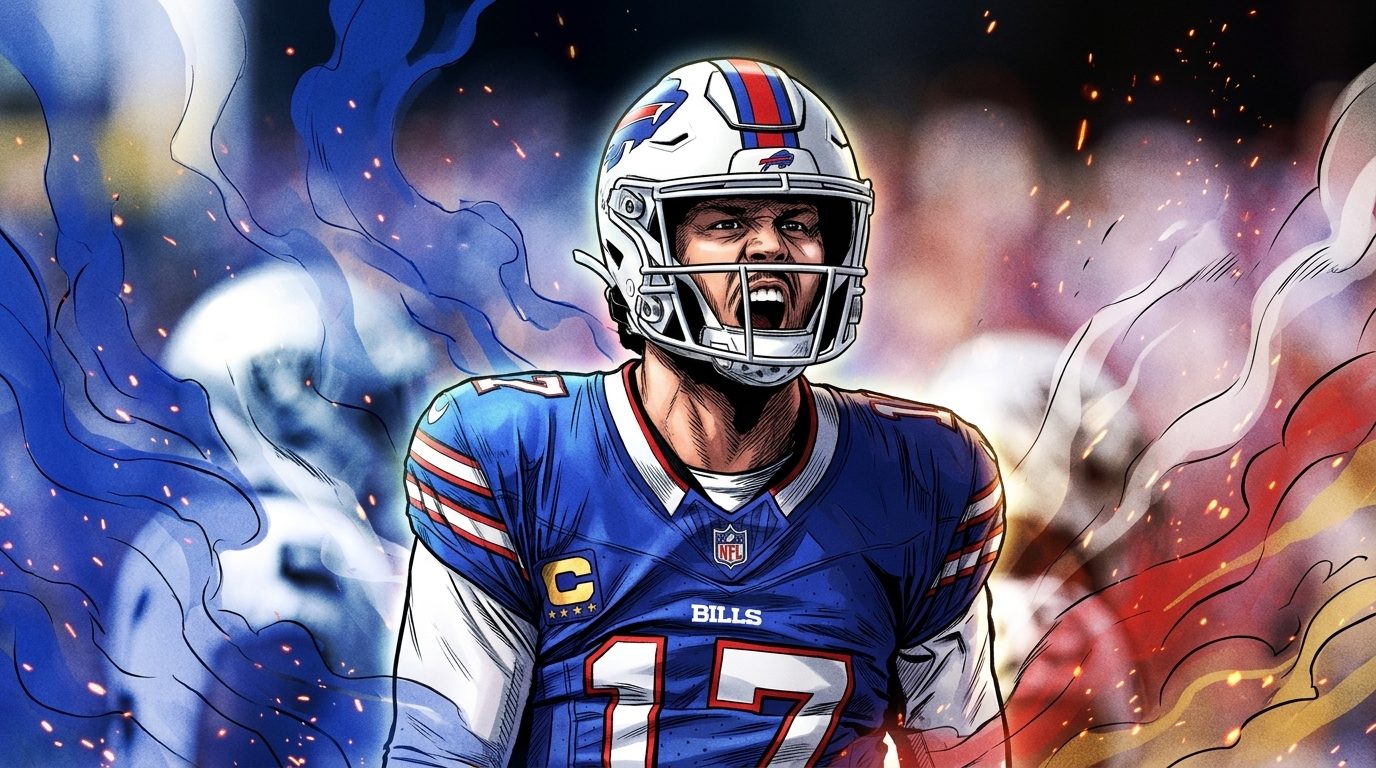
The Buffalo Bills are an American Football League charter franchise that has played in western New York since 1960. They are the only club to reach four consecutive Super Bowls, and they lost all four. Their two AFL championships in 1964 and 1965 remain the only major professional titles won by a Buffalo team. Across more than six decades the Bills have produced a 2,000-yard rusher, three league MVPs, the longest playoff drought of its era in North American sports and one of the most recognizable fan bases in the NFL. In 2026 they moved into a new $2.1 billion stadium across the street from the one they had used since 1973.
| Vitals | |
|---|---|
| Founded | Oct. 28, 1959 (began play 1960, AFL charter member) |
| League / conference / division | NFL / AFC / East (AFL Eastern Division 1960–69) |
| Stadium | Highmark Stadium, Orchard Park, N.Y. (opened 2026) |
| Owner | Terry and Kim Pegula (since Oct. 8, 2014) |
| Head coach (Nov. 16, 2026) | Joe Brady |
| Titles | AFL champions 1964, 1965; AFC champions 1990, 1991, 1992, 1993 |
Founding and the early AFL (1960–1963)
A charter franchise. Detroit businessman Ralph C. Wilson Jr. was granted the franchise on Oct. 28, 1959, and he owned it until his death in 2014. The name came from an earlier All-America Football Conference team in Buffalo, which had been named after the frontiersman Buffalo Bill. Home games were played at War Memorial Stadium, a Depression-era bowl on the city’s East Side.
A slow start. The Bills lost their first regular-season game 27-3 to the New York Titans on Sept. 11, 1960. They earned their first win on Sept. 23, a 13-0 shutout of the Boston Patriots, per the Pro Football Hall of Fame. Buster Ramsey’s two teams went 5-8-1 and 6-8.
Saban, Kemp and Gilchrist. Lou Saban took over in 1962 and put the core of a contender in place. Quarterback Jack Kemp arrived that year. Fullback Cookie Gilchrist became the club’s first 1,000-yard rusher with 1,096 yards in 1962, and that 7-6-1 season was the franchise’s first winning record. In 1963 Buffalo tied Boston for the Eastern Division lead, then lost the franchise’s first playoff game 26-8 to the Patriots on Dec. 28, 1963.
Back-to-back AFL champions (1964–1966)
The 1964 title. The 1964 Bills went 12-2, led by Kemp and a physical defense. They beat the San Diego Chargers 20-7 at War Memorial Stadium in the AFL Championship Game.
The 1965 repeat. Buffalo went 10-3-1 in 1965, traveled to San Diego for a rematch and won the title game 23-0. The two championships are the franchise’s only league titles, and the Hall of Fame lists them alongside three straight Eastern Division crowns (1964–66).
One game from Super Bowl I. Saban left after the 1965 title, and Joe Collier coached the 1966 team to a third straight division title. The Kansas City Chiefs won that AFL Championship Game in Buffalo 31-7 and went on to play in the first Super Bowl.
The lean years after the titles (1967–1971)
A fast collapse. The title roster aged quickly. Buffalo went 4-10 in 1967, then 1-12-1 in 1968, when Collier was fired during the season. That 1968 record earned the first overall selection in the 1969 draft, which the Bills used on USC running back O.J. Simpson.
Into the NFL. The AFL–NFL merger put Buffalo in the AFC East in 1970. The early NFL teams were among the league’s worst: 3-10-1 in 1970 and 1-13 in 1971 under Harvey Johnson.
O.J. Simpson and the Electric Company (1972–1977)
Saban’s return. Lou Saban came back in 1972 and built the offense around Simpson behind a blocking unit nicknamed “the Electric Company” (1973–76), anchored by guards Reggie McKenzie and Joe DeLamielleure. In 1973 the team moved into a new stadium in suburban Orchard Park, which later carried the Rich, Ralph Wilson, New Era and Highmark names.
2,003 yards. In 1973 Simpson ran for 2,003 yards on 332 carries in 14 games, an average of 143.1 yards per game. He was the first player to reach 2,000 in a season, and he won the league MVP award. Buffalo went 9-5 that year.
One playoff trip. The 1974 team went 9-5 again and lost a divisional game 32-14 at Pittsburgh. Simpson played through 1977 and was inducted into the Pro Football Hall of Fame in 1985. Saban resigned during the 1976 season, and the 1976 and 1977 teams won five games combined.
Chuck Knox and the Ferguson years (1978–1985)
Knox’s turnaround. Chuck Knox arrived in 1978 with quarterback Joe Ferguson in place. The 1980 Bills opened by beating Miami, ending a losing streak against the Dolphins that had spanned the whole 1970s, and finished 11-5. It was the club’s first division title since the merger, followed by a 20-14 divisional loss at San Diego.
A first NFL playoff win. The 1981 team won the AFC wild-card game 31-27 at the New York Jets, then lost 28-21 at Cincinnati. Knox left after the strike-shortened 1982 season.
The bottom, and the payoff. Ferguson threw for 419 yards against Miami on Oct. 9, 1983, but the club went 2-14 in both 1984 and 1985. Those records brought early draft selections, and the 1985 choice was defensive end Bruce Smith, who would become the NFL’s career sacks leader.
Marv Levy and the K-Gun (1986–1989)
Kelly comes to Buffalo. Jim Kelly, a 1983 Bills draftee who had first played in the USFL, signed with Buffalo on Aug. 18, 1986. Marv Levy replaced Hank Bullough during that season. General manager Bill Polian added running back Thurman Thomas in 1988 to a roster that already had receiver Andre Reed and Smith.
Contention. The 1988 Bills went 12-4, beat Houston 17-10 for their first home playoff win since the 1964 AFL Championship Game, and lost the AFC Championship Game 21-10 at Cincinnati. The 1989 team, nicknamed “the Bickering Bills” for its locker-room disputes, won the division at 9-7 and lost a 34-30 divisional game at Cleveland.
Four straight Super Bowls (1990–1993)
The K-Gun and 51-3. Levy and coordinator Ted Marchibroda ran a no-huddle attack, the “K-Gun,” that made Buffalo the AFC’s best team. The 1990 Bills went 13-3, beat Miami 44-34 and then beat the Los Angeles Raiders 51-3 in the AFC Championship Game.
Wide Right. In Super Bowl XXV on Jan. 27, 1991, in Tampa, Scott Norwood’s 47-yard field goal try in the final seconds sailed wide right. The New York Giants won 20-19, and it remains the only Super Bowl decided by one point.
Thomas’s MVP year. Thomas was the league MVP in 1991 as Buffalo went 13-3 again. The Bills beat Denver 10-7 for the AFC title, then lost Super Bowl XXVI to Washington 37-24.
The Comeback. In the 1992 wild-card round, with Kelly injured, backup Frank Reich led Buffalo back from a 35-3 deficit to beat Houston 41-38 in overtime. It is still the largest comeback in NFL playoff history. The Bills then won at Pittsburgh (24-3) and Miami (29-10) before losing Super Bowl XXVII 52-17 to Dallas.
The fourth trip. The 1993 team went 12-4, beat the Raiders and the Chiefs, and lost Super Bowl XXVIII to Dallas 30-13. It was the fourth straight AFC championship and the fourth straight Super Bowl loss, a run no other franchise has matched in either direction.
The last Levy years and the Music City Miracle (1994–1999)
Holding on. After a 7-9 season in 1994, the 1995 Bills won the AFC East and beat Miami 37-22 in the wild-card round, Don Shula’s last game as a coach. They then lost 40-21 at Pittsburgh. Kelly’s final game was a 30-27 wild-card loss to Jacksonville after the 1996 season, and Levy retired after a 6-10 season in 1997.
The Music City Miracle. Under Wade Phillips the Bills made wild-card trips in 1998 and 1999. In the 1999 game at Tennessee on Jan. 8, 2000, Buffalo had just taken the lead with 16 seconds left. On the ensuing kickoff, a cross-field lateral and Kevin Dyson’s touchdown return gave the Titans a 22-16 win. The play was upheld on replay, and no Bills team made the playoffs for the next 17 seasons.
The drought (2000–2016)
Seventeen seasons out. Buffalo missed the postseason every year from 2000 through 2016. A string of coaches followed: Gregg Williams (2001–03), Mike Mularkey (2004–05), Dick Jauron (2006–09), Chan Gailey (2010–12), Doug Marrone (2013–14) and Rex Ryan (2015–16). The 2001 team went 3-13, and only two seasons in the stretch (2004 and 2014, both 9-7) finished above .500.
A change in ownership. Ralph Wilson died in March 2014. On Oct. 8, 2014, NFL owners unanimously approved the sale of the team to Terry and Kim Pegula, who also own the NHL’s Sabres, for $1.4 billion.
The McDermott–Allen era (2017–2025)
The drought ends. Sean McDermott was hired in 2017, and Brandon Beane became general manager that year. On Dec. 31, 2017, Buffalo beat Miami 22-16 to finish 9-7. Later that day Andy Dalton’s 49-yard touchdown pass to Tyler Boyd on fourth-and-12 gave Cincinnati a 31-27 win at Baltimore, which put the Bills into the playoffs for the first time since 1999. They lost the wild-card game 10-3 at Jacksonville.
Josh Allen. Buffalo drafted Wyoming quarterback Josh Allen in the first round in 2018. The 2020 Bills went 13-3, won the franchise’s first division title since 1995 and reached the AFC Championship Game, where they lost 38-24 at Kansas City. That was the first of five straight AFC East titles from 2020 to 2024.
Thirteen seconds. In the 2021 divisional round at Kansas City, Buffalo led with 13 seconds left in regulation. The Chiefs tied the game in those 13 seconds and won 42-36 in overtime. The Chiefs also ended Buffalo’s seasons after 2020, 2023 and 2024. The 2024 loss was a 32-29 AFC Championship Game.
Damar Hamlin. On Jan. 2, 2023, safety Damar Hamlin collapsed on the field in Cincinnati after a cardiac arrest. The game was canceled, and Hamlin recovered and returned to play the following season.
MVP and dismissal. Allen was named the 2024 AP NFL Most Valuable Player, the first Bills quarterback to win the award. After a 33-30 overtime divisional loss at Denver, the Bills fired McDermott on Jan. 19, 2026. He finished with a 98-50 regular-season record and an 8-8 playoff record, with eight playoff trips in nine seasons and no Super Bowl appearance. Beane was promoted to president of football operations.
The Brady era and the new Highmark Stadium (2026– )
Brady promoted. Offensive coordinator Joe Brady was named head coach on Jan. 27, 2026, on a five-year contract.
The new stadium. The new Highmark Stadium was designed by Populous and built across the street from the 1973 stadium, which is being demolished. NFL.com reports a $2.1 billion cost, with $850 million in public money from New York State and Erie County and the Pegulas paying about $700 million in overruns. Capacity fell from about 73,000 to just over 60,000. The stadium has natural grass and a roof overhang that shelters about 60% of the seats. The team held a ribbon cutting in June 2026 and played its first regular-season game there on Sept. 17, 2026, beating Detroit 41-31.
A record start. Buffalo opened 3-0 and lost 29-26 to New England on Oct. 4. The 36-10 win over Baltimore on Nov. 1 made Brady the first coach in team history to begin his career 6-1. In that game Allen threw his 259th career touchdown pass, regular season and playoffs combined, passing Jim Kelly’s franchise mark of 258; Kelly’s regular-season record of 237 still stood. On Nov. 13, 2026, the team was 7-1 after a 23-6 win at Minnesota on Nov. 9. After a 31-12 win over the Jets on Nov. 15, Buffalo was 8-1 and first in the AFC East, per StatMuse and the NFL.
Bills Mafia
A name from a hashtag. The name traces to November 2010, when receiver Stevie Johnson vented on Twitter after dropping a would-be winning touchdown pass in an overtime loss to Pittsburgh. Hours after the tweet had already circulated, ESPN reporter Adam Schefter retweeted it, and fans mocked him with the hashtag #SchefterBreakingNews. Del Reid was among the fans who then coined #BillsMafia, and he later launched the @TheBillsMafia account (Yahoo).
Tables and tailgates. The best-known ritual is jumping through folding tables at tailgates, which dates to a viral video from around 2015. The team does not endorse it.
Giving. The fan base has made giving part of its identity since donating more than $100,000 to Andy Dalton’s foundation after the 2017 season, many of the gifts in $17 increments for the 17-year drought. Fans have donated in large amounts to causes tied to opposing players, including Tua Tagovailoa’s foundation and causes connected to Nick Chubb after his 2023 leg injury.
Retired numbers
Three numbers, one wall. The Bills have retired three numbers, all from the Super Bowl teams. Kelly’s No. 12 was the first, announced by Wilson at Kelly’s Wall of Fame induction on Nov. 18, 2001. Bruce Smith’s No. 78 was retired at the 2016 home opener. Thurman Thomas’s No. 34 was retired at halftime against New England on Oct. 29, 2018. In June 2026 the team said it would not display O.J. Simpson on the Wall of Fame or the outdoor Family Circle at the new stadium (Spectrum News).
Retired numbers
| No. | Player | Pos. | Team tenure | Retired |
|---|---|---|---|---|
| 12 | Jim Kelly | QB | 1986–1996 | Nov. 18, 2001 |
| 34 | Thurman Thomas | RB | 1988–1999 | Oct. 29, 2018 |
| 78 | Bruce Smith | DE | 1985–1999 | 2016 (home opener) |
Season by season
Every Bills season since 1960, by decade, from the season-by-season record and StatMuse.
The 2020s 73–27 through 2025 (2026: 8–1 through Nov. 15) · 6 playoff berths · 0 Super Bowls
| Season | W–L | Finish | Playoffs |
|---|---|---|---|
| 2026 | 8-1 (through Nov. 15) | 1st AFC East (Nov. 16) | Season in progress |
| 2025 | 12-5 | 2nd AFC East | Won Wild Card (at JAX 27-24); Lost Divisional (at DEN 30-33 OT) |
| 2024 | 13-4 | 1st AFC East | Won Wild Card (DEN 31-7); Won Divisional (BAL 27-25); Lost AFC Championship (at KC 29-32) |
| 2023 | 11-6 | 1st AFC East | Won Wild Card (PIT 31-17); Lost Divisional (KC 24-27) |
| 2022 | 13-3 | 1st AFC East | Won Wild Card (MIA 34-31); Lost Divisional (CIN 10-27) |
| 2021 | 11-6 | 1st AFC East | Won Wild Card (NE 47-17); Lost Divisional (at KC 36-42 OT) |
| 2020 | 13-3 | 1st AFC East | Won Wild Card (IND 27-24); Won Divisional (BAL 17-3); Lost AFC Championship (at KC 24-38) |
The 2010s 71–89 · 2 playoff berths · drought ended 2017
| Season | W–L | Finish | Playoffs |
|---|---|---|---|
| 2019 | 10-6 | 2nd AFC East | Lost Wild Card (at HOU 19-22 OT) |
| 2018 | 6-10 | 3rd AFC East | — |
| 2017 | 9-7 | 2nd AFC East | Lost Wild Card (at JAX 3-10) |
| 2016 | 7-9 | 3rd AFC East | — |
| 2015 | 8-8 | 3rd AFC East | — |
| 2014 | 9-7 | 2nd AFC East | — |
| 2013 | 6-10 | 4th AFC East | — |
| 2012 | 6-10 | 4th AFC East | — |
| 2011 | 6-10 | 4th AFC East | — |
| 2010 | 4-12 | 4th AFC East | — |
The 2000s 66–94 · 0 playoff berths
| Season | W–L | Finish | Playoffs |
|---|---|---|---|
| 2009 | 6-10 | 4th AFC East | — |
| 2008 | 7-9 | 4th AFC East | — |
| 2007 | 7-9 | 2nd AFC East | — |
| 2006 | 7-9 | 3rd AFC East | — |
| 2005 | 5-11 | 3rd AFC East | — |
| 2004 | 9-7 | 3rd AFC East | — |
| 2003 | 6-10 | 3rd AFC East | — |
| 2002 | 8-8 | 4th AFC East | — |
| 2001 | 3-13 | 5th AFC East | — |
| 2000 | 8-8 | 4th AFC East | — |
The 1990s 103–57 · 8 playoff berths · 4 AFC titles, 4 Super Bowl losses
| Season | W–L | Finish | Playoffs |
|---|---|---|---|
| 1999 | 11-5 | 2nd AFC East | Lost Wild Card (at TEN 16-22) |
| 1998 | 10-6 | 3rd AFC East | Lost Wild Card (at MIA 17-24) |
| 1997 | 6-10 | 4th AFC East | — |
| 1996 | 10-6 | 2nd AFC East | Lost Wild Card (JAX 27-30) |
| 1995 | 10-6 | 1st AFC East | Won Wild Card (MIA 37-22); Lost Divisional (at PIT 21-40) |
| 1994 | 7-9 | 4th AFC East | — |
| 1993 | 12-4 | 1st AFC East | Won AFC Championship (KC 30-13); Lost Super Bowl XXVIII (DAL 13-30) |
| 1992 | 11-5 | 2nd AFC East | Won AFC Championship (at MIA 29-10); Lost Super Bowl XXVII (DAL 17-52) |
| 1991 | 13-3 | 1st AFC East | Won AFC Championship (DEN 10-7); Lost Super Bowl XXVI (WAS 24-37) |
| 1990 | 13-3 | 1st AFC East | Won AFC Championship (LA Raiders 51-3); Lost Super Bowl XXV (NYG 19-20) |
The 1980s 69–83 · 4 playoff berths · 1 AFC Championship Game
| Season | W–L | Finish | Playoffs |
|---|---|---|---|
| 1989 | 9-7 | 1st AFC East | Lost Divisional (at CLE 30-34) |
| 1988 | 12-4 | 1st AFC East | Won Divisional (HOU 17-10); Lost AFC Championship (at CIN 10-21) |
| 1987 | 7-8 | 4th AFC East | — |
| 1986 | 4-12 | 4th AFC East | — |
| 1985 | 2-14 | 5th AFC East | — |
| 1984 | 2-14 | 5th AFC East | — |
| 1983 | 8-8 | 3rd AFC East | — |
| 1982 | 4-5 | 9th AFC (strike season) | — |
| 1981 | 10-6 | 3rd AFC East | Won Wild Card (at NYJ 31-27); Lost Divisional (at CIN 21-28) |
| 1980 | 11-5 | 1st AFC East | Lost Divisional (at SD 14-20) |
The 1970s 51–91–2 · 1 playoff berth
| Season | W–L | Finish | Playoffs |
|---|---|---|---|
| 1979 | 7-9 | 4th AFC East | — |
| 1978 | 5-11 | 4th AFC East | — |
| 1977 | 3-11 | 5th AFC East | — |
| 1976 | 2-12 | 5th AFC East | — |
| 1975 | 8-6 | 3rd AFC East | — |
| 1974 | 9-5 | 2nd AFC East | Lost Divisional (at PIT 14-32) |
| 1973 | 9-5 | 2nd AFC East | — |
| 1972 | 4-9-1 | 4th AFC East | — |
| 1971 | 1-13 | 5th AFC East | — |
| 1970 | 3-10-1 | 4th AFC East | — |
The 1960s 65–69–6 · 4 playoff berths · 2 AFL titles
| Season | W–L | Finish | Playoffs |
|---|---|---|---|
| 1969 | 4-10 | 4th AFL East | — |
| 1968 | 1-12-1 | 5th AFL East | — |
| 1967 | 4-10 | 3rd AFL East | — |
| 1966 | 9-4-1 | 1st AFL East | Lost AFL Championship (KC 7-31) |
| 1965 | 10-3-1 | 1st AFL East | Won AFL Championship (at SD 23-0) |
| 1964 | 12-2 | 1st AFL East | Won AFL Championship (SD 20-7) |
| 1963 | 7-6-1 | 2nd AFL East (tied) | Lost East playoff (BOS 8-26) |
| 1962 | 7-6-1 | 3rd AFL East | — |
| 1961 | 6-8 | 4th AFL East | — |
| 1960 | 5-8-1 | 3rd AFL East | — |
By the numbers
Franchise marks
Per Pro Football Hall of Fame, StatMuse and the season-by-season record, through the 2025 season.
Ranks
- 1st Consecutive Super Bowl appearances, NFL history (4, 1990–93)
- 1st Career rushing yards, franchise history: Thurman Thomas (11,938)
- 1st Career receptions, franchise history: Andre Reed (941)
- 1st Career passing touchdowns incl. playoffs, franchise history: Josh Allen (259 through Nov. 1, 2026)
Per Pro Football Hall of Fame, BuffaloBills.com, EssentiallySports and Wikipedia, through Nov. 1, 2026.
Honors
- 1964 AFL champion
- 1965 AFL champion
- 4× AFC champion (1990, 1991, 1992, 1993)
- NFL MVP: O.J. Simpson (1973)
- NFL MVP: Thurman Thomas (1991)
- NFL MVP: Josh Allen (2024)
- 15 division titles (1964–2024)
- First 2,000-yard rushing season (Simpson, 1973)
Per NFL.com, Pro Football Hall of Fame (1973 game log) and the Pro Football Hall of Fame, through Nov. 16, 2026.
The arguments
Four straight Super Bowls: achievement or failure? One view holds that four consecutive AFC championships are a feat no other franchise has matched and show sustained excellence. The other holds that losing all four, three of them by double digits, defines the era.
Firing a 98-50 coach. The AP reported that McDermott’s dismissal came from Terry Pegula, who said the organization needed a new structure within its leadership. The reasoning as reported was the absence of a Super Bowl trip despite eight playoff berths in nine seasons. The opposing view rests on the record itself: McDermott inherited a team that had missed the playoffs for 17 straight years and left one of the AFC’s most consistent winners.
O.J. Simpson and the new stadium. Chief operating officer Pete Guelli said Simpson was not a fit for display at the new stadium (WTOP/AP). A local group started a petition asking the team to reconsider (Audacy).
Why it matters
The Bills’ history is one of extremes: the only titles a Buffalo team has won, the only team to reach four straight Super Bowls, and a 17-year drought that ended only with help from a Cincinnati touchdown in Baltimore. The franchise has also stayed in one of the NFL’s smallest markets through an owner’s death, a sale and a $2.1 billion stadium build. The Brady-era Bills opened their new stadium with an 8-1 start through Nov. 15, 2026, but the question that has followed the franchise since Super Bowl XXV, whether it can win the game itself, was still unanswered on that date.