Dallas Cowboys
The complete history of the Dallas Cowboys: how America's Team won five Super Bowls, built sports' most valuable franchise, and chased a title since 1995.
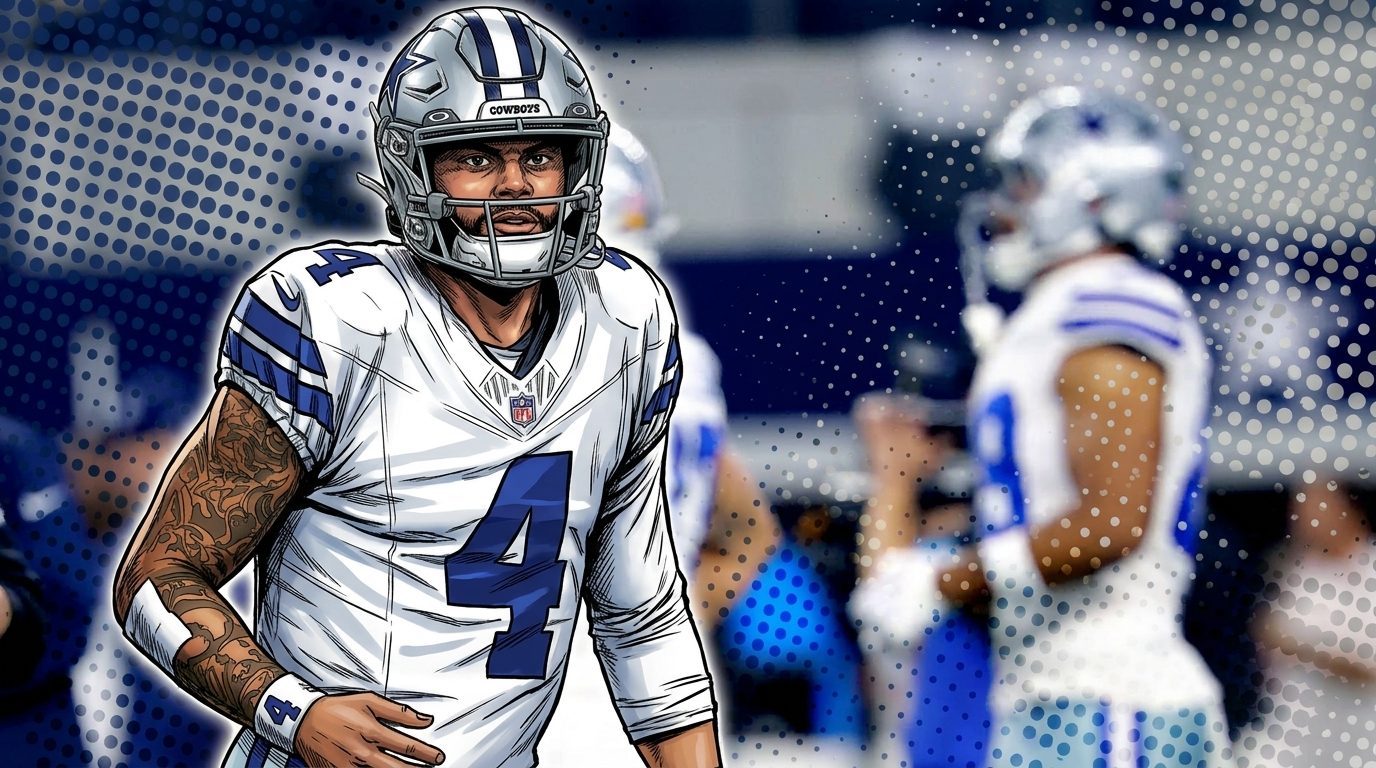
The Dallas Cowboys are a professional American football franchise that entered the NFL as an expansion team in 1960 and grew into the most commercially powerful club the sport has produced. Nicknamed “America’s Team” since 1978, they have won five Super Bowls and appeared in eight, a haul matched by only a handful of franchises. They are also, by Forbes’ reckoning, the most valuable team in all of sports. Yet the modern Cowboys are defined as much by absence as by trophies: they have not played in an NFC Championship Game since the 1995 season, the longest such drought in the NFL. No franchise in the league holds a wider gap between its brand and its recent on-field ceiling.
| Vitals | |
|---|---|
| Founded | 1960 (franchise awarded Jan. 28, 1960) |
| League / conference / division | NFL — NFC East |
| Stadium | AT&T Stadium, Arlington, Texas (opened 2009) |
| Owner | Jerry Jones (since 1989) |
| Head coach | Brian Schottenheimer (since Jan. 2025; as of Oct. 11, 2026) |
| Titles | 5 Super Bowls (1971, 1977, 1992, 1993, 1995) |
Expansion and the Landry foundation (1960–1965)
The NFL awarded Dallas a franchise on Jan. 28, 1960, to oil heir Clint Murchison Jr., and the team was officially named the Cowboys that April after flirting with “Steers” and “Rangers.” Murchison’s first hires set the template for everything that followed: Tex Schramm as general manager, Gil Brandt as player personnel director, and former New York Giants defensive assistant Tom Landry as head coach.
The first season was a shutout of a different kind. Forced to stock the roster from an expansion allocation pool, the 1960 Cowboys went 0–11–1, the only winless campaign in franchise history. Landry, armed with a long contract and ownership patience that would be unthinkable later, was given time to build.
The climb was gradual but unmistakable. Brandt turned the Cowboys into pioneers of computer-aided scouting, mining small colleges and other sports for talent. Quarterback Don Meredith, defensive tackle Bob Lilly — the franchise’s first draft pick — and world-class sprinter-turned-receiver Bob Hayes formed the nucleus. By 1965 Dallas reached 7–7, the launching point for one of the longest sustained runs of excellence in league history.
The near-miss years (1966–1970)
In 1966 the Cowboys arrived. They went 10–3–1 and won the Eastern Conference, the first of what would become 20 consecutive winning seasons from 1966 through 1985. They lost the NFL Championship Game to the Green Bay Packers on Jan. 1, 1967, then lost to the Packers again in the 1967 title game.
That rematch became one of football’s enduring myths. On Dec. 31, 1967, in the Ice Bowl at Lambeau Field — air temperature roughly −13°F — Bart Starr’s quarterback sneak in the final seconds beat Dallas 21–17. The Cowboys had the title in their grasp and lost it on frozen turf.
The near misses hardened into a reputation: a team that always came up a game short. Dallas reached its first Super Bowl after the 1970 season, only to fall to the Baltimore Colts 16–13 in Super Bowl V on a Jim O’Brien field goal with five seconds left on Jan. 17, 1971. Landry had built a perennial contender that could not yet win the last game.
The Doomsday dynasty and Roger Staubach (1971–1979)
The breakthrough came with Roger Staubach under center. The former Navy quarterback and Heisman winner took the job in 1971 and drove Dallas to a 24–3 demolition of the Miami Dolphins in Super Bowl VI on Jan. 16, 1972 — the only Super Bowl in which a team has allowed no touchdown. Staubach was named MVP; the franchise had its first title, and had just moved into its new home, Texas Stadium, with its signature hole in the roof.
The “Doomsday Defense” anchored a decade of contention. Bob Lilly, Randy White, Harvey Martin, Cliff Harris and Mel Renfro made Dallas a fixture in January. The Cowboys lost Super Bowl X to Pittsburgh 21–17 on Jan. 18, 1976, then won Super Bowl XII over Denver 27–10 on Jan. 15, 1978, with Martin and White sharing MVP honors — the only shared award in Super Bowl history.
Staubach authored the vocabulary of comebacks. On Dec. 28, 1975, his desperation heave to Drew Pearson beat Minnesota in a divisional playoff; afterward Staubach said he closed his eyes and said a “Hail Mary,” coining the term. Rookie Tony Dorsett arrived in 1977 and gave the offense a game-breaking back. Dallas lost a classic Super Bowl XIII to the Steelers 35–31 on Jan. 21, 1979, closing the decade as the sport’s defining rivalry opposite Pittsburgh.
The slow decline of the Landry era (1980–1988)
The early 1980s were a story of title games just out of reach. Dallas reached the NFC Championship Game after the 1980, 1981 and 1982 seasons and lost all three. The cruelest was Jan. 10, 1982, when Joe Montana found Dwight Clark in the back of the end zone — “The Catch” — to give the San Francisco 49ers a 28–27 win and pass the torch of NFC supremacy westward.
Flashes of the old brilliance remained. On Jan. 3, 1983, Tony Dorsett ripped off a 99-yard touchdown run against Minnesota, a record that can be tied but never broken.
Then the foundation gave way. Age, thin drafts and a changing league caught up with Landry. The Cowboys posted their first losing season since 1964 in 1986, slid to 7–8 in the strike-marred 1987 campaign, and bottomed out at 3–13 in 1988. The man who had been the only head coach the franchise ever knew was running out of time.
Jerry Jones, Jimmy Johnson and the Triplets (1989–1995)
Everything changed on Feb. 25, 1989. Arkansas oilman Jerry Jones bought the Cowboys from Bum Bright for $140 million and immediately fired Tom Landry, replacing him with his old college teammate, University of Miami coach Jimmy Johnson. The abruptness of Landry’s dismissal scandalized the fan base. The rebuild that followed was ruthless: Dallas went 1–15 in 1989, the worst record in team history.
The roster was rebuilt through one of sport’s great heists. Johnson drafted quarterback Troy Aikman first overall in 1989, then on Oct. 12, 1989, shipped running back Herschel Walker to Minnesota in a trade that netted a cascade of picks. Those selections, directly or indirectly, delivered running back Emmitt Smith (1990) and the depth around receiver Michael Irvin (1988). Aikman, Smith and Irvin — “the Triplets” — became the core of a juggernaut.
The payoff was a dynasty. Dallas hammered Buffalo 52–17 in Super Bowl XXVII on Jan. 31, 1993, with Aikman named MVP, then beat the Bills again 30–13 in Super Bowl XXVIII on Jan. 30, 1994, Smith taking MVP after a league-MVP regular season. A power struggle between Jones and Johnson ended with Johnson’s departure that offseason; Barry Switzer took over and guided a loaded roster to a 27–17 win over Pittsburgh in Super Bowl XXX on Jan. 28, 1996 — three championships in four seasons.
After the dynasty: the lean years (1996–2002)
The core aged out faster than the Cowboys could reload. Salary-cap bills from the dynasty came due, the drafts dried up, and the window closed. Irvin’s career ended after a 1999 neck injury; Aikman, battered by concussions, retired after the 2000 season; Switzer gave way to Chan Gailey and then Dave Campo.
The slide was steep. Under Campo the Cowboys went 5–11 in three straight seasons from 2000 through 2002. The lone highlight was individual: on Oct. 27, 2002, Emmitt Smith passed Walter Payton to become the NFL’s all-time leading rusher, a record he would carry out of Dallas and into Canton.
Bill Parcells and the Tony Romo years (2003–2016)
Jones turned to a proven fixer. Bill Parcells arrived in 2003 and restored respectability, going 10–6 in his first season. His most lasting legacy was an undrafted quarterback named Tony Romo, who seized the starting job in 2006 and rewrote the franchise passing records.
The era produced thrills and heartbreak in equal measure. Romo’s bobbled hold on a chip-shot field goal ended a wild-card loss at Seattle on Jan. 6, 2007. Under Wade Phillips the 2007 team went 13–3 but lost at home to the Giants. Jason Garrett’s 2014 club went 12–4 behind DeMarco Murray, only to see Dez Bryant’s apparent catch overturned in a 26–21 divisional loss at Green Bay on Jan. 11, 2015 — a replay ruling fans still dispute.
The next generation announced itself in 2016. Rookies Dak Prescott and Ezekiel Elliott led Dallas to a 13–3 record and the NFC’s top seed before another divisional exit against the Packers. Romo, displaced by injury and Prescott’s emergence, soon retired as the franchise’s career passing leader.
The Dak Prescott era and the title drought (2017–2026)
Prescott became the face of the franchise and the symbol of its ceiling. Dallas won NFC East titles in 2018, 2021 and 2023 and routinely fielded top-tier offenses, yet kept exiting in the wild-card or divisional round. The Cowboys signed Prescott to a record four-year, $240 million extension on Sept. 8, 2024, briefly the highest average annual salary in NFL history, a bet that the drought was a matter of timing rather than structure.
The on-field results stalled. Mike McCarthy, hired in 2020, went 7–10 in 2024 and was not retained. Jones promoted offensive coordinator Brian Schottenheimer to head coach on Jan. 24, 2025, the 10th in franchise history. Before Schottenheimer’s first season, Dallas made the stunning move of trading All-Pro edge rusher Micah Parsons to Green Bay for defensive tackle Kenny Clark and two first-round picks.
The 2025 season extended the wait. The Cowboys finished 7–9–1 and second in the NFC East, missing the playoffs despite a top-ranked offense, as a thin defense sagged. With no conference-title-game appearance since the 1995 season, Dallas owned the longest NFC Championship Game drought in league history as of Oct. 11, 2026 — 30 years without reaching the final four of its conference.
Retired numbers
The Cowboys are one of a small group of NFL teams that, as a matter of policy, do not retire jersey numbers. Their equivalent honor is the Ring of Honor, ringing the stadium interior since 1975 and now displayed at AT&T Stadium. It comprises 20 players, two head coaches and two executives; several numbers (54, 22, 43, 88, 94) are shared by more than one honoree. The complete roll of honored figures:
| No. | Player | Pos. | Team tenure | Inducted |
|---|---|---|---|---|
| 74 | Bob Lilly | DT | 1961–1974 | Nov. 23, 1975 |
| 17 | Don Meredith | QB | 1960–1968 | Nov. 7, 1976 |
| 43 | Don Perkins | FB | 1961–1968 | Nov. 7, 1976 |
| 54 | Chuck Howley | LB | 1961–1973 | Oct. 30, 1977 |
| 20 | Mel Renfro | CB | 1964–1977 | Oct. 25, 1981 |
| 12 | Roger Staubach | QB | 1969–1979 | Oct. 9, 1983 |
| 55 | Lee Roy Jordan | LB | 1963–1976 | Oct. 29, 1989 |
| 33 | Tony Dorsett | RB | 1977–1987 | Oct. 9, 1994 |
| 54 | Randy White | DT | 1975–1988 | Oct. 9, 1994 |
| 22 | Bob Hayes | WR | 1965–1974 | Sep. 23, 2001 |
| 43 | Cliff Harris | S | 1970–1979 | Oct. 10, 2004 |
| 70 | Rayfield Wright | OT | 1967–1979 | Oct. 10, 2004 |
| 8 | Troy Aikman | QB | 1989–2000 | Sep. 19, 2005 |
| 88 | Michael Irvin | WR | 1988–1999 | Sep. 19, 2005 |
| 22 | Emmitt Smith | RB | 1990–2002 | Sep. 19, 2005 |
| 88 | Drew Pearson | WR | 1973–1983 | Nov. 6, 2011 |
| 94 | Charles Haley | DE | 1992–1996 | Nov. 6, 2011 |
| 73 | Larry Allen | OG | 1994–2005 | Nov. 6, 2011 |
| 28 | Darren Woodson | S | 1992–2004 | Nov. 1, 2015 |
| 94 | DeMarcus Ware | LB | 2005–2013 | Oct. 29, 2023 |
| — | Tom Landry (head coach) | HC | 1960–1988 | Nov. 7, 1993 |
| — | Jimmy Johnson (head coach) | HC | 1989–1993 | Dec. 30, 2023 |
| — | Tex Schramm (general manager) | Exec | 1960–1989 | Oct. 12, 2003 |
| — | Gil Brandt (player personnel) | Exec | 1960–1988 | Nov. 29, 2018 |
Season by season
Every season the franchise has played, folded by decade, newest first.
The 2020s 56–44–1 · 3 playoff berths · 1 playoff win
| Season | W–L | Finish | Playoffs |
|---|---|---|---|
| 2025 | 7-9-1 | 2nd NFC East | — |
| 2024 | 7-10 | 3rd NFC East | — |
| 2023 | 12-5 | 1st NFC East | Lost Wild Card |
| 2022 | 12-5 | 2nd NFC East | Won Wild Card; Lost Divisional |
| 2021 | 12-5 | 1st NFC East | Lost Wild Card |
| 2020 | 6-10 | 3rd NFC East | — |
The 2010s 86–74 · 3 playoff berths · 3 NFC East titles
| Season | W–L | Finish | Playoffs |
|---|---|---|---|
| 2019 | 8-8 | 2nd NFC East | — |
| 2018 | 10-6 | 1st NFC East | Won Wild Card; Lost Divisional |
| 2017 | 9-7 | 2nd NFC East | — |
| 2016 | 13-3 | 1st NFC East | Lost Divisional |
| 2015 | 4-12 | 4th NFC East | — |
| 2014 | 12-4 | 1st NFC East | Won Wild Card; Lost Divisional |
| 2013 | 8-8 | 2nd NFC East | — |
| 2012 | 8-8 | 3rd NFC East | — |
| 2011 | 8-8 | 3rd NFC East | — |
| 2010 | 6-10 | 3rd NFC East | — |
The 2000s 82–78 · 4 playoff berths · 1 playoff win (2009)
| Season | W–L | Finish | Playoffs |
|---|---|---|---|
| 2009 | 11-5 | 1st NFC East | Won Wild Card; Lost Divisional |
| 2008 | 9-7 | 3rd NFC East | — |
| 2007 | 13-3 | 1st NFC East | Lost Divisional |
| 2006 | 9-7 | 2nd NFC East | Lost Wild Card |
| 2005 | 9-7 | 3rd NFC East | — |
| 2004 | 6-10 | 3rd NFC East | — |
| 2003 | 10-6 | 2nd NFC East | Lost Wild Card |
| 2002 | 5-11 | 4th NFC East | — |
| 2001 | 5-11 | 5th NFC East | — |
| 2000 | 5-11 | 4th NFC East | — |
The 1990s 101–59 · 8 playoff berths · 3 Super Bowl titles
| Season | W–L | Finish | Playoffs |
|---|---|---|---|
| 1999 | 8-8 | 2nd NFC East | Lost Wild Card |
| 1998 | 10-6 | 1st NFC East | Lost Wild Card |
| 1997 | 6-10 | 4th NFC East | — |
| 1996 | 10-6 | 1st NFC East | Won Wild Card; Lost Divisional |
| 1995 | 12-4 | 1st NFC East | Won Super Bowl XXX |
| 1994 | 12-4 | 1st NFC East | Lost NFC Championship |
| 1993 | 12-4 | 1st NFC East | Won Super Bowl XXVIII |
| 1992 | 13-3 | 1st NFC East | Won Super Bowl XXVII |
| 1991 | 11-5 | 2nd NFC East | Won Wild Card; Lost Divisional |
| 1990 | 7-9 | 4th NFC East | — |
The 1980s 79–73 · 5 playoff berths · 3 NFC title games
| Season | W–L | Finish | Playoffs |
|---|---|---|---|
| 1989 | 1-15 | 5th NFC East | — |
| 1988 | 3-13 | 5th NFC East | — |
| 1987 | 7-8 | 2nd NFC East | — |
| 1986 | 7-9 | 3rd NFC East | — |
| 1985 | 10-6 | 1st NFC East | Lost Divisional |
| 1984 | 9-7 | 4th NFC East | — |
| 1983 | 12-4 | 2nd NFC East | Lost Wild Card |
| 1982 | 6-3 | 2nd NFC | Won First & Second Round; Lost NFC Championship |
| 1981 | 12-4 | 1st NFC East | Lost NFC Championship |
| 1980 | 12-4 | 2nd NFC East | Won Wild Card & Divisional; Lost NFC Championship |
The 1970s 105–39 · 9 playoff berths · 5 Super Bowls, 2 titles
| Season | W–L | Finish | Playoffs |
|---|---|---|---|
| 1979 | 11-5 | 1st NFC East | Lost Divisional |
| 1978 | 12-4 | 1st NFC East | Lost Super Bowl XIII |
| 1977 | 12-2 | 1st NFC East | Won Super Bowl XII |
| 1976 | 11-3 | 1st NFC East | Lost Divisional |
| 1975 | 10-4 | 2nd NFC East | Won NFC Championship; Lost Super Bowl X |
| 1974 | 8-6 | 3rd NFC East | — |
| 1973 | 10-4 | 1st NFC East | Lost NFC Championship |
| 1972 | 10-4 | 2nd NFC East | Lost NFC Championship |
| 1971 | 11-3 | 1st NFC East | Won Super Bowl VI |
| 1970 | 10-4 | 1st NFC East | Won NFC Championship; Lost Super Bowl V |
The 1960s 67–65–6 · 4 playoff berths · 2 NFL title games
| Season | W–L | Finish | Playoffs |
|---|---|---|---|
| 1969 | 11-2-1 | 1st Capitol | Lost Conference playoffs |
| 1968 | 12-2 | 1st Capitol | Lost Conference playoffs |
| 1967 | 9-5 | 1st Capitol | Lost NFL Championship (Ice Bowl) |
| 1966 | 10-3-1 | 1st Eastern | Lost NFL Championship |
| 1965 | 7-7 | 2nd Eastern | — |
| 1964 | 5-8-1 | 5th Eastern | — |
| 1963 | 4-10 | 5th Eastern | — |
| 1962 | 5-8-1 | 5th Eastern | — |
| 1961 | 4-9-1 | 6th Eastern | — |
| 1960 | 0-11-1 | 7th Western | — |
By the numbers
Franchise marks
Ranks
- 1st Most valuable franchise in the NFL and in all of sports (Forbes)
- T-3rd Super Bowl titles, NFL history (5)
- 1st Longest active NFC Championship Game drought (since the 1995 season)
- 1st NFC East division titles since the 1970 merger
Honors
- 5× Super Bowl champion (1971, 1977, 1992, 1993, 1995)
- 8× NFC/NFL conference champion
- 25 division titles
- "America's Team" (since 1978)
- Most valuable team in world sports (Forbes)
- 20 consecutive winning seasons (1966–1985)
Per Wikipedia's franchise season list, Forbes via CultureMap and Fox Sports, through the 2025 season.
The arguments
Is Jerry Jones the architect of the empire or the obstacle to the trophy? Jones’ defenders note that he bought a stagnant franchise for $140 million, funded the dynasty of the 1990s, built a billion-dollar stadium and turned the Cowboys into the most valuable team in sports. His critics counter that Jones has served as his own general manager since 1989 and that the franchise has not reached a conference title game in the entire span of his self-appointed GM tenure after the 1995 season. Both camps are arguing about the same man and the same record.
Did the Jones–Johnson split cost Dallas a longer dynasty? Jimmy Johnson left after back-to-back championships following a public power struggle with Jones over credit and control. Johnson’s supporters contend his roster-building could have delivered more than three titles; Jones has maintained that the organization he built — and the third title won under Barry Switzer — proves the structure, not the coach, was decisive. The two did not publicly reconcile until Johnson’s 2023 induction into the Ring of Honor.
Are the Cowboys still “America’s Team”? By television ratings, merchandise and valuation, Dallas remains the league’s most-watched and most-discussed brand decades after NFL Films coined the phrase in 1978. By competitive results — one playoff win across most of the 2010s and 2020s and no deep January runs — rivals argue the nickname describes a legacy, not a contender. The label endures precisely because both readings are defensible.
Why it matters
The Dallas Cowboys are the rare franchise whose cultural footprint has outgrown the scoreboard. Five Lombardi Trophies, the Landry and Jones dynasties, the Ring of Honor and the “America’s Team” mythology make them one of the most important clubs in NFL history, while their valuation and reach make them the financial center of gravity for the entire sport. That those achievements now coexist with the league’s longest conference-final drought is the defining tension of the modern Cowboys — a team that still sells out stadiums and leads broadcasts while a generation of fans has grown up without seeing it play for a championship.