Minnesota Timberwolves
The Minnesota Timberwolves joined the NBA in 1989 and reached the Western Conference Finals in 2004, 2024 and 2025, still chasing a first title.
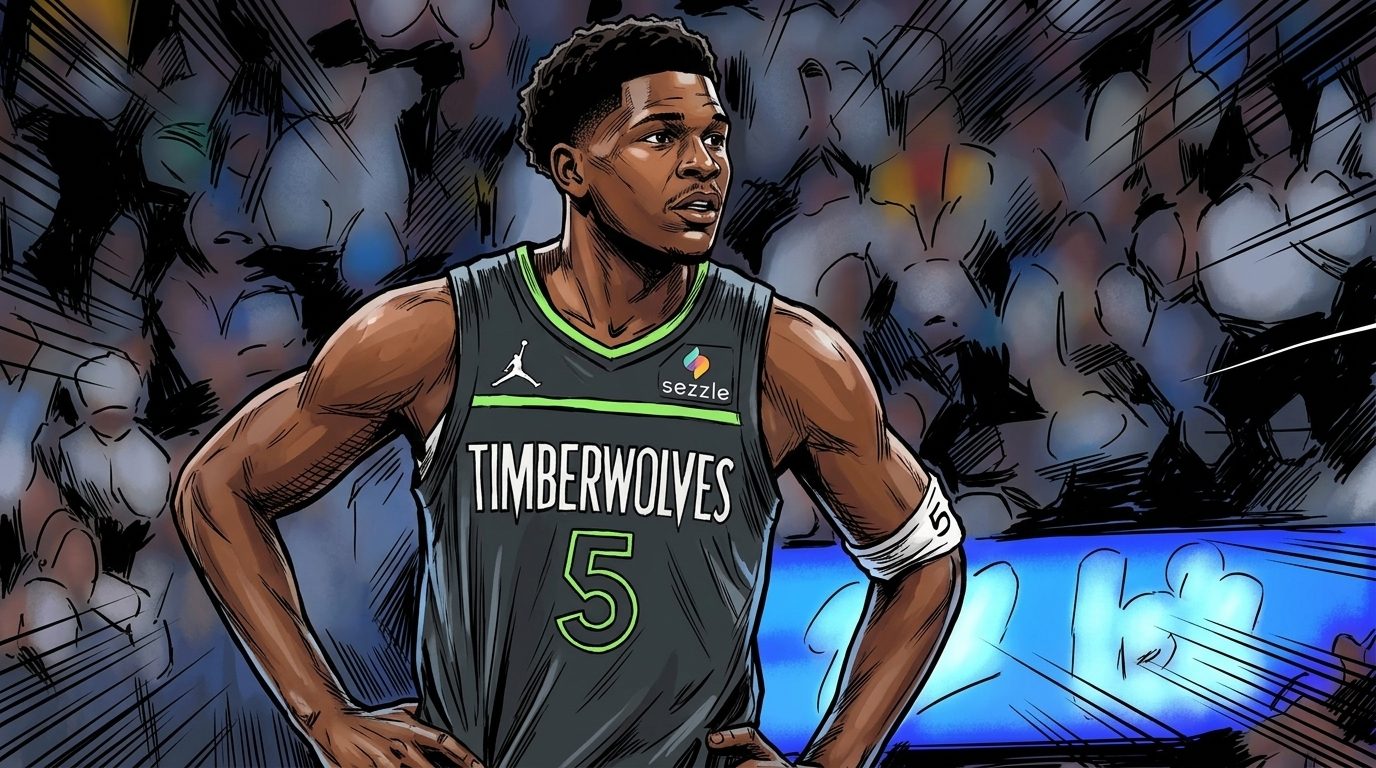
The Minnesota Timberwolves are the National Basketball Association franchise that returned major professional basketball to Minnesota in 1989, nearly three decades after the Lakers left Minneapolis for Los Angeles. For most of their history they have been one of the league’s hardest-luck teams — a single division title, a long stretch as the NBA’s longest playoff drought, and, through the 2025-26 season, a regular-season record of 1,245–1,713 (.421) with no championship. Yet the franchise has also produced one of the great individual careers in league history in Kevin Garnett, three trips to the Western Conference Finals, and, in the Anthony Edwards era, the closest thing to a sustained contender the state has seen since the 1950s.
| Vitals | |
|---|---|
| Founded | 1989 (awarded April 22, 1987; first season 1989-90) |
| League / conference / division | NBA · Western Conference · Northwest |
| Arena | Target Center, Minneapolis (opened 1990) |
| Owner | Marc Lore and Alex Rodriguez (sale completed 2025) |
| Head coach | Chris Finch (as of Oct. 11, 2026) |
| Titles | None |
Origins and the expansion years (1989–1995)
The team was born from a civic campaign to bring the NBA back. The league awarded Minnesota an expansion franchise on April 22, 1987, alongside Orlando, Charlotte and Miami, with local businessmen Harvey Ratner and Marv Wolfenson as the original owners. A public naming contest produced two finalists, “Timberwolves” and “Polars,” and local officials chose the former — a nod to Minnesota holding the largest timberwolf population in the contiguous United States, per the franchise’s own history.
The first season set an attendance record and little else. Coached by Bill Musselman and led by guard Tony Campbell, the 1989-90 Wolves went 22–60 while playing their inaugural year at the Hubert H. Humphrey Metrodome and drawing more than a million fans — an NBA single-season record at the time. The team moved into Target Center in 1990, but wins did not follow. Minnesota lost at least 60 games in 1989-90, 1991-92 (15–67) and 1993-94, cycling through Musselman, Jimmy Rodgers, Sidney Lowe and Bill Blair on the bench. Lottery picks Christian Laettner (1992) and Isaiah “J.R.” Rider (1993) brought talent but no traction.
The franchise nearly left before it found its footing. In 1994 Ratner and Wolfenson agreed to sell the team to a group that intended to relocate it to New Orleans; the NBA blocked the move, and Mankato businessman Glen Taylor stepped in to buy the Timberwolves and keep them in Minnesota. Taylor’s purchase ended the relocation threat and began an ownership tenure that would last three decades.
The Kevin Garnett era and the 2004 breakthrough (1995–2007)
Everything changed with the fifth pick of the 1995 draft. Minnesota selected Kevin Garnett, a 19-year-old straight out of Chicago’s Farragut Career Academy, and paired him under new coach Flip Saunders with a young nucleus. The Wolves added Stephon Marbury (acquired on 1996 draft night) and Tom Gugliotta, and in 1996-97 they reached the playoffs for the first time. It was the start of eight straight postseason appearances — and, at first, eight straight disappointments, as Minnesota lost in the first round in each season from 1996-97 through 2002-03.
The 2003-04 season remains the franchise’s high-water mark. Flanked by veteran additions Sam Cassell and Latrell Sprewell, Garnett was named the NBA’s Most Valuable Player and carried Minnesota to a franchise-best 58–24 record and the Midwest Division title. The Wolves beat Denver and then outlasted Sacramento in a seven-game semifinal before falling to the Los Angeles Lakers 4–2 in the Western Conference Finals — the deepest run in team history to that point and, for two decades, the only time the franchise advanced past the first round.
Tragedy and decline followed the peak. Guard Malik Sealy, a close friend of Garnett’s, was killed by a drunk driver in May 2000, and the team retired his No. 2. After 2004 the supporting cast aged and dispersed, and Minnesota missed the playoffs for three straight seasons. On July 31, 2007, the Wolves traded Garnett to the Boston Celtics for Al Jefferson, Ryan Gomes, Sebastian Telfair, Gerald Green, Theo Ratliff, cash and two first-round picks — the largest package ever surrendered for a single player. Garnett won a title in Boston the next June; Minnesota began a long rebuild.
The post-Garnett wilderness (2007–2014)
The Wolves spent the better part of a decade in the lottery. The years after Garnett produced some of the worst teams in the NBA — 24–58 in 2008-09, back-to-back 15–67 and 17–65 finishes in 2009-10 and 2010-11 — and a string of front-office decisions that still define the era’s reputation. In the 2009 draft, basketball operations head David Kahn selected point guards Ricky Rubio and Jonny Flynn with consecutive picks, passing over Stephen Curry, who went seventh to Golden State.
Kevin Love became the one bright spot. Acquired on draft night in 2008, Love developed into an All-Star power forward and posted a 30-point, 30-rebound game in November 2010, the NBA’s first such line in nearly three decades. But the team never won around him, and in August 2014 Minnesota traded Love to the Cleveland Cavaliers in a three-team deal headlined by the arrival of No. 1 overall pick Andrew Wiggins. The trade closed one era and opened the next.
The Wiggins–Towns rebuild and the 2018 return (2014–2020)
A new core arrived through the top of the draft. With Wiggins in hand, Minnesota added Kentucky center Karl-Anthony Towns first overall in 2015, and Towns was a unanimous Rookie of the Year, taking all 130 first-place votes. The rebuild was shadowed by loss: Flip Saunders, who had returned as president of basketball operations and head coach, died of cancer in October 2015, and the franchise later raised a “FLIP” banner in his honor.
Tom Thibodeau ended the drought in 2018. Hired in 2016 as coach and president, Thibodeau reunited with Jimmy Butler via a 2017 trade, and on the final night of the 2017-18 regular season Minnesota beat Denver 112–106 in overtime — Butler scoring 31 — to clinch a playoff berth and end what had grown into the NBA’s longest active postseason drought, 13 seasons. Houston dispatched the Wolves 4–1 in the first round. The Butler experiment soured quickly: he forced his way out in a dramatic preseason standoff in 2018 and was traded to Philadelphia that November, and Thibodeau was fired in January 2019.
The Anthony Edwards era (2020–present)
The franchise’s current contender was built around a No. 1 pick and a blockbuster. Minnesota selected Georgia guard Anthony Edwards first overall in the 2020 draft, hired Chris Finch as head coach in February 2021, and in July 2022 traded a franchise-altering package to Utah for Rudy Gobert — Malik Beasley, Patrick Beverley, Jarred Vanderbilt, Leandro Bolmaro, rookie Walker Kessler and four first-round picks. The deal was widely questioned at the time.
The 2023-24 season vindicated the risk. Minnesota won 56 games, swept Phoenix, then stunned the defending-champion Denver Nuggets 4–3 in a semifinal that reached a Game 7 in Denver, before losing to Dallas 4–1 in the Western Conference Finals. Edwards emerged as a franchise cornerstone and, with Garnett and Towns before him, one of the few Timberwolves to earn repeated All-NBA recognition, making the All-NBA team in both 2024 and 2025.
A surprise trade reshaped the roster, and the team went back to the conference finals. On the eve of the 2024-25 season, Minnesota traded Karl-Anthony Towns to the New York Knicks for Julius Randle, Donte DiVincenzo and a first-round pick. The reshaped Wolves won 49 games, beat the Lakers and Warriors in the playoffs, and returned to the Western Conference Finals, where the top-seeded Oklahoma City Thunder beat them 4–1. In 2025-26 Minnesota again won 49 games and reached the second round before losing to San Antonio.
The ownership saga finally resolved in 2025. Glen Taylor had agreed in 2021 to sell the team to Marc Lore and Alex Rodriguez in installments, but in 2024 he declared the deal dead, triggering a bitter dispute. An arbitration panel ruled in favor of Lore and Rodriguez in early 2025, and in June the NBA Board of Governors approved the roughly $1.5 billion sale, ending Taylor’s three-decade run as owner.
Retired numbers
The Timberwolves have retired one playing number and raised one honorary coaching banner, per the franchise. Guard Malik Sealy’s No. 2 was retired after his death in a May 2000 car crash caused by a drunk driver, as documented here. The “FLIP” banner honors Flip Saunders, the winningest coach in team history, who died in 2015. Kevin Garnett’s No. 21 is not yet in the rafters: the franchise has scheduled its retirement for Feb. 28, 2027, against the Boston Celtics.
| No. | Player | Pos. | Team tenure | Retired |
|---|---|---|---|---|
| 2 | Malik Sealy | G/F | 1999–2000 | 2000 |
| FLIP | Flip Saunders (coach/executive) | — | 1995–2005, 2013–2015 | 2015 |
Season by season
Every season the franchise has completed, folded by decade with the newest first.
The 2020s 284–262 · 5 playoff berths · 2 conference finals
| Season | W–L | Finish | Playoffs |
|---|---|---|---|
| 2019-20 | 19–45 | 5th (Northwest) | Did not qualify |
| 2020-21 | 23–49 | 4th (Northwest) | Did not qualify |
| 2021-22 | 46–36 | 3rd (Northwest) | Lost First Round (MEM 2–4) |
| 2022-23 | 42–40 | 2nd (Northwest) | Lost First Round (DEN 1–4) |
| 2023-24 | 56–26 | 3rd (Northwest) | Lost Conf. Finals (DAL 1–4) |
| 2024-25 | 49–33 | 3rd (Northwest) | Lost Conf. Finals (OKC 1–4) |
| 2025-26 | 49–33 | 3rd (Northwest) | Lost Conf. Semis (SAS 2–4) |
The 2010s 288–516 · 1 playoff berth · no title
| Season | W–L | Finish | Playoffs |
|---|---|---|---|
| 2009-10 | 15–67 | 5th (Northwest) | Did not qualify |
| 2010-11 | 17–65 | 5th (Northwest) | Did not qualify |
| 2011-12 | 26–40 | 5th (Northwest) | Did not qualify |
| 2012-13 | 31–51 | 5th (Northwest) | Did not qualify |
| 2013-14 | 40–42 | 3rd (Northwest) | Did not qualify |
| 2014-15 | 16–66 | 5th (Northwest) | Did not qualify |
| 2015-16 | 29–53 | 5th (Northwest) | Did not qualify |
| 2016-17 | 31–51 | 5th (Northwest) | Did not qualify |
| 2017-18 | 47–35 | 4th (Northwest) | Lost First Round (HOU 1–4) |
| 2018-19 | 36–46 | 5th (Northwest) | Did not qualify |
The 2000s 411–409 · 5 playoff berths · 1 conference finals
| Season | W–L | Finish | Playoffs |
|---|---|---|---|
| 1999-00 | 50–32 | 3rd (Midwest) | Lost First Round (POR 1–3) |
| 2000-01 | 47–35 | 4th (Midwest) | Lost First Round (SAS 1–3) |
| 2001-02 | 50–32 | 3rd (Midwest) | Lost First Round (DAL 0–3) |
| 2002-03 | 51–31 | 3rd (Midwest) | Lost First Round (LAL 2–4) |
| 2003-04 | 58–24 | 1st (Midwest) | Lost Conf. Finals (LAL 2–4) |
| 2004-05 | 44–38 | 3rd (Northwest) | Did not qualify |
| 2005-06 | 33–49 | 4th (Northwest) | Did not qualify |
| 2006-07 | 32–50 | 4th (Northwest) | Did not qualify |
| 2007-08 | 22–60 | 4th (Northwest) | Did not qualify |
| 2008-09 | 24–58 | 4th (Northwest) | Did not qualify |
The 1990s 262–526 · 3 playoff berths · no title
| Season | W–L | Finish | Playoffs |
|---|---|---|---|
| 1989-90 | 22–60 | 6th (Midwest) | Did not qualify |
| 1990-91 | 29–53 | 5th (Midwest) | Did not qualify |
| 1991-92 | 15–67 | 6th (Midwest) | Did not qualify |
| 1992-93 | 19–63 | 5th (Midwest) | Did not qualify |
| 1993-94 | 20–62 | 5th (Midwest) | Did not qualify |
| 1994-95 | 21–61 | 6th (Midwest) | Did not qualify |
| 1995-96 | 26–56 | 6th (Midwest) | Did not qualify |
| 1996-97 | 40–42 | 3rd (Midwest) | Lost First Round (HOU 0–3) |
| 1997-98 | 45–37 | 3rd (Midwest) | Lost First Round (SEA 2–3) |
| 1998-99 | 25–25 | 4th (Midwest) | Lost First Round (SAS 1–3) |
By the numbers
Franchise marks
Per Basketball-Reference, through the 2025-26 season.
Ranks
- 1st Points, franchise history (Kevin Garnett, 19,201)
- 1st Rebounds, franchise history (Kevin Garnett, 10,718)
- 1st Made threes, franchise history (Anthony Edwards, 1,314)
- 2nd Points, franchise history (Karl-Anthony Towns, 13,121)
- 2nd Assists, franchise history (Ricky Rubio, 3,424)
Per Basketball-Reference career leaders, through the 2025-26 season.
Honors
- 2003-04 NBA MVP — Kevin Garnett
- 2015-16 Rookie of the Year — Karl-Anthony Towns
- 3× Western Conference finalist (2004, 2024, 2025)
- 2003-04 Midwest Division title
- 8× All-NBA — Kevin Garnett
- 2× All-NBA — Anthony Edwards (2024, 2025)
Per NBA.com and Basketball-Reference.
The arguments
The Gobert trade. When Minnesota sent four first-round picks and a package of players and prospects to Utah for Rudy Gobert in 2022, critics called it a historic overpay that mortgaged the franchise’s future to pair two centers who did not obviously fit. Defenders pointed to the 56-win 2023-24 season and the conference-finals runs that followed as evidence that the defense Gobert anchored was exactly what a young team needed. Both sides agree on the price; they disagree on whether the deep playoff runs justified it.
The David Kahn draft years. The decision to take Ricky Rubio and Jonny Flynn with back-to-back 2009 picks while Stephen Curry remained on the board is held up by some as the defining front-office blunder of the post-Garnett era. Others note that Rubio became a durable NBA starter and that few teams in 2009 projected Curry’s trajectory. The debate is less about the picks in isolation than about how much hindsight a draft critique should carry.
The Towns trade. Dealing Karl-Anthony Towns — a No. 1 pick, a unanimous Rookie of the Year and a face of the franchise — just before the 2024-25 season struck some observers as cutting bait on a cornerstone for salary and fit reasons. Supporters argued the return of Julius Randle and Donte DiVincenzo, plus a return to the conference finals that spring, showed the reshaped roster worked. The trade is still litigated by both camps.
Garnett and the long wait. The two-decade gap between Garnett’s departure and the scheduling of his jersey retirement is frequently tied to a personal rift between Garnett and former owner Glen Taylor. Garnett has publicly criticized Taylor; Taylor’s side has disputed the framing. With the ownership change and the Feb. 28, 2027, ceremony set, the particulars remain contested and are best left to the people who lived them.
Why it matters
The Minnesota Timberwolves are the franchise that brought the NBA back to a basketball-proud state and then spent most of four decades learning how hard sustained success is to build. Their history is Garnett’s greatness and the 2004 run that briefly made Minnesota a contender; the long lottery years and the draft-night gambles; the 2018 night that ended the league’s longest drought; and the Edwards-era teams that finally stacked conference-finals appearances on top of one another. No banner yet hangs for a title, which is precisely why the current era carries the weight it does — for a fan base that has waited since 1989, the Timberwolves are a story still reaching for its ending.