San Francisco 49ers
The San Francisco 49ers are a five-time Super Bowl champion NFL franchise, from the Bill Walsh dynasty to the Kyle Shanahan era and Brock Purdy.
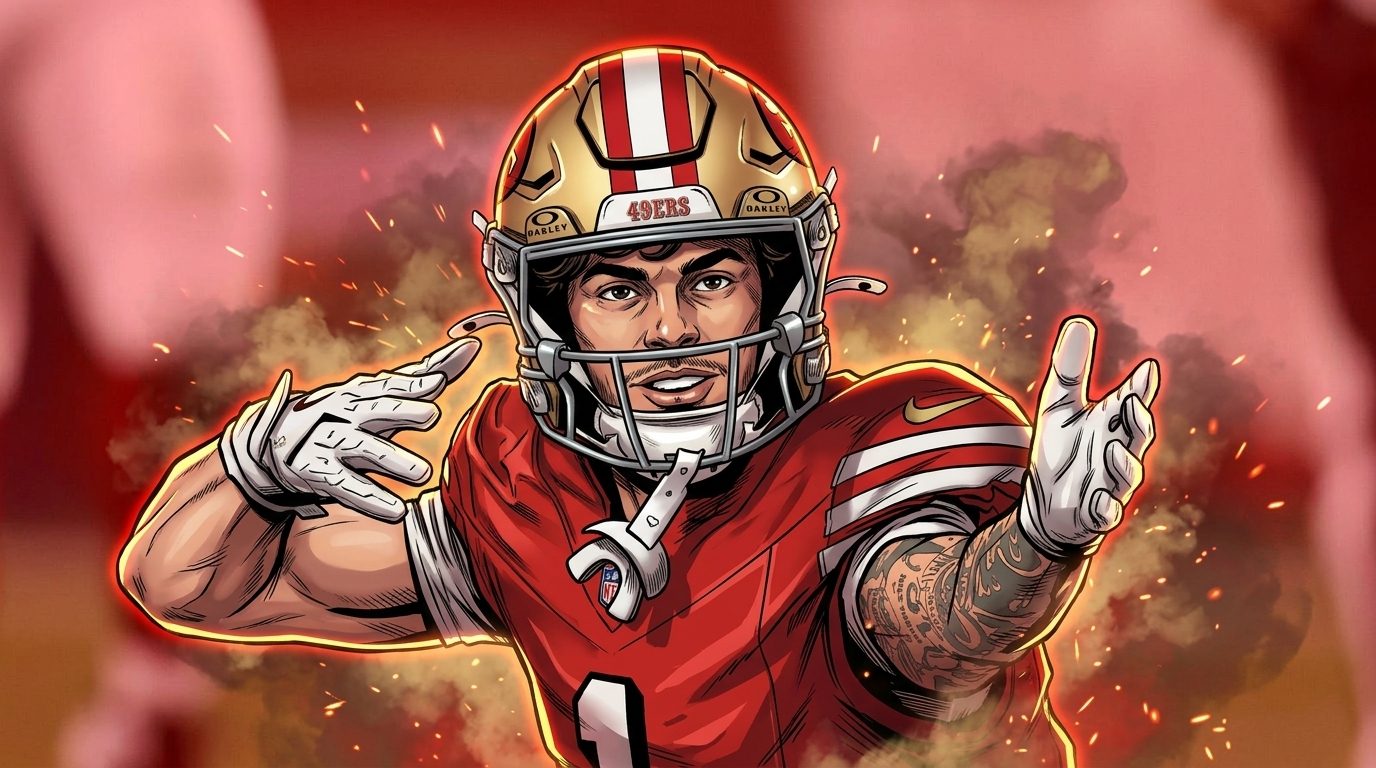
The San Francisco 49ers are one of the National Football League’s defining franchises, a five-time Super Bowl champion and the first major-league professional team to call the West Coast home. Founded in 1946 as a charter member of the All-America Football Conference, they became the laboratory for Bill Walsh’s West Coast offense and the home of Joe Montana, Jerry Rice and Steve Young — the engine of a dynasty that won four championships in the 1980s and a fifth in the 1990s. After two decades of searching for that standard again, the Kyle Shanahan era returned them to the sport’s center stage, where quarterback Brock Purdy’s rise from the draft’s final pick and three agonizing title-game near misses have come to define the modern club.
| Vitals | |
|---|---|
| Founded | 1946 (All-America Football Conference); joined the NFL in 1950 |
| League / conference / division | NFL — National Football Conference, NFC West |
| Stadium | Levi’s Stadium, Santa Clara, California (opened 2014) |
| Owner | Jed York, DeBartolo–York family |
| Head coach | Kyle Shanahan (as of Oct. 20, 2026) |
| Super Bowl titles | 5 — XVI (1981), XIX (1984), XXIII (1988), XXIV (1989), XXIX (1994) |
Origins: the All-America Football Conference (1946–1949)
The 49ers were born with a rival league. Lumber magnate Tony Morabito founded the club in 1946 as a charter member of the All-America Football Conference, naming the team for the prospectors of the 1849 California Gold Rush. They were the first major-league professional sports team to originate on the West Coast, playing at San Francisco’s Kezar Stadium under coach Buck Shaw.
They were the AAFC’s second-best team and never its champion. San Francisco went 9–5, 8–4–2, 12–2 and 9–3 across the league’s four seasons, led by scrambling, bootleg-inventing quarterback Frankie Albert. But the Cleveland Browns won all four AAFC titles, and the 49ers’ only title shot ended in a 1949 championship loss to Cleveland, 21–7. Fullback Joe Perry, “The Jet,” arrived in 1948 and would become a franchise cornerstone.
Into the NFL: the Million Dollar Backfield and lean years (1950–1969)
The AAFC folded after 1949, and the 49ers were absorbed into the NFL for 1950. Their first NFL season was a 3–9 struggle, but the decade produced one of the great backfields in league history. From 1954 to 1956 the “Million Dollar Backfield” paired quarterback Y.A. Tittle with runners Joe Perry, Hugh McElhenny and John Henry Johnson — the only full-house backfield ever to send all four members to the Pro Football Hall of Fame. Perry became the first player in NFL history to rush for 1,000 yards in consecutive seasons (1953–54).
The Alley-Oop gave San Francisco its first NFL playoff game. In 1957, Tittle began lofting jump-ball passes to leaping receiver R.C. Owens; the play, nicknamed the “Alley-Oop,” helped the 49ers to an 8–4 finish and a conference playoff, which they lost to Detroit. The rest of the 1960s were mostly middling-to-poor — a low of 2–12 in 1963 — as the franchise cycled through the Western and Coastal divisions without a title.
The Nolan division titles and the pre-Walsh collapse (1970–1978)
Dick Nolan built the 49ers’ first real NFL contenders. Under Nolan, San Francisco won three straight NFC West titles in 1970, 1971 and 1972, going 10–3–1, 9–5 and 8–5–1. Each run ended against the Dallas Cowboys — 17–10 and 14–3 in the 1970 and 1971 NFC Championship Games, and a 30–28 divisional loss in 1972 — the start of a rivalry the franchise would eventually settle on its own terms.
Then came the bottom. The team sank through the mid-1970s, and Edward DeBartolo Jr. bought the franchise from the Morabito family in 1977. His first two full seasons were disasters: back-to-back 2–14 records in 1978 and 1979, among the worst in football. The ruins of those seasons set up the most important hire in team history.
Bill Walsh and the West Coast offense (1979–1988)
Bill Walsh arrived in 1979 and changed professional football. Hired from Stanford, Walsh installed a ball-control passing system — short, timed, high-percentage throws that stretched defenses horizontally and let receivers create after the catch — that became known as the West Coast offense. His first team also went 2–14, but in that 1979 draft he had used the 82nd pick, in the third round, on a Notre Dame quarterback named Joe Montana.
“The Catch” launched the dynasty. On Jan. 10, 1982, trailing the Cowboys in the NFC Championship Game at Candlestick Park, Montana found Dwight Clark in the back of the end zone with 58 seconds left for a 28–27 win. Two weeks later the 49ers beat the Cincinnati Bengals 26–21 in Super Bowl XVI for the first championship in franchise history, with Montana named MVP.
The 1984 team was nearly perfect. San Francisco went 15–1 and routed the Miami Dolphins 38–16 in Super Bowl XIX, again with Montana as MVP. In 1985 Walsh traded up to the 16th pick to draft Mississippi Valley State receiver Jerry Rice, who would become the most prolific receiver the sport has produced.
Montana’s final drive closed Walsh’s run. In Super Bowl XXIII on Jan. 22, 1989, Montana led a 92-yard march capped by a touchdown to John Taylor with 34 seconds left to beat Cincinnati 20–16; Rice was the MVP. Walsh retired days later with a regular-season record of 92–59–1 and three Super Bowl titles, and entered the Hall of Fame in 1993.
The Seifert dynasty’s second act (1989–1996)
George Seifert inherited a champion and made it a juggernaut. Promoted from defensive coordinator for 1989, Seifert’s first team closed the season by demolishing the Denver Broncos 55–10 in Super Bowl XXIV — still the largest margin in Super Bowl history — with Montana as MVP for a franchise-fourth title.
Steve Young stepped out of Montana’s shadow. When Montana was sidelined by an elbow injury in 1991, Young seized the job, led the NFL in passing four straight years and was named league MVP in 1992 and 1994. Montana was traded to the Kansas City Chiefs in April 1993. Young answered the questions for good on Jan. 29, 1995, throwing a Super Bowl-record six touchdown passes in a 49–26 win over the San Diego Chargers in Super Bowl XXIX.
Seifert’s 49ers were a model of sustained excellence. He went 98–30 in the regular season across eight years with two titles, and his rosters were loaded with future Hall of Famers: dynasty holdovers Joe Montana, Jerry Rice, Steve Young, Ronnie Lott, Charles Haley and Roger Craig, the 1994 free-agent and rookie reinforcements Deion Sanders, Rickey Jackson, Richard Dent and Bryant Young, and 1996 arrivals Chris Doleman and Terrell Owens. Rice retired as the NFL’s all-time leader in receptions, receiving yards and receiving touchdowns (1,549 / 22,895 / 197).
After the dynasty: the long decline (1997–2010)
The winning outlasted the dynasty’s core. San Francisco won at least 10 games every year from 1983 through 1998 — an NFL-record 16 consecutive seasons. Under Steve Mariucci the 49ers kept contending — a 13–3 1997 season, and a 2002 wild-card win over the New York Giants built on a frantic fourth-quarter comeback with Jeff Garcia and Terrell Owens.
Then a dark decade followed. The roster and salary cap cratered, and San Francisco bottomed out at 2–14 in 2004, missing the playoffs every year from 2003 through 2010 under coaches Dennis Erickson, Mike Nolan and Mike Singletary — the longest postseason drought of the franchise’s modern era.
The Harbaugh era (2011–2014)
Jim Harbaugh turned the 49ers around overnight. Hired in January 2011, Harbaugh took a 6–10 team to 13–3 and reached three consecutive NFC Championship Games. With Colin Kaepernick emerging at quarterback, the 2012 team won the conference and reached Super Bowl XLVII on Feb. 3, 2013 — the “blackout” game against brother John Harbaugh’s Baltimore Ravens, a 34–31 loss after a late rally fell short. A 2013 NFC title-game loss at Seattle followed, and Harbaugh departed after the 2014 season amid front-office friction.
The floor fell out again. Jim Tomsula lasted one year (5–11 in 2015) and Chip Kelly one more (2–14 in 2016) before ownership cleared the house.
Shanahan, Lynch and Purdy (2017–present)
Kyle Shanahan and John Lynch rebuilt the franchise. Hired in early 2017 as head coach and general manager, they acquired quarterback Jimmy Garoppolo from New England that October and, by 2019, had a 13–3 NFC champion. Super Bowl LIV, on Feb. 2, 2020, ended in heartbreak: San Francisco led the Chiefs 20–10 entering the fourth quarter and lost 31–20 as Patrick Mahomes rallied Kansas City.
Brock Purdy went from the last pick to franchise quarterback. San Francisco drafted Purdy out of Iowa State with the 262nd and final selection of the 2022 draft — “Mr. Irrelevant” — and he took over late that season after injuries to Trey Lance and Garoppolo. He led deep playoff runs in 2022 and 2023, the latter reaching Super Bowl LVIII on Feb. 11, 2024, a 25–22 overtime loss to the Chiefs. In May 2025 the club signed Purdy to a five-year extension worth up to $265 million.
The roster around him stayed star-laden even as it turned over. The modern core featured running back Christian McCaffrey, tight end George Kittle, edge rusher Nick Bosa — the 2022 Defensive Player of the Year — and linebacker Fred Warner. Receiver Deebo Samuel was traded to Washington in 2025. After a 6–11 injury-wrecked 2024, San Francisco went 12–5 in 2025, beat Philadelphia in the wild-card round and lost 41–6 at Seattle in the divisional round, with McCaffrey named Comeback Player of the Year. Through six games of the 2026 season, as of Oct. 20, 2026, the 49ers were 6–0 and first in the NFC West.
Retired numbers
The 49ers have retired 12 jersey numbers, honoring the quarterbacks, backs and linemen who built the franchise across the AAFC era, the Million Dollar Backfield and the Walsh–Seifert dynasty. The club has not established a separate ring-of-honor number set beyond these.
| No. | Player | Pos. | Team tenure | Retired |
|---|---|---|---|---|
| 8 | Steve Young | QB | 1987–1999 | Oct. 5, 2008 |
| 12 | John Brodie | QB | 1957–1973 | Dec. 15, 1973 |
| 16 | Joe Montana | QB | 1979–1992 | Dec. 15, 1997 |
| 34 | Joe Perry | FB | 1948–1960, 1963 | 1971 |
| 37 | Jimmy Johnson | CB | 1961–1976 | 1977 |
| 39 | Hugh McElhenny | HB | 1952–1960 | 1971 |
| 42 | Ronnie Lott | S/CB | 1981–1990 | Nov. 17, 2003 |
| 70 | Charlie Krueger | DT | 1959–1973 | Oct. 6, 1974 |
| 73 | Leo Nomellini | DT | 1950–1963 | 1971 |
| 79 | Bob St. Clair | OT | 1953–1963 | Dec. 2, 2001 |
| 80 | Jerry Rice | WR | 1985–2000 | Sept. 20, 2010 |
| 87 | Dwight Clark | WR | 1979–1987 | Dec. 11, 1988 |
Per the San Francisco 49ers retired-numbers list; some pre-1980 dates are recorded by year only.
Season by season
The complete record, from the 1946 AAFC season through the 2026 campaign in progress, folded by decade.
The 2020s 59–42 (2020–25) · 4 playoff berths · 1 Super Bowl · 6–0 in 2026
| Season | W–L–T | Finish | Playoffs |
|---|---|---|---|
| 2020 | 6–10 | 4th (West) | — |
| 2021 | 10–7 | 3rd (West) | Lost NFC Championship |
| 2022 | 13–4 | 1st (West) | Lost NFC Championship |
| 2023 | 12–5 | 1st (West) | Lost Super Bowl LVIII |
| 2024 | 6–11 | 4th (West) | — |
| 2025 | 12–5 | 3rd (West) | Lost Divisional |
| 2026 | 6–0 | 1st (West) | In progress (as of Oct. 20, 2026) |
The 2010s 80–79–1 · 4 playoff berths · 2 Super Bowl appearances
| Season | W–L–T | Finish | Playoffs |
|---|---|---|---|
| 2010 | 6–10 | 3rd (West) | — |
| 2011 | 13–3 | 1st (West) | Lost NFC Championship |
| 2012 | 11–4–1 | 1st (West) | Lost Super Bowl XLVII |
| 2013 | 12–4 | 2nd (West) | Lost NFC Championship |
| 2014 | 8–8 | 3rd (West) | — |
| 2015 | 5–11 | 4th (West) | — |
| 2016 | 2–14 | 4th (West) | — |
| 2017 | 6–10 | 4th (West) | — |
| 2018 | 4–12 | 3rd (West) | — |
| 2019 | 13–3 | 1st (West) | Lost Super Bowl LIV |
The 2000s 68–92 · 2 playoff berths
| Season | W–L–T | Finish | Playoffs |
|---|---|---|---|
| 2000 | 6–10 | 4th (West) | — |
| 2001 | 12–4 | 2nd (West) | Lost Wild Card |
| 2002 | 10–6 | 1st (West) | Lost Divisional |
| 2003 | 7–9 | 3rd (West) | — |
| 2004 | 2–14 | 4th (West) | — |
| 2005 | 4–12 | 4th (West) | — |
| 2006 | 7–9 | 3rd (West) | — |
| 2007 | 5–11 | 3rd (West) | — |
| 2008 | 7–9 | 2nd (West) | — |
| 2009 | 8–8 | 2nd (West) | — |
The 1990s 113–47 · 8 playoff berths · 1 Super Bowl title
| Season | W–L–T | Finish | Playoffs |
|---|---|---|---|
| 1990 | 14–2 | 1st (West) | Lost NFC Championship |
| 1991 | 10–6 | 3rd (West) | — |
| 1992 | 14–2 | 1st (West) | Lost NFC Championship |
| 1993 | 10–6 | 1st (West) | Lost NFC Championship |
| 1994 | 13–3 | 1st (West) | Won Super Bowl XXIX |
| 1995 | 11–5 | 1st (West) | Lost Divisional |
| 1996 | 12–4 | 2nd (West) | Lost Divisional |
| 1997 | 13–3 | 1st (West) | Lost NFC Championship |
| 1998 | 12–4 | 2nd (West) | Lost Divisional |
| 1999 | 4–12 | 4th (West) | — |
The 1980s 104–47–1 · 8 playoff berths · 4 Super Bowl titles
| Season | W–L–T | Finish | Playoffs |
|---|---|---|---|
| 1980 | 6–10 | 3rd (West) | — |
| 1981 | 13–3 | 1st (West) | Won Super Bowl XVI |
| 1982 | 3–6 | 11th | — |
| 1983 | 10–6 | 1st (West) | Lost NFC Championship |
| 1984 | 15–1 | 1st (West) | Won Super Bowl XIX |
| 1985 | 10–6 | 2nd (West) | Lost Wild Card |
| 1986 | 10–5–1 | 1st (West) | Lost Divisional |
| 1987 | 13–2 | 1st (West) | Lost Divisional |
| 1988 | 10–6 | 1st (West) | Won Super Bowl XXIII |
| 1989 | 14–2 | 1st (West) | Won Super Bowl XXIV |
The 1970s 60–82–2 · 3 playoff berths · 3 straight division titles
| Season | W–L–T | Finish | Playoffs |
|---|---|---|---|
| 1970 | 10–3–1 | 1st (West) | Lost NFC Championship |
| 1971 | 9–5 | 1st (West) | Lost NFC Championship |
| 1972 | 8–5–1 | 1st (West) | Lost Divisional |
| 1973 | 5–9 | 3rd (West) | — |
| 1974 | 6–8 | 2nd (West) | — |
| 1975 | 5–9 | 2nd (West) | — |
| 1976 | 8–6 | 2nd (West) | — |
| 1977 | 5–9 | 3rd (West) | — |
| 1978 | 2–14 | 4th (West) | — |
| 1979 | 2–14 | 4th (West) | — |
The 1960s 57–74–7 · no playoff berths
| Season | W–L–T | Finish | Playoffs |
|---|---|---|---|
| 1960 | 7–5 | 3rd (Western) | — |
| 1961 | 7–6–1 | 5th (Western) | — |
| 1962 | 6–8 | 5th (Western) | — |
| 1963 | 2–12 | 7th (Western) | — |
| 1964 | 4–10 | 7th (Western) | — |
| 1965 | 7–6–1 | 4th (Western) | — |
| 1966 | 6–6–2 | 4th (Western) | — |
| 1967 | 7–7 | 3rd (Coastal) | — |
| 1968 | 7–6–1 | 3rd (Coastal) | — |
| 1969 | 4–8–2 | 4th (Coastal) | — |
The 1950s 63–54–3 · 1 playoff berth
| Season | W–L–T | Finish | Playoffs |
|---|---|---|---|
| 1950 | 3–9 | 5th (National) | — |
| 1951 | 7–4–1 | 3rd (National) | — |
| 1952 | 7–5 | 3rd (National) | — |
| 1953 | 9–3 | 3rd (Western) | — |
| 1954 | 7–4–1 | 3rd (Western) | — |
| 1955 | 4–8 | 5th (Western) | — |
| 1956 | 5–6–1 | 3rd (Western) | — |
| 1957 | 8–4 | 2nd (Western) | Lost Conf. Playoff |
| 1958 | 6–6 | 4th (Western) | — |
| 1959 | 7–5 | 4th (Western) | — |
The 1940s 38–14–2 · AAFC charter member · 1 league title game
| Season | W–L–T | Finish | Playoffs |
|---|---|---|---|
| 1946 | 9–5 | 2nd (Western) | — |
| 1947 | 8–4–2 | 2nd (Western) | — |
| 1948 | 12–2 | 2nd (Western) | — |
| 1949 | 9–3 | 2nd | Lost AAFC Championship |
By the numbers
Franchise marks
Ranks
- T-3rd Super Bowl titles, NFL history (5, with Dallas)
- 9th All-time NFL regular-season wins
- 5th Most valuable NFL franchise (Forbes, 2025)
Honors
- 5× Super Bowl champion (XVI, XIX, XXIII, XXIV, XXIX)
- 8× conference champion (NFL/NFC)
- 22× division champion
- 4× NFL MVP (Montana 1989–90; Young 1992, 1994)
- 30+ Pro Football Hall of Famers
Per Pro-Football-Reference, the franchise season log and the Pro Football Hall of Fame, through Oct. 20, 2026.
The arguments
Montana or Young? The franchise produced two Hall of Fame quarterbacks in succession, and Bay Area argument has never fully settled which was the greater 49er. Montana’s supporters point to four Super Bowl titles, a perfect championship record and “The Catch” era. Young’s backers note that he posted higher passing efficiency, won two league MVP awards and had to win a title of his own to escape the comparison — which he did in 1994.
Are the Shanahan-era 49ers unlucky or unfinished? Since 2019 the club has reached a Super Bowl twice and lost both, blowing a fourth-quarter lead in LIV and falling in overtime in LVIII, on top of the 2012 “blackout” defeat. One side argues they are the best team of their era never to win it all, undone by moments rather than flaws; the other contends a decorated roster that cannot close the biggest games has a problem no talent influx has solved.
Does George Seifert get his due? Seifert won two Super Bowls and went 98–30 as head coach, yet remains outside the Hall of Fame, and critics argue he inherited a finished machine from Walsh. His defenders counter that sustaining a dynasty — and rebuilding it around Young after Montana — is its own achievement, and that few coaches have ever matched his winning percentage.
Why it matters
The 49ers matter because they changed how football is played and reset what a franchise could be. Bill Walsh’s West Coast offense proliferated through the league’s coaching tree and reshaped the modern passing game, while Montana, Rice and Young gave the 1980s and ’90s their defining dynasty. For the Bay Area, the 49ers were the region’s first major-league team and remain its standard-bearer; for the NFL, they are a five-time champion whose history runs unbroken from the leather-helmet AAFC through the last pick of a draft becoming a franchise quarterback — a club measured, always, against the highest bar it set itself.