Kawhi Leonard
Kawhi Leonard is a two-time NBA champion and Finals MVP whose Spurs, Raptors and Clippers career, injury history and 2026 salary-cap scandal are detailed here.
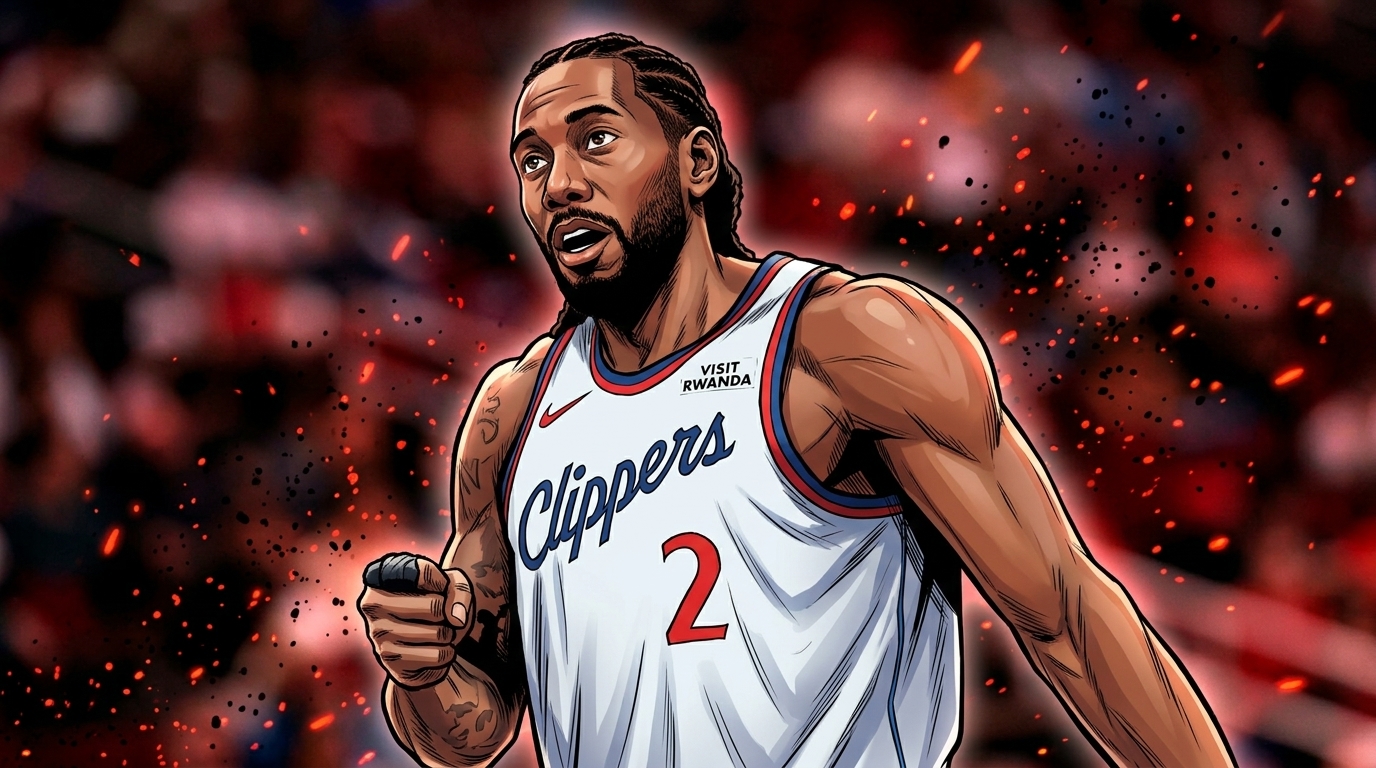
Kawhi Leonard is a two-time NBA champion, two-time NBA Finals MVP and two-time Defensive Player of the Year, a wing whose value was measured as much in what he stopped as in what he scored. Across 14 seasons with the San Antonio Spurs, Toronto Raptors and Los Angeles Clippers he played 798 regular-season games and averaged 20.7 points, 6.4 rebounds and 3.1 assists, built one of the most efficient two-way résumés of his generation, and — across 2025 and 2026 — sat at the center of the largest cap-circumvention penalty in league history. This entry covers the basketball and the case around it.
| Vitals | |
|---|---|
| Born | June 29, 1991, Los Angeles, California |
| Position | Small forward |
| Teams | San Antonio Spurs (2011–2018), Toronto Raptors (2018–2019), Los Angeles Clippers (2019–2026), Toronto Raptors (2026– ) |
| Draft | 2011, 1st round, 15th overall by the Indiana Pacers; traded to San Antonio |
| Contract | Two-year, $115M extension agreed with Toronto on Sept. 22, 2026 |
| Number | 2 |
San Diego State
Before the league. Leonard played two seasons at San Diego State (2009–2011) before declaring for the draft. He was selected 15th overall in the 2011 NBA Draft by the Indiana Pacers and traded on draft night to the San Antonio Spurs, along with Erazem Lorbek and Dāvis Bertāns, in exchange for guard George Hill — a swap that reshaped a franchise.
San Antonio: the two-way prototype
The apprenticeship. Leonard arrived on a veteran Spurs team and grew from a defensive role player into a franchise cornerstone. His scoring climbed steadily, from 7.9 points as a rookie to 25.5 by the 2016-17 season, while his defense earned early acclaim.
The breakthrough. In the 2014 NBA Finals, Leonard helped San Antonio dismantle the Miami Heat and was named 2014 NBA Finals MVP at age 22. He followed with back-to-back Defensive Player of the Year awards in 2015 and 2016 and made All-NBA First Team.
The rupture. His San Antonio tenure ended amid a dispute over the handling of a quadriceps injury (detailed below). He was traded to Toronto in the summer of 2018.
Toronto: the one-year masterpiece
The arrival. Leonard played a single season for the Raptors, 2018-19, averaging 26.6 points across 60 games while the team managed his workload.
The title. He then produced one of the great individual postseasons in league history, scoring the most points in any single Raptors playoff run — 732 across 24 games in 2018-19 — and delivering Toronto its first championship. Leonard was named 2019 NBA Finals MVP, becoming one of a small group to win the award with two different franchises. He left in free agency that summer.
Los Angeles: the Clippers years
The homecoming. A Southern California native, Leonard signed with the Clippers in 2019 and spent seven seasons there. When healthy, he remained an elite scorer, posting 27.9 points per game across 65 games in the 2025-26 season.
The ceiling. Despite deep, talented rosters, the Clippers never reached a Finals during his tenure, and Leonard’s availability became the recurring subtext of the era. His time in Los Angeles would ultimately be defined off the court as much as on it.
The injuries
By season, the record. Leonard’s durability is a documented thread through his career. He played just nine games in the 2017-18 season for San Antonio while managing a right quadriceps issue, a standoff over his rehabilitation that preceded his trade to Toronto. With the Clippers he was managed carefully, playing 57 and 52 games in 2019-20 and 2020-21.
The ACL. In the 2021 playoffs, Leonard suffered a partially torn ACL in his right knee and underwent surgery, per the Clippers’ announcement, which cost him the entire 2021-22 season. Knee issues limited him again in the 2024 postseason, and he opened the 2024-25 season on the sideline, playing 37 games that year before a healthier 2025-26.
The Aspiration investigation
The report. On September 3, 2025, journalist Pablo Torre reported that Leonard had signed a four-year endorsement contract in 2021 — reported at roughly $28 million — with Aspiration, a since-bankrupt environmental financial-services firm, and characterized it as a “no-show” arrangement requiring little promotional work. Clippers owner Steve Ballmer had personally invested about $50 million in Aspiration.
The inquiry. The NBA retained the law firm Wachtell, Lipton, Rosen & Katz to examine whether the endorsement money functioned as disguised salary that circumvented the cap. According to reporting, investigators found no evidence that Ballmer had directly funneled money to Leonard through team sponsors; the case turned instead on whether the team had improperly arranged the income.
The penalties. On September 2, 2026, the NBA announced its findings: the Clippers had circumvented the cap by “affirmatively initiating” off-court income for Leonard with four companies doing business with the team — Aspiration, Boingo Wireless, Daktronics and Lockton. The league fined the franchise $30 million, stripped five future first-round picks, suspended Ballmer for one year, suspended business-operations president Gillian Zucker for one year and basketball-operations president Lawrence Frank for six months, and barred Leonard’s longtime business manager Dennis Robertson from dealings with NBA teams for five years. Leonard himself was fined $700,000 and was not suspended. The Clippers said they would challenge the ruling.
The return to Toronto
North again. With the investigation still open, a Leonard trade that had been agreed in principle earlier in 2026 was not completed until September 14, 2026, when Toronto reacquired him for a package built around Brandon Ingram, Gradey Dick and multiple first-round picks. Leonard, who had delivered Toronto its only title seven years earlier, then agreed to a two-year extension reported at $115 million on September 22, 2026. As of September 22, 2026, he was under that contract entering the 2026-27 season with the Raptors.
By the numbers
Regular-season averages by season, per StatMuse and the NBA.
| Season | Team | GP | PPG | RPG | APG | FG% |
|---|---|---|---|---|---|---|
| 2011-12 | SAS | 64 | 7.9 | 5.1 | 1.1 | .493 |
| 2012-13 | SAS | 58 | 11.9 | 6.0 | 1.6 | .494 |
| 2013-14 | SAS | 66 | 12.8 | 6.2 | 2.0 | .522 |
| 2014-15 | SAS | 64 | 16.5 | 7.2 | 2.5 | .479 |
| 2015-16 | SAS | 72 | 21.2 | 6.8 | 2.6 | .506 |
| 2016-17 | SAS | 74 | 25.5 | 5.8 | 3.5 | .485 |
| 2017-18 | SAS | 9 | 16.2 | 4.7 | 2.3 | .468 |
| 2018-19 | TOR | 60 | 26.6 | 7.3 | 3.3 | .496 |
| 2019-20 | LAC | 57 | 27.1 | 7.1 | 4.9 | .470 |
| 2020-21 | LAC | 52 | 24.8 | 6.5 | 5.2 | .512 |
| 2021-22 | LAC | — | Did not play (ACL) | |||
| 2022-23 | LAC | 52 | 23.8 | 6.5 | 3.9 | .512 |
| 2023-24 | LAC | 68 | 23.7 | 6.1 | 3.6 | .525 |
| 2024-25 | LAC | 37 | 21.5 | 5.9 | 3.1 | .498 |
| 2025-26 | LAC | 65 | 27.9 | 6.4 | 3.6 | .505 |
Career totals
Per StatMuse, through the 2025-26 season.
Ranks
- 1st Points in a single postseason, Raptors franchise history (732, 2019)
- 2nd Steals per game, active players (1.7)
- 8th Playoff points per game, active players (21.5, min. 100 games)
Per StatMuse leaderboards: Raptors postseason scoring, active steals, active playoff scoring.
Honors
- 2× NBA champion (2014, 2019)
- 2× NBA Finals MVP (2014, 2019)
- 2× Defensive Player of the Year (2015, 2016)
- 7× NBA All-Star
- 7× All-NBA (3× First Team)
- 7× All-Defensive Team
- 2020 All-Star Game MVP
- 2015 NBA steals leader
- NBA 75th Anniversary Team
- 2012 NBA All-Rookie First Team
The arguments
Dominance versus availability. Leonard’s peaks — two titles, two Finals MVPs on opposite ends of the continent, two Defensive Player of the Year awards — place him, in the view of many analysts, among the finest two-way forwards the league has produced. The counterargument is durability: he cleared 60 games in only two of his seven Clippers seasons — 68 in 2023-24 and 65 in 2025-26 — and critics frame the missed time and load management as a ceiling on what the résumé might have been. Supporters counter that the play-when-healthy standard he set was rarely matched.
Culpability in the cap case. The NBA’s findings assigned the initiative to the franchise, concluding the Clippers “affirmatively initiated” the arrangements; the league fined Leonard $700,000 but did not suspend him, and the heaviest penalties fell on Ballmer and team executives. One reading holds that the structure implicates the player who collected the money; another, reflected in the league’s own framing, treats the team as the driving party. The Clippers, for their part, disputed the ruling publicly and said they would contest it.
The two-franchise legacy. Winning Finals MVP with two teams is a distinction shared with only a handful of players, and admirers cite it as evidence of portable, system-proof greatness. Skeptics note the short tenures — one season in Toronto, a Clippers run without a Finals — and argue his legacy is a collection of brilliant chapters rather than a sustained era anchored to one franchise.
Why it matters
Kawhi Leonard is a study in two truths held at once: a defender-turned-superstar who authored a near-perfect championship run and delivered a Finals MVP on two coasts, and the figure at the middle of a scandal that produced the NBA’s steepest cap-circumvention penalty. However the arguments settle, the ledger is unusual — a résumé sparse in games but dense in the moments that decide titles, and a chapter in league governance that will be cited long after the box scores are filed.