San Antonio Spurs
The San Antonio Spurs are a five-time NBA champion, from George Gervin and David Robinson through Tim Duncan's dynasty to the Wembanyama era.
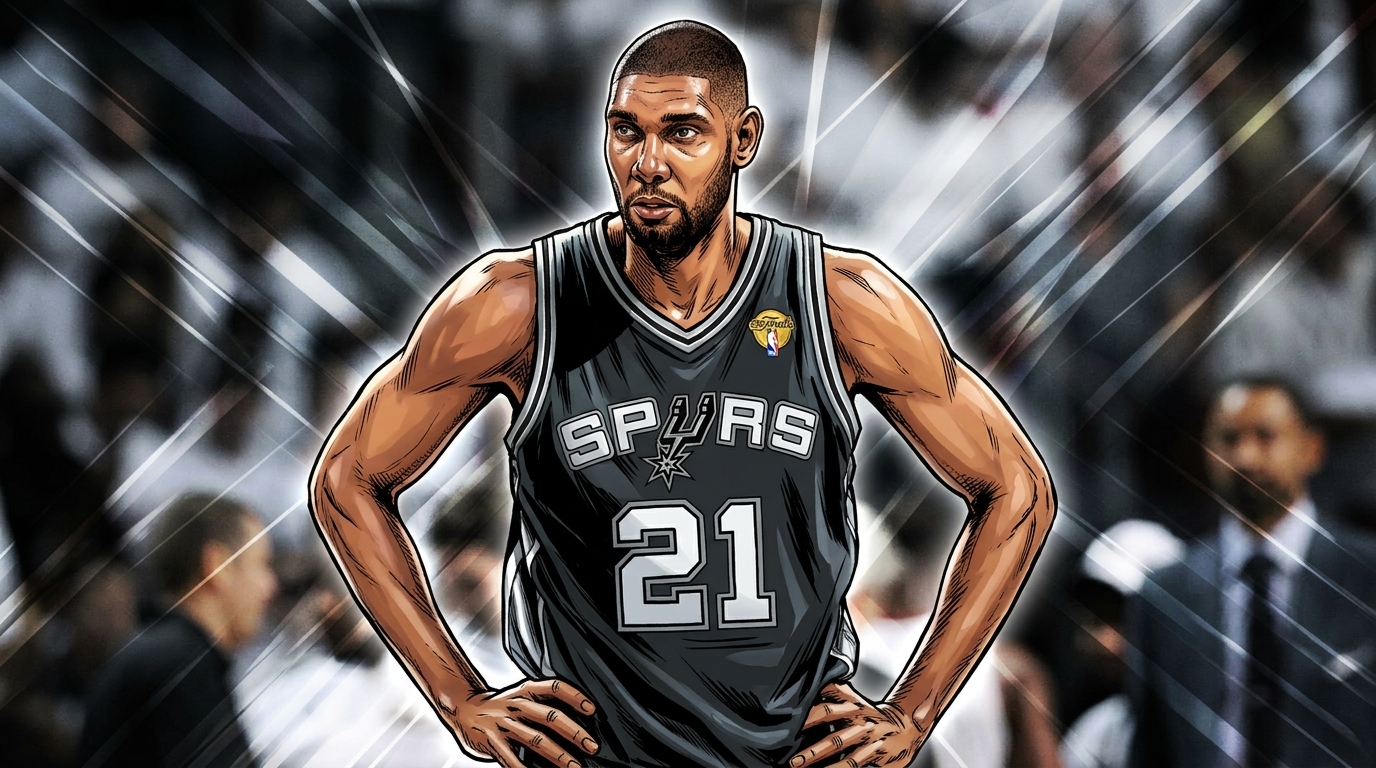
The San Antonio Spurs are one of the most successful and admired franchises in professional basketball, a small-market club that turned patience, defense and unselfish basketball into five NBA championships. Born in the American Basketball Association and folded into the NBA in the 1976 merger, the Spurs became the league’s model of continuity: 22 straight playoff appearances, three defining big men in George Gervin, David Robinson and Tim Duncan, and the longest-tenured coach in NBA history in Gregg Popovich. In the 2020s the franchise reset around Victor Wembanyama and, in 2026, returned to the NBA Finals for the first time in more than a decade.
| Vitals | |
|---|---|
| Founded | 1967 (as the Dallas Chaparrals, ABA); joined the NBA in 1976 |
| League / conference / division | NBA — Western Conference, Southwest Division |
| Arena | Frost Bank Center, San Antonio, Texas (opened 2002; renamed 2023) |
| Owner | Peter J. Holt / Spurs Sports & Entertainment |
| Head coach | Mitch Johnson (as of Sep. 23, 2026) |
| Titles | 5 (1999, 2003, 2005, 2007, 2014) |
Origins: the Chaparrals and the ABA (1967–1976)
The franchise began roughly 270 miles from San Antonio. It entered the world in 1967 as the Dallas Chaparrals, a charter member of the ABA, and went 46-32 in its first season. The Chaparrals never drew well in Dallas, and after six seasons a San Antonio investor group led by Angelo Drossos and Red McCombs — with financing arranged by banker Tom C. Frost — moved the team to South Texas in 1973 and renamed it the Spurs.
San Antonio embraced the team immediately. The Spurs acquired guard George Gervin from the Virginia Squires in 1974 and, behind Gervin and the shot-making of James Silas, posted a 51-33 mark in 1974-75. When the ABA folded in 1976, the Spurs were one of four surviving teams absorbed into the NBA, carrying a 378-366 ABA regular-season record into their new league.
The Iceman: George Gervin and the early NBA years (1976–1985)
George Gervin made the Spurs must-watch television. Nicknamed “The Iceman” for his cool and famous for a finger-roll that has never been duplicated, Gervin won four NBA scoring titles — 1978, 1979, 1980 and 1982 — and on April 9, 1978 scored 63 points on the season’s final day to edge David Thompson for the crown by the narrowest margin in league history. He remains one of only five players to win at least four scoring titles.
The Gervin Spurs were a nightly track meet. Coached by Doug Moe and later Stan Albeck, San Antonio led the league in scoring more than once and won a string of division titles. Their best shot at a Finals came in 1978-79, when they took a 3-1 lead on the Washington Bullets in the Eastern Conference finals before losing in seven — a series San Antonio has never forgotten. The 1981-82 and 1982-83 teams reached the conference finals again but ran into the Los Angeles Lakers’ Showtime dynasty both times. Gervin’s No. 44 was retired on Dec. 5, 1987.
The Admiral: David Robinson revives San Antonio (1987–1997)
A lottery bottomed out at 21-61. By the late 1980s the Spurs had collapsed, and the 21-61 low of 1988-89 came only because the franchise was waiting: with the No. 1 pick in 1987 it had drafted Navy center David Robinson, who first fulfilled a two-year military commitment before debuting in 1989-90.
Robinson’s arrival produced a 35-win turnaround. The Spurs jumped from 21-61 to 56-26 in his rookie year, then the largest single-season improvement in NBA history, and “The Admiral” was named Rookie of the Year. He went on to win Defensive Player of the Year in 1992, a scoring title in 1994 — punctuated by a 71-point game on April 24, 1994 — and the 1995 MVP award. Playoff success proved elusive; the 62-win 1994-95 team lost the conference finals to Hakeem Olajuwon’s Rockets. When Robinson missed most of 1996-97 with injuries, the Spurs fell to 20-62 and back into the lottery — the most consequential losing season in franchise history.
The Twin Towers and the first championships (1997–2003)
That lottery delivered Tim Duncan. San Antonio won the No. 1 pick in 1997 and selected the Wake Forest forward, pairing him with Robinson to form the “Twin Towers.” Gregg Popovich, who had moved from the front office to the bench in December 1996, now had his cornerstone. In the lockout-shortened 1998-99 season the Spurs went 37-13 and beat the New York Knicks 4-1 in the Finals, becoming the first former ABA team to win an NBA title. Duncan was named Finals MVP.
A quiet reload kept the window open. San Antonio drafted Tony Parker in 2001 and brought over Manu Ginóbili, a 1999 second-round pick, in 2002. The 60-22 2002-03 team sent Robinson into retirement a champion, beating the New Jersey Nets 4-2 as Duncan — who nearly recorded a quadruple-double in the close-out game — won his second Finals MVP.
The Big Three dynasty: Parker, Ginóbili and four more Finals (2003–2014)
Duncan, Parker and Ginóbili became the winningest trio in NBA history. Anchored by Duncan and the perimeter defense of Bruce Bowen, the Spurs took the 2005 title in a seven-game classic over the Detroit Pistons, Duncan collecting his third Finals MVP. Two years later they swept a young LeBron James and the Cleveland Cavaliers 4-0 in the 2007 Finals, with Parker named Finals MVP. Across this stretch San Antonio strung together 18 consecutive 50-win seasons and 22 straight playoff berths.
The 2013 Finals were an inch from a sixth banner. Leading the Miami Heat by five with 28 seconds left in Game 6, the Spurs watched Ray Allen bury a corner three to force overtime, then lost Game 7. San Antonio answered a year later with one of the great redemption stories: the 62-20 2013-14 team dismantled the Heat 4-1 with a ball-movement masterpiece, and 22-year-old Kawhi Leonard was named Finals MVP — the franchise’s fifth and, through 2026, most recent championship.
The Kawhi Leonard era and the end of an age (2014–2018)
The torch passed from Duncan to Leonard. Duncan retired after the 2015-16 season, which the Spurs finished a franchise-record 67-15. Leonard, twice Defensive Player of the Year in 2015 and 2016 and an MVP candidate, had become the team’s best player, with LaMarcus Aldridge signing in 2015 to play alongside him.
A single ankle changed everything. In the 2017 Western Conference finals, Leonard sprained his ankle landing on Golden State’s Zaza Pachulia with the Spurs leading, and the series slipped away. A quadriceps injury and a rift over its handling defined 2017-18, and in July 2018 San Antonio traded Leonard to Toronto for DeMar DeRozan. Ginóbili retired that summer and Parker signed elsewhere, closing the dynasty.
Rebuild: the down years (2018–2023)
The famous streaks finally ended. DeRozan and Aldridge stretched the playoff run to a record-tying 22 seasons before it snapped in 2019-20. What followed were four straight trips to the lottery, bottoming out at 22-60 in 2022-23 — by design, as the franchise positioned itself for a generational prize in the 2023 draft.
The Wembanyama era begins (2023–2025)
Victor Wembanyama was the most anticipated prospect in a generation. San Antonio won the 2023 lottery and selected the 7-foot-4 Frenchman first overall. He was named Rookie of the Year for 2023-24 while leading the league in blocks, a rim-protecting, three-point-shooting unicorn who reset expectations for the position.
His second season was cut short by a health scare. Wembanyama made the 2024-25 All-Star team and was a Defensive Player of the Year favorite before the Spurs shut him down in February 2025 with deep vein thrombosis — a blood clot in his right shoulder. Popovich, who had suffered a stroke in November 2024, missed the season as Mitch Johnson ran the bench. On May 2, 2025, Popovich stepped down after 29 seasons to become team president, and Johnson was named the 19th head coach in franchise history. Around Wembanyama the front office assembled a young core: a February 2025 trade for guard De’Aaron Fox, 2024-25 Rookie of the Year Stephon Castle, and No. 2 overall pick Dylan Harper in 2025.
The 2025-26 season and the run to the Finals
Wembanyama’s return made the Spurs contenders again. Fully recovered, he was named the unanimous Defensive Player of the Year, and San Antonio went 62-20 to earn the No. 2 seed in the Western Conference — its best season since 2015-16 and a 28-win jump from the year before.
The playoff run was Wembanyama’s coming-out party. The Spurs eliminated the Portland Trail Blazers 4-1 in the first round and the Minnesota Timberwolves 4-2 in the semifinals, then survived a seven-game Western Conference finals against the defending-champion Oklahoma City Thunder, closing it out 111-103 on May 30, 2026. Wembanyama was named the Western Conference finals MVP in his first postseason.
The Finals ended in heartbreak. Facing the New York Knicks, the Spurs lost the series 4-1 in one of the most competitive championship rounds on record — the Knicks rallied from double-digit deficits in all four of their wins, and every game was within five points in the final five minutes. New York took Game 1 105-95 on June 3 and closed the series with a 94-90 Game 5 win on June 13, when Jalen Brunson scored 45 points and was named Finals MVP. It was the Spurs’ first Finals appearance since 2014 and a foundation the Wembanyama era was built to return to.
Retired numbers
San Antonio has retired ten player numbers, honoring stars from every era — the ABA-into-NBA guards Johnny Moore and James Silas, “The Iceman” George Gervin, and the four pillars of the championship years in David Robinson, Tim Duncan, Tony Parker and Manu Ginóbili, plus role-players Sean Elliott, Bruce Bowen and Avery Johnson. On Oct. 26, 2025 the club raised a banner reading “Pop 1,390,” marking Popovich’s 1,390 career wins. The No. 6 also hangs for Bill Russell, retired league-wide by the NBA in 2022.
| No. | Player | Pos. | Team tenure | Retired |
|---|---|---|---|---|
| 00 | Johnny Moore | G | 1980–1987, 1989–1990 | Mar. 20, 1998 |
| 6 | Avery Johnson | G | 1991–1993, 1994–2001 | Dec. 22, 2007 |
| 6 | Bill Russell (league-wide) | C | — | Aug. 11, 2022 |
| 9 | Tony Parker | G | 2001–2018 | Nov. 11, 2019 |
| 12 | Bruce Bowen | F | 2001–2009 | Mar. 21, 2012 |
| 13 | James Silas | G | 1972–1981 | Feb. 28, 1984 |
| 20 | Manu Ginóbili | G | 2002–2018 | Mar. 28, 2019 |
| 21 | Tim Duncan | F/C | 1997–2016 | Dec. 18, 2016 |
| 32 | Sean Elliott | F | 1989–1993, 1994–2001 | Mar. 6, 2005 |
| 44 | George Gervin | G | 1974–1985 | Dec. 5, 1987 |
| 50 | David Robinson | C | 1989–2003 | Nov. 10, 2003 |
| 1,390 | Gregg Popovich (coach & president) | — | 1996–2025 | Oct. 26, 2025 |
Season by season
Every season the franchise has played, ABA and NBA, folded by decade with the newest first.
The 2020s 207–275 · 1 playoff berth · 1 Finals
| Season | W–L | Result |
|---|---|---|
| 2025-26 | 62-20 | Lost NBA Finals (1-4 vs New York) |
| 2024-25 | 34-48 | Missed playoffs |
| 2023-24 | 22-60 | Missed playoffs |
| 2022-23 | 22-60 | Missed playoffs |
| 2021-22 | 34-48 | Missed playoffs |
| 2020-21 | 33-39 | Missed playoffs |
The 2010s 541–252 · 9 playoff berths · 2 Finals · 1 title
| Season | W–L | Result |
|---|---|---|
| 2019-20 | 32-39 | Missed playoffs |
| 2018-19 | 48-34 | Lost First Round |
| 2017-18 | 47-35 | Lost First Round |
| 2016-17 | 61-21 | Lost Conf. Finals |
| 2015-16 | 67-15 | Lost Conf. Semifinals |
| 2014-15 | 55-27 | Lost First Round |
| 2013-14 | 62-20 | Won NBA Championship |
| 2012-13 | 58-24 | Lost NBA Finals |
| 2011-12 | 50-16 | Lost Conf. Finals |
| 2010-11 | 61-21 | Lost First Round |
The 2000s 573–247 · 10 playoff berths · 3 titles
| Season | W–L | Result |
|---|---|---|
| 2009-10 | 50-32 | Lost Conf. Semifinals |
| 2008-09 | 54-28 | Lost First Round |
| 2007-08 | 56-26 | Lost Conf. Finals |
| 2006-07 | 58-24 | Won NBA Championship |
| 2005-06 | 63-19 | Lost Conf. Semifinals |
| 2004-05 | 59-23 | Won NBA Championship |
| 2003-04 | 57-25 | Lost Conf. Semifinals |
| 2002-03 | 60-22 | Won NBA Championship |
| 2001-02 | 58-24 | Lost Conf. Semifinals |
| 2000-01 | 58-24 | Lost Conf. Finals |
The 1990s 493–295 · 9 playoff berths · 1 title
| Season | W–L | Result |
|---|---|---|
| 1999-00 | 53-29 | Lost First Round |
| 1998-99 | 37-13 | Won NBA Championship |
| 1997-98 | 56-26 | Lost Conf. Semifinals |
| 1996-97 | 20-62 | Missed playoffs |
| 1995-96 | 59-23 | Lost Conf. Semifinals |
| 1994-95 | 62-20 | Lost Conf. Finals |
| 1993-94 | 55-27 | Lost First Round |
| 1992-93 | 49-33 | Lost Conf. Semifinals |
| 1991-92 | 47-35 | Lost First Round |
| 1990-91 | 55-27 | Lost First Round |
The 1980s 402–418 · 7 playoff berths · 2 conference finals
| Season | W–L | Result |
|---|---|---|
| 1989-90 | 56-26 | Lost Conf. Semifinals |
| 1988-89 | 21-61 | Missed playoffs |
| 1987-88 | 31-51 | Lost First Round |
| 1986-87 | 28-54 | Missed playoffs |
| 1985-86 | 35-47 | Lost First Round |
| 1984-85 | 41-41 | Lost First Round |
| 1983-84 | 37-45 | Missed playoffs |
| 1982-83 | 53-29 | Lost Conf. Finals |
| 1981-82 | 48-34 | Lost Conf. Finals |
| 1980-81 | 52-30 | Lost Conf. Semifinals |
The 1970s 431–401 · 9 playoff berths · joined the NBA in 1976
| Season | W–L | Result |
|---|---|---|
| 1979-80 | 41-41 | Lost First Round |
| 1978-79 | 48-34 | Lost Conf. Finals |
| 1977-78 | 52-30 | Lost Conf. Semifinals |
| 1976-77 | 44-38 | Lost First Round (NBA debut) |
| 1975-76 | 50-34 | Lost ABA Semifinals |
| 1974-75 | 51-33 | Lost ABA Division Semifinals |
| 1973-74 | 45-39 | Lost ABA Division Semifinals |
| 1972-73 | 28-56 | Missed playoffs |
| 1971-72 | 42-42 | Lost ABA Division Semifinals |
| 1970-71 | 30-54 | Lost ABA Division Semifinals |
The 1960s 132–108 · 3 ABA playoff berths (as the Dallas Chaparrals)
| Season | W–L | Result |
|---|---|---|
| 1969-70 | 45-39 | Lost ABA Division Semifinals |
| 1968-69 | 41-37 | Lost ABA Division Semifinals |
| 1967-68 | 46-32 | Lost ABA Division Finals |
By the numbers
Franchise marks
Ranks
- 1st Consecutive 50-win seasons, NBA history (18)
- 1st Career coaching wins, Gregg Popovich (1,390)
- T-1st Consecutive playoff appearances (22)
- 5th NBA championships, franchise history (5)
Honors
- 5× NBA champion (1999, 2003, 2005, 2007, 2014)
- Tim Duncan — 3× Finals MVP (1999, 2003, 2005)
- 7× Western Conference champion
- 3× NBA MVP (Robinson 1995; Duncan 2002, 2003)
- 4× Defensive Player of the Year (Robinson, Leonard ×2, Wembanyama)
- 4× Rookie of the Year (Robinson, Duncan, Wembanyama, Castle)
- 3× Coach of the Year — Gregg Popovich
Per Basketball-Reference / franchise records and NBA.com, through Sep. 23, 2026.
The arguments
Where do the Spurs rank among the great dynasties? Supporters point out that Duncan, Parker, Ginóbili and Popovich won titles 15 years apart, across three distinct rule eras, without ever bottoming out between them — a case for the most sustained excellence the league has seen. Skeptics counter that the five championships came in five separate title windows rather than back-to-back runs, and that the Spurs never repeated, unlike the Bulls, Lakers or Celtics dynasties they are measured against.
Did the 2013 Finals cost them a sixth banner? One camp treats Ray Allen’s Game 6 three as a fluke that obscures how close the Spurs came to a dynasty capstone; another argues the 2014 title, won by a wider margin over the same Heat team, is the more representative result and settles the question in San Antonio’s favor.
How should the Kawhi Leonard ending be judged? The team’s defenders describe a franchise blindsided by a star’s discontent and a murky injury, and note they recouped an All-Star in DeMar DeRozan. Critics contend the famously player-friendly Spurs mishandled the situation and turned a two-way superstar — who won a title in Toronto in 2019 — into a departure that hastened the rebuild.
Why it matters
The San Antonio Spurs matter because they proved a small market could become the sport’s gold standard through drafting, development and culture rather than spectacle. For a quarter-century they were the league’s steadiest hand — five titles, an unbroken run of playoff basketball, and a coaching tree and style copied across the NBA and beyond. The Wembanyama era, and the 2026 Finals run that announced it, is the franchise’s bid to prove that standard can be rebuilt for a new generation.