Miami Heat
The Miami Heat, an NBA franchise founded in 1988, won three championships in 2006, 2012 and 2013 behind Dwyane Wade, LeBron James and Heat Culture.
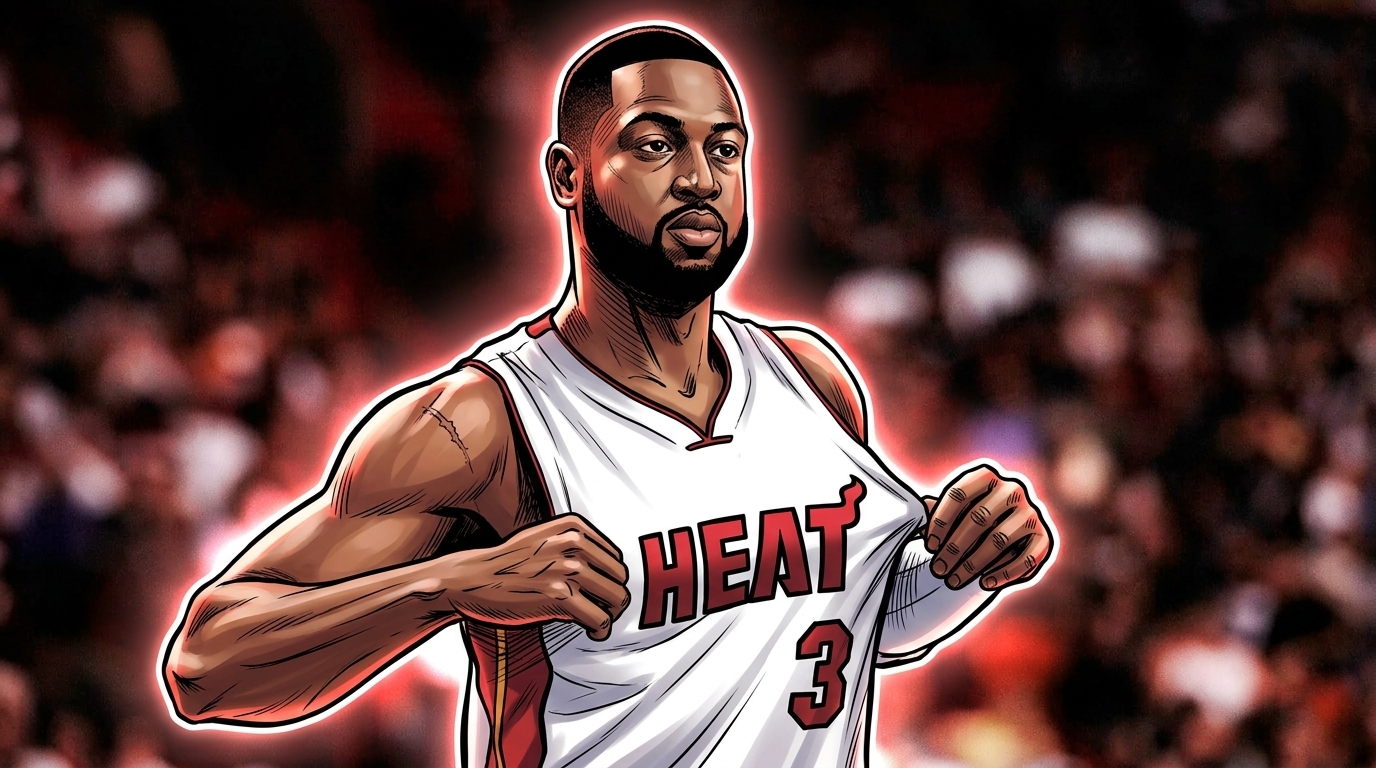
The Miami Heat are a National Basketball Association franchise that began as a 1988 expansion team and grew, in a single generation, into one of the sport’s most respected organizations. Three championship banners — 2006, 2012 and 2013 — hang inside the Kaseya Center, won across two distinct dynasties and a run of seven Eastern Conference titles. As much as the trophies, the Heat are known for a self-styled institutional identity: a demand for conditioning, accountability and undrafted overachievement that the franchise and its fans call “Heat Culture.” Built by Micky Arison’s ownership and defined by the front-office presence of Pat Riley since 1995, Miami has, per Basketball-Reference, posted a 1,601–1,448 all-time regular-season record and reached the playoffs 26 times.
| Vitals | |
|---|---|
| Founded | 1988 (expansion) |
| League / conference / division | NBA — Eastern Conference, Southeast Division |
| Arena | Kaseya Center, Miami, Florida |
| Owner | Micky Arison (Arison family) |
| Head coach (Sep. 26, 2026) | Erik Spoelstra |
| Titles | 3 — 2006, 2012, 2013 |
Origins: the expansion years (1988–1995)
The Heat were awarded to Miami in 1987 and began play in the 1988-89 season under first head coach Ron Rothstein. The expansion roster was thin and the growing pains were immediate: Miami lost its first 17 games on the way to a 15–67 record, tied for the worst mark in franchise history. The team’s first draft pick, center Rony Seikaly, taken ninth in 1988, became its early cornerstone.
The first genuine talent arrived in the 1989 draft. Miami selected Michigan sharpshooter Glen Rice fourth overall, and alongside guards Sherman Douglas and Steve Smith he formed the core of the early-1990s teams. The Heat, playing in the downtown Miami Arena, reached the postseason for the first time in 1991-92, a 38–44 season that ended with a first-round sweep by Michael Jordan’s Chicago Bulls.
Those years were about respectability rather than contention. Miami made the playoffs again in 1993-94 and 1995-96 but never advanced past the opening round, and the franchise finished no higher than fourth in its division. The arrival of a new decision-maker in 1995 changed everything.
The Riley era and the Knicks wars (1995–2003)
Pat Riley left the New York Knicks to become the Heat’s president and head coach in September 1995, and immediately remade the roster. He traded Glen Rice to the Charlotte Hornets that November for defensive anchor Alonzo Mourning, then acquired point guard Tim Hardaway from the Golden State Warriors in February 1996. The result was a grinding, physical contender. In 1996-97 the Heat won 61 games, captured the first division title in franchise history, and reached the Eastern Conference Finals before losing to the Bulls.
The defining feature of the era was a blood feud with Riley’s former team. Miami and the Knicks met in the playoffs in four straight seasons from 1997 through 2000. The 1997 conference semifinal turned notorious when a late-game altercation led to suspensions that swung the series; Miami won it in seven. New York returned the favor in 1998 and, as an eighth seed, again in 1999, when the top-seeded Heat were eliminated by Allan Houston’s series-winning runner. Miami and New York split the rivalry, with each series decided by the narrowest margins.
Mourning and Hardaway carried the Heat to four consecutive division crowns (1997–2000), but health intervened. Mourning was diagnosed with a serious kidney condition in 2000 that cost him most of two seasons and eventually required a transplant. Without him the roster declined; Miami slid to 25–57 in 2002-03, and Riley stepped down as head coach that spring, handing the bench to Stan Van Gundy while remaining team president. By then the Heat had a new home, having moved into the waterfront AmericanAirlines Arena in January 2000.
Wade, Shaq and the 2006 championship (2003–2010)
Everything turned on the 2003 draft, when Miami selected Marquette guard Dwyane Wade fifth overall. Wade was an immediate playoff performer, and Riley pushed his chips in during the summer of 2004, trading Lamar Odom, Caron Butler and Brian Grant to the Los Angeles Lakers for Shaquille O’Neal. The pairing of the game’s most dominant center and a rising young star made Miami a title favorite. In 2004-05 the Heat went 59–23 and reached the Eastern Conference Finals, falling to the Detroit Pistons in seven games with Wade hampered by a rib injury.
Riley returned to the bench in December 2005 after Van Gundy resigned, and coached the Heat to their first title. Miami went 52–30 in 2005-06 and met the Dallas Mavericks in the NBA Finals, where they fell behind two games to none. Wade then delivered one of the great Finals performances in league history, averaging 34.7 points as Miami won four straight to take the series 4–2. He was named Finals MVP, and the franchise had its first championship.
The title team aged quickly. Injuries and roster attrition dropped Miami to a franchise-worst 15–67 in 2007-08, and O’Neal was traded to Phoenix that February. Riley stepped down as head coach afterward and elevated longtime assistant Erik Spoelstra to lead the team beginning in 2008. Wade carried the franchise nearly alone, winning the 2008-09 scoring title, while Riley cleared cap space for a summer that would reshape the NBA.
The Big Three (2010–2014)
On July 8, 2010, LeBron James announced on a televised special that he would “take my talents to South Beach,” and with Chris Bosh joining via sign-and-trade, Miami had assembled a Big Three around Wade. The team drew intense national scrutiny, and its first attempt ended in disappointment: after a 58–24 regular season, the Heat lost the 2011 Finals to the Dallas Mavericks in six games.
The next two seasons were the peak. In the lockout-shortened 2011-12 campaign Miami went 46–20 and beat the Oklahoma City Thunder 4–1 in the Finals, with James claiming his first title and Finals MVP award. The 2012-13 team was even better, going 66–16 and reeling off a 27-game winning streak — the second-longest in NBA history. That season ended with the franchise’s signature moment: trailing the San Antonio Spurs by three in the closing seconds of Game 6, Ray Allen drilled a corner three off a Bosh rebound to force overtime, and Miami won the game and then Game 7 to repeat as champions.
The run closed in 2014. Miami reached a fourth straight Finals but was overwhelmed by a San Antonio team out for revenge, losing 4–1. That July, James returned to Cleveland as a free agent, ending the era and sending the franchise into transition.
Heat Culture and the post-LeBron years (2014–2019)
With its stars gone, the organization leaned into the identity Riley had branded “Heat Culture.” The phrase describes an insistence on elite conditioning, professionalism and player development, and it became a recruiting pitch as much as a philosophy: Miami built a reputation for turning undrafted and overlooked players into rotation regulars. The transition was not smooth on the court. Bosh’s career was cut short by recurring blood clots in 2016, and Wade departed for his hometown Chicago Bulls that same summer before returning for a farewell season in 2018-19.
The franchise honored its icons even as it rebuilt. Chris Bosh’s No. 1 was raised on March 26, 2019, and Wade’s No. 3 followed on February 22, 2020. Miami missed the playoffs in 2018-19, but a foundation of developed talent — center Bam Adebayo and undrafted shooter Duncan Robinson among them — was taking shape for the next contender.
The Butler era (2019–2025)
Miami acquired Jimmy Butler in a sign-and-trade in July 2019, and the fit was immediate. Butler’s combative, defense-first game matched Heat Culture perfectly, and in the pandemic-disrupted 2019-20 season the fifth-seeded Heat made a stunning run through the Orlando “bubble,” beating Milwaukee and Boston to reach the Finals before losing to the Los Angeles Lakers in six games. Two years later, in 2021-22, Miami earned the East’s top seed and pushed Boston to seven games in the conference finals.
The most improbable run came in 2022-23. Miami had to survive the play-in tournament just to claim the eighth seed, then upset the top-seeded Milwaukee Bucks, downed New York, and beat Boston in a seven-game conference finals to reach the NBA Finals as only the second eighth seed ever to do so. The Denver Nuggets ended the run 4–1. During this stretch the arena took its present name, becoming the Kaseya Center in April 2023 under a 17-year, $117 million naming-rights agreement, after brief spells as FTX Arena and Miami-Dade Arena.
The Butler chapter ended in a public fracture. After first-round exits in 2023-24 and 2024-25 and a midseason standoff, Miami traded Butler to the Golden State Warriors on February 5, 2025, in a five-team deal that returned Andrew Wiggins, Kyle Anderson and a 2025 first-round pick. The trade closed the door on the era and reset the roster around Adebayo and guard Tyler Herro.
The 2025-26 season
The first full season of the post-Butler roster was a step back. Miami finished 43–39, tenth in the Eastern Conference, with Erik Spoelstra still on the bench and Bam Adebayo anchoring the team. The Heat reached the knockout stage of the NBA Cup as the conference wildcard before being eliminated by Orlando. In the play-in tournament, Miami lost its opening game to the Charlotte Hornets in overtime on April 14, 2026, missing the playoffs for the first time since 2019.
Retired numbers
The Heat have retired six numbers for players who defined the franchise’s championship eras, from the Riley-era anchors to the Big Three and its longest-serving captain. The organization has also honored Michael Jordan, raising his No. 23 on April 11, 2003, though Jordan never played for Miami; the NBA separately retired Bill Russell’s No. 6 across the entire league in 2022.
| No. | Player | Pos. | Team tenure | Retired |
|---|---|---|---|---|
| 1 | Chris Bosh | F/C | 2010–2017 | Mar. 26, 2019 |
| 3 | Dwyane Wade | G | 2003–2016, 2018–2019 | Feb. 22, 2020 |
| 10 | Tim Hardaway | G | 1996–2001 | Oct. 28, 2009 |
| 23 | Michael Jordan (honored) | G | — | Apr. 11, 2003 |
| 32 | Shaquille O’Neal | C | 2004–2008 | Dec. 22, 2016 |
| 33 | Alonzo Mourning | C | 1995–2003, 2005–2008 | Mar. 30, 2009 |
| 40 | Udonis Haslem | F | 2003–2023 | Jan. 19, 2024 |
Season by season
The complete regular-season record, folded by decade with the newest first.
The 2020s 263–219 · 5 playoff berths · 1 Finals
| Season | W–L | Finish | Playoffs |
|---|---|---|---|
| 2025-26 | 43-39 | 4th (Southeast) | Did not qualify |
| 2024-25 | 37-45 | 3rd (Southeast) | Lost E. Conf. 1st Rnd. |
| 2023-24 | 46-36 | 2nd (Southeast) | Lost E. Conf. 1st Rnd. |
| 2022-23 | 44-38 | 1st (Southeast) | Lost NBA Finals (DEN 1-4) |
| 2021-22 | 53-29 | 1st (Southeast) | Lost E. Conf. Finals |
| 2020-21 | 40-32 | 2nd (Southeast) | Lost E. Conf. 1st Rnd. |
The 2010s 477–318 · 7 playoff berths · 5 Finals · 2 titles
| Season | W–L | Finish | Playoffs |
|---|---|---|---|
| 2019-20 | 44-29 | 1st (Southeast) | Lost NBA Finals (LAL 2-4) |
| 2018-19 | 39-43 | 3rd (Southeast) | Did not qualify |
| 2017-18 | 44-38 | 1st (Southeast) | Lost E. Conf. 1st Rnd. |
| 2016-17 | 41-41 | 3rd (Southeast) | Did not qualify |
| 2015-16 | 48-34 | 1st (Southeast) | Lost E. Conf. Semis |
| 2014-15 | 37-45 | 3rd (Southeast) | Did not qualify |
| 2013-14 | 54-28 | 1st (Southeast) | Lost NBA Finals (SAS 1-4) |
| 2012-13 | 66-16 | 1st (Southeast) | Won NBA Finals (SAS 4-3) |
| 2011-12 | 46-20 | 1st (Southeast) | Won NBA Finals (OKC 4-1) |
| 2010-11 | 58-24 | 1st (Southeast) | Lost NBA Finals (DAL 2-4) |
The 2000s 413–407 · 7 playoff berths · 1 Finals · 1 title
| Season | W–L | Finish | Playoffs |
|---|---|---|---|
| 2009-10 | 47-35 | 3rd (Southeast) | Lost E. Conf. 1st Rnd. |
| 2008-09 | 43-39 | 3rd (Southeast) | Lost E. Conf. 1st Rnd. |
| 2007-08 | 15-67 | 5th (Southeast) | Did not qualify |
| 2006-07 | 44-38 | 1st (Southeast) | Lost E. Conf. 1st Rnd. |
| 2005-06 | 52-30 | 1st (Southeast) | Won NBA Finals (DAL 4-2) |
| 2004-05 | 59-23 | 1st (Southeast) | Lost E. Conf. Finals |
| 2003-04 | 42-40 | 2nd (Atlantic) | Lost E. Conf. Semis |
| 2002-03 | 25-57 | 7th (Atlantic) | Did not qualify |
| 2001-02 | 36-46 | 6th (Atlantic) | Did not qualify |
| 2000-01 | 50-32 | 2nd (Atlantic) | Lost E. Conf. 1st Rnd. |
The 1990s 415–373 · 7 playoff berths · 4 division titles
| Season | W–L | Finish | Playoffs |
|---|---|---|---|
| 1999-00 | 52-30 | 1st (Atlantic) | Lost E. Conf. Semis |
| 1998-99 | 33-17 | 1st (Atlantic) | Lost E. Conf. 1st Rnd. |
| 1997-98 | 55-27 | 1st (Atlantic) | Lost E. Conf. 1st Rnd. |
| 1996-97 | 61-21 | 1st (Atlantic) | Lost E. Conf. Finals |
| 1995-96 | 42-40 | 3rd (Atlantic) | Lost E. Conf. 1st Rnd. |
| 1994-95 | 32-50 | 4th (Atlantic) | Did not qualify |
| 1993-94 | 42-40 | 4th (Atlantic) | Lost E. Conf. 1st Rnd. |
| 1992-93 | 36-46 | 5th (Atlantic) | Did not qualify |
| 1991-92 | 38-44 | 4th (Atlantic) | Lost E. Conf. 1st Rnd. |
| 1990-91 | 24-58 | 6th (Atlantic) | Did not qualify |
The 1980s 33–131 · 0 playoff berths
| Season | W–L | Finish | Playoffs |
|---|---|---|---|
| 1989-90 | 18-64 | 5th (Midwest) | Did not qualify |
| 1988-89 | 15-67 | 6th (Midwest) | Did not qualify |
By the numbers
Franchise marks
Ranks
- 1st Points, franchise history (Dwyane Wade)
- 2nd Longest win streak in NBA history (27 games, 2012-13)
- 9th Most valuable NBA franchise (~$5.7B, 2025)
Honors
- 3× NBA champion (2006, 2012, 2013)
- 7× Eastern Conference champion (2006, 2011, 2012, 2013, 2014, 2020, 2023)
- 2006 Finals MVP — Dwyane Wade
- 2× Finals MVP — LeBron James (2012, 2013)
- 16× division champion
- 27-game win streak (2012-13)
Per Basketball-Reference, Olympics.com and CNBC, through Sep. 26, 2026.
The arguments
Were the Big Three a triumph or a shortcut? Critics argued that assembling James, Wade and Bosh through free agency in 2010 diminished the achievement, and the raucous, confetti-heavy welcome rally hardened that view; supporters counter that the group still had to win it on the floor, reaching four straight Finals and delivering the two hardest-earned titles in franchise history. The debate over “superteams” that James’s decision helped launch has never fully settled.
Which title matters most? One camp holds up 2006, the Wade-and-Shaq championship that ended nearly two decades of waiting and was carried by one of the great individual Finals runs. Another points to 2013, the 66-win juggernaut saved by Ray Allen’s corner three, as the peak of the franchise. Each side can marshal a banner.
Does “Heat Culture” describe a real advantage or a marketing slogan? Admirers cite the pipeline of undrafted contributors and the organization’s reputation for accountability; skeptics note that culture did not prevent the sub-.500 seasons of the mid-2010s or the eventual Butler falling-out, and argue the phrase does more work in branding than in the standings. The 2022-23 run to the Finals as an eighth seed is the case most often cited by both sides.
Why it matters
The Miami Heat compressed the arc most franchises take half a century to complete into a few decades: from a 15-win expansion team to a three-time champion and one of the NBA’s most valuable and closely watched organizations. Their history is inseparable from the era of player empowerment that James’s 2010 move helped define, and their self-branded culture became a template other teams tried to copy. For a fan, the throughline is continuity — Arison’s ownership, Riley’s presence and Spoelstra’s bench have anchored the whole story — and a standard, set across two dynasties, that every Miami season is now measured against.