Los Angeles Rams
From their 1936 Cleveland founding to Super Bowl LVI at SoFi Stadium, the Los Angeles Rams have won NFL titles in three different cities across eight decades.
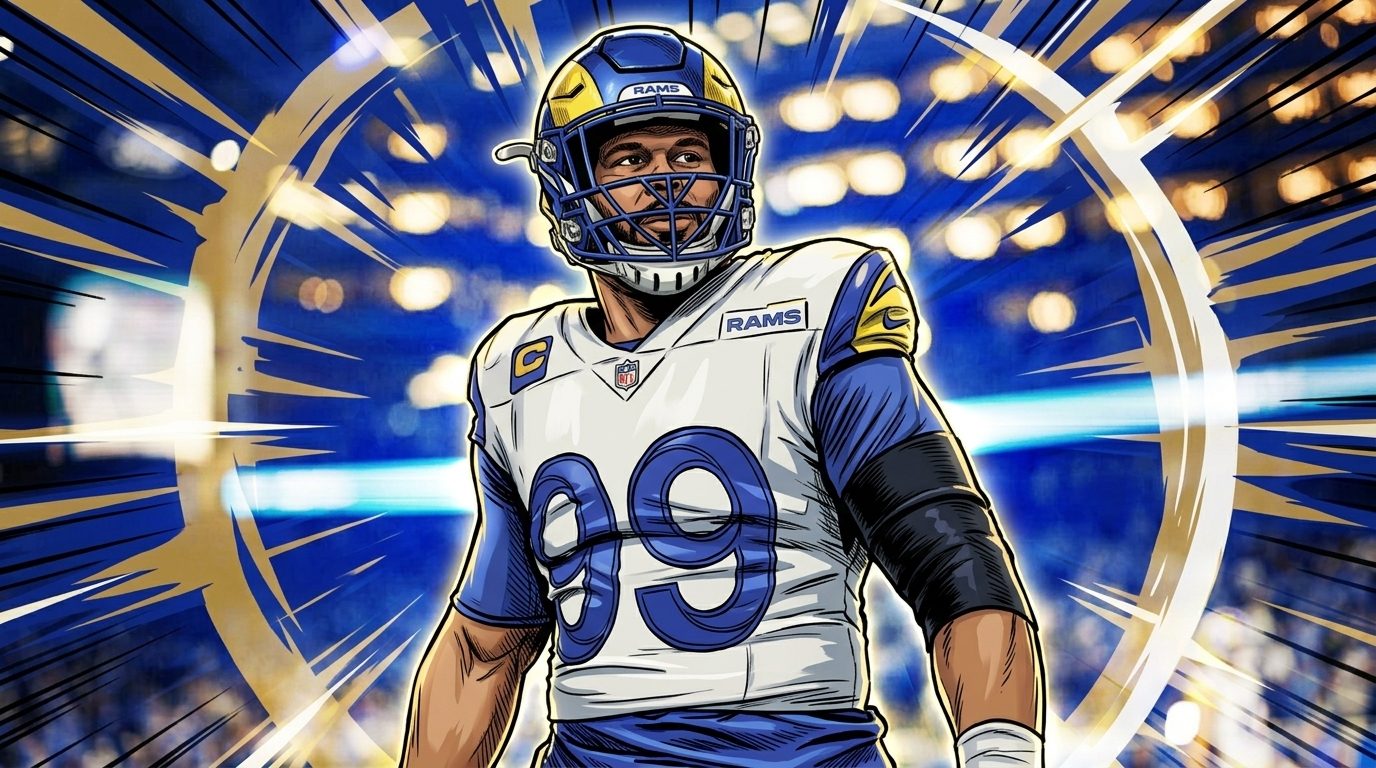
The Los Angeles Rams are one of professional football’s great wandering institutions: a franchise that has won championships in Cleveland, Los Angeles and St. Louis, that put the first modern Black player back on an NFL field, that built the most explosive offense of the turn of the century and then the youngest coaching staff of the modern era. Founded in 1936 and a member of the NFC West, the Rams have claimed four league titles across eight decades while carrying an all-time regular-season record of 638–615–21 (.509) as of Oct. 19, 2026. No franchise’s history is so thoroughly a map of the league’s own geography.
| Vitals | |
|---|---|
| Founded | 1936 (as the Cleveland Rams) |
| League / conference / division | NFL — NFC West |
| Stadium | SoFi Stadium (Inglewood, Calif.) |
| Owner | Stan Kroenke |
| Head coach | Sean McVay (as of Oct. 19, 2026) |
| Titles | 4 — NFL 1945, 1951; Super Bowl XXXIV (1999 season), Super Bowl LVI (2021 season) |
Cleveland origins (1936–1945)
The Rams were born in Cleveland. Attorney Homer Marshman founded the club in 1936, first in the short-lived second American Football League, then as an NFL expansion member from 1937. The nickname was borrowed from the Fordham Rams, a college power Marshman admired.
The early Cleveland years were lean, including a 1–10 debut NFL season in 1937, but the decade ended in glory. Behind rookie tailback Bob Waterfield, the 1945 Rams went 9–1 and won the NFL Championship Game on Dec. 16, 1945, beating Washington 15–14 at a frozen Cleveland Municipal Stadium. The margin came from a first-quarter safety when a Sammy Baugh pass struck the goalpost in the end zone — a quirk of the rules that handed the city its only NFL title.
Westward to Los Angeles (1946–1949)
Owner Dan Reeves did not wait to celebrate. Less than a month after the championship, on Jan. 11, 1946, he announced the Rams would move to Los Angeles, making them the first major-league sports franchise on the Pacific Coast and tenants of the cavernous Los Angeles Memorial Coliseum.
The move carried historic weight beyond geography. To use the publicly financed Coliseum, the Rams signed Kenny Washington in March 1946, the first Black player in the modern NFL after a de facto color line had stood since 1933; Woody Strode followed. On the field the rebuild was quick: the 1949 Rams reached the NFL title game before falling 14–0 to the Philadelphia Eagles in the mud.
The championship teams of the 1950s
Los Angeles fielded one of the era’s most glamorous offenses. With Waterfield and Norm Van Brocklin at quarterback and receivers Elroy “Crazy Legs” Hirsch and Tom Fears, the Rams reached three NFL Championship Games in six years. On Sept. 28, 1951, Van Brocklin threw for 554 yards against the New York Yanks, a single-game passing record that still stands.
The 1951 season delivered the breakthrough. After losing the 1950 title game to the Cleveland Browns 30–28 on a late Lou Groza field goal, the Rams beat the same Browns 24–17 in the 1951 NFL Championship Game on Dec. 23 at the Coliseum, Van Brocklin hitting Fears for a 73-yard fourth-quarter touchdown. A third title game appearance in 1955 ended in a 38–14 loss to Cleveland, and the decade closed with the franchise sliding to 2–10 in 1959.
The Fearsome Foursome (1960s)
The 1960s rebuilt the Rams on defense. The front four of Deacon Jones, Merlin Olsen, Rosey Grier and Lamar Lundy — the “Fearsome Foursome,” formed around 1963 — became the most famous defensive line of its time; Jones is widely credited with coining the term “sack.” Under head coach George Allen the team turned the corner, going 11–1–2 in 1967 and 11–3 in 1969, both division-winning seasons that ended in playoff defeats.
Knox, Malavasi and Super Bowl XIV (1970s)
The 1970s were the most consistently dominant stretch in franchise history. The Rams won seven straight NFC West titles from 1973 through 1979, the first five under head coach Chuck Knox and the last two under Ray Malavasi. They twice won 12 games (1973, 1975) and reached four NFC Championship Games in the decade, yet repeatedly stalled a step short of the Super Bowl.
The breakthrough finally came in 1979. A 9–7 regular season gave way to a playoff run that carried the Rams to Super Bowl XIV on Jan. 20, 1980, at the Rose Bowl, where they led the Pittsburgh Steelers into the fourth quarter before losing 31–19. Defensive end Jack Youngblood played the entire postseason, including that Super Bowl, on a fractured left fibula — an act of durability that defined the era’s identity.
The Eric Dickerson era (1980s)
Then came the greatest individual season a Ram ever produced. In 1984, running back Eric Dickerson rushed for 2,105 yards, breaking O.J. Simpson’s record and setting an NFL single-season mark that has survived every rule change since.
Dickerson’s Rams were perennial contenders. Los Angeles reached the playoffs seven times in the decade and twice advanced to the NFC Championship Game, losing to the Chicago Bears (1985) and the San Francisco 49ers (1989), each by lopsided margins. The run faded as the decade turned, and a 3–13 collapse in 1991 began a grim stretch that would end the Rams’ Southern California tenure.
The move to St. Louis (1995)
Four straight losing seasons emptied the Coliseum. In 1995, owner Georgia Frontiere — a St. Louis native — relocated the franchise to her hometown, where the Rams moved into the domed Trans World Dome (later the Edward Jones Dome). The first St. Louis seasons were as bleak as the last Los Angeles ones, four consecutive sub-.500 finishes that gave no hint of what was coming.
The Greatest Show on Turf (1999–2001)
Out of that futility rose the most electric offense of its generation. When a preseason injury to Trent Green pushed unheralded backup Kurt Warner — a former grocery-store stocker — into the lineup, the 1999 Rams exploded. Coached by Dick Vermeil and powered by Warner, running back Marshall Faulk and receivers Isaac Bruce and Torry Holt, St. Louis went 13–3 and scored 526 points. Warner was named NFL MVP in his first year as a starter.
The season ended in a title. At Super Bowl XXXIV on Jan. 30, 2000, Warner threw for a then-record 414 yards and found Bruce for a 73-yard go-ahead touchdown, and the Rams beat the Tennessee Titans 23–16 when linebacker Mike Jones tackled Kevin Dyson one yard short of the end zone on the final play — “The Tackle.” Warner was the game’s MVP.
The Show nearly repeated. The 2001 Rams went 14–2, Warner won a second MVP, and St. Louis returned to Super Bowl XXXVI on Feb. 3, 2002. There they were upset 20–17 by the New England Patriots, Adam Vinatieri’s field goal as time expired launching a dynasty and ending the Rams’ own.
Decline and the return to Los Angeles (2002–2016)
The post-Warner years were long and quiet. After a divisional-round loss in 2003 and a brief playoff trip in 2004, St. Louis bottomed out with records of 2–14 (2008) and 1–15 (2009). Jeff Fisher’s four-plus seasons (2012–2016) never produced a winning year.
Stan Kroenke brought the Rams home. For the 2016 season the franchise returned to Los Angeles after 21 years in Missouri, playing again at the Memorial Coliseum while SoFi Stadium was built. The team drafted quarterback Jared Goff first overall but stumbled to 4–12, and Fisher was fired at 4–9 in December.
The McVay era and Super Bowl LVI (2017–present)
The hire that changed everything came on Jan. 12, 2017. The Rams named 30-year-old Sean McVay head coach, the youngest in the NFL’s modern era. He turned a moribund roster around immediately, going 11–5 for the division title in 2017 and 13–3 in 2018, a run that reached Super Bowl LIII on Feb. 3, 2019 — a 13–3 loss to New England that remains the lowest-scoring Super Bowl in history.
McVay then went all-in. On Jan. 30, 2021, the Rams agreed to trade Goff and a package of draft picks — including first-round selections in 2022 and 2023 — to Detroit for veteran quarterback Matthew Stafford, finalized that March. Midseason additions of pass rusher Von Miller and receiver Odell Beckham Jr. completed a roster built to win immediately.
It won it all at home. At Super Bowl LVI on Feb. 13, 2022, at SoFi Stadium, the Rams beat the Cincinnati Bengals 23–20 on a late Stafford touchdown pass to Cooper Kupp — the game’s MVP, who in 2021 had won the receiving triple crown with 145 catches, 1,947 yards and 16 touchdowns. On defense, Aaron Donald — the 13th overall pick in 2014, a three-time Defensive Player of the Year (2017, 2018, 2020) and 10-time Pro Bowler with 111 career sacks — closed the Bengals’ final drive with the pressure that sealed the title.
The years since have swung hard. The Rams fell to 5–12 in 2022 amid injuries, then reloaded around Stafford, receiver Puka Nacua and running back Kyren Williams. They went 10–7 and won the NFC West in 2024, beating Minnesota in the wild-card round before a divisional loss to the eventual-champion Philadelphia Eagles, with edge rusher Jared Verse named Defensive Rookie of the Year. In 2025, bolstered by the March 2025 signing of receiver Davante Adams, they went 12–5, beat Carolina and Chicago in the playoffs, and lost 31–27 to the Seattle Seahawks in the NFC Championship Game. Donald, who had retired in March 2024, un-retired and re-signed on Aug. 30, 2026. Through Oct. 19, 2026, the Rams sit 2–4 in the 2026 season under McVay and Stafford.
Retired numbers
The Rams honor eight figures from across their championship eras, spanning Cleveland, Los Angeles and St. Louis. No franchise-wide banner for a coach or executive accompanies them; the honored numbers belong entirely to players.
| No. | Player | Pos. | Team tenure |
|---|---|---|---|
| 7 | Bob Waterfield | QB | 1945–1952 |
| 28 | Marshall Faulk | RB | 1999–2005 |
| 29 | Eric Dickerson | RB | 1983–1987 |
| 74 | Merlin Olsen | DT | 1962–1976 |
| 75 | Deacon Jones | DE | 1961–1971 |
| 78 | Jackie Slater | OT | 1976–1995 |
| 80 | Isaac Bruce | WR | 1994–2007 |
| 85 | Jack Youngblood | DE | 1971–1984 |
Season by season
The full franchise record, folded by decade, newest first.
The 2020s 59–42 (through 2025) · 5 playoff berths · Super Bowl LVI champions (2021)
| Season | W–L | Finish | Playoffs |
|---|---|---|---|
| 2020 | 10-6 | NFC West 2nd | Won Wild Card; Lost Divisional (GB) |
| 2021 | 12-5 | NFC West 1st | Won Super Bowl LVI (CIN 23-20) |
| 2022 | 5-12 | NFC West 3rd | — |
| 2023 | 10-7 | NFC West 2nd | Lost Wild Card (DET) |
| 2024 | 10-7 | NFC West 1st | Won Wild Card; Lost Divisional (PHI) |
| 2025 | 12-5 | NFC West 2nd | Lost NFC Championship (SEA 27-31) |
| 2026 | 2-4 | NFC West 4th | In progress (through Oct. 19, 2026) |
The 2010s 73–86–1 · 2 playoff berths · Super Bowl LIII (2018)
| Season | W–L | Finish | Playoffs |
|---|---|---|---|
| 2010 | 7-9 | NFC West 2nd | — |
| 2011 | 2-14 | NFC West 4th | — |
| 2012 | 7-8-1 | NFC West 3rd | — |
| 2013 | 7-9 | NFC West 4th | — |
| 2014 | 6-10 | NFC West 4th | — |
| 2015 | 7-9 | NFC West 3rd | — |
| 2016 | 4-12 | NFC West 3rd | — |
| 2017 | 11-5 | NFC West 1st | Lost Wild Card (ATL) |
| 2018 | 13-3 | NFC West 1st | Lost Super Bowl LIII (NE 3-13) |
| 2019 | 9-7 | NFC West 3rd | — |
The 2000s 71–89 · 4 playoff berths · Super Bowl XXXVI (2001)
| Season | W–L | Finish | Playoffs |
|---|---|---|---|
| 2000 | 10-6 | NFC West 2nd | Lost Wild Card (NO) |
| 2001 | 14-2 | NFC West 1st | Lost Super Bowl XXXVI (NE 17-20) |
| 2002 | 7-9 | NFC West 2nd | — |
| 2003 | 12-4 | NFC West 1st | Lost Divisional (CAR, 2OT) |
| 2004 | 8-8 | NFC West 2nd | Won Wild Card; Lost Divisional (ATL) |
| 2005 | 6-10 | NFC West 2nd | — |
| 2006 | 8-8 | NFC West 2nd | — |
| 2007 | 3-13 | NFC West 4th | — |
| 2008 | 2-14 | NFC West 4th | — |
| 2009 | 1-15 | NFC West 4th | — |
The 1990s 58–102 · 1 playoff berth · Super Bowl XXXIV champions (1999)
| Season | W–L | Finish | Playoffs |
|---|---|---|---|
| 1990 | 5-11 | NFC West 3rd | — |
| 1991 | 3-13 | NFC West 4th | — |
| 1992 | 6-10 | NFC West 4th | — |
| 1993 | 5-11 | NFC West 4th | — |
| 1994 | 4-12 | NFC West 4th | — |
| 1995 | 7-9 | NFC West 3rd | — |
| 1996 | 6-10 | NFC West 3rd | — |
| 1997 | 5-11 | NFC West 5th | — |
| 1998 | 4-12 | NFC West 5th | — |
| 1999 | 13-3 | NFC West 1st | Won Super Bowl XXXIV (TEN 23-16) |
The 1980s 86–66 · 7 playoff berths · 2 NFC Championship Games
| Season | W–L | Finish | Playoffs |
|---|---|---|---|
| 1980 | 11-5 | NFC West 2nd | Lost Wild Card (DAL) |
| 1981 | 6-10 | NFC West 3rd | — |
| 1982 | 2-7 | NFC (strike) | — |
| 1983 | 9-7 | NFC West 2nd | Won Wild Card; Lost Divisional (WAS) |
| 1984 | 10-6 | NFC West 2nd | Lost Wild Card (NYG) |
| 1985 | 11-5 | NFC West 1st | Won Divisional; Lost NFC Championship (CHI) |
| 1986 | 10-6 | NFC West 2nd | Lost Wild Card (WAS) |
| 1987 | 6-9 | NFC West 3rd | — |
| 1988 | 10-6 | NFC West 2nd | Lost Wild Card (MIN) |
| 1989 | 11-5 | NFC West 2nd | Won WC & Divisional; Lost NFC Championship (SF) |
The 1970s 98–42–4 · 7 straight playoff berths · Super Bowl XIV (1979)
| Season | W–L | Finish | Playoffs |
|---|---|---|---|
| 1970 | 9-4-1 | NFC West 2nd | — |
| 1971 | 8-5-1 | NFC West 2nd | — |
| 1972 | 6-7-1 | NFC West 3rd | — |
| 1973 | 12-2 | NFC West 1st | Lost Divisional (DAL) |
| 1974 | 10-4 | NFC West 1st | Won Divisional; Lost NFC Championship (MIN) |
| 1975 | 12-2 | NFC West 1st | Won Divisional; Lost NFC Championship (DAL) |
| 1976 | 10-3-1 | NFC West 1st | Won Divisional; Lost NFC Championship (MIN) |
| 1977 | 10-4 | NFC West 1st | Lost Divisional (MIN) |
| 1978 | 12-4 | NFC West 1st | Won Divisional; Lost NFC Championship (DAL) |
| 1979 | 9-7 | NFC West 1st | Won Div & NFC Champ; Lost Super Bowl XIV (PIT) |
The 1960s 63–68–7 · 2 playoff berths
| Season | W–L | Finish | Playoffs |
|---|---|---|---|
| 1960 | 4-7-1 | Western 6th | — |
| 1961 | 4-10 | Western 6th | — |
| 1962 | 1-12-1 | Western 7th | — |
| 1963 | 5-9 | Western 6th | — |
| 1964 | 5-7-2 | Western 5th | — |
| 1965 | 4-10 | Western 7th | — |
| 1966 | 8-6 | Western 3rd | — |
| 1967 | 11-1-2 | Coastal 1st | Lost Conference playoff (GB) |
| 1968 | 10-3-1 | Coastal 2nd | — |
| 1969 | 11-3 | Coastal 1st | Lost Conference playoff (MIN) |
The 1950s 68–49–3 · 4 postseason berths · 1951 NFL champions
| Season | W–L | Finish | Playoffs |
|---|---|---|---|
| 1950 | 9-3 | National 1st | Won Conf playoff; Lost NFL Championship (CLE 28-30) |
| 1951 | 8-4 | National 1st | Won NFL Championship (CLE 24-17) |
| 1952 | 9-3 | National 2nd | Lost Conference playoff (DET) |
| 1953 | 8-3-1 | Western 3rd | — |
| 1954 | 6-5-1 | Western 4th | — |
| 1955 | 8-3-1 | Western 1st | Lost NFL Championship (CLE 14-38) |
| 1956 | 4-8 | Western T-5th | — |
| 1957 | 6-6 | Western 4th | — |
| 1958 | 8-4 | Western T-2nd | — |
| 1959 | 2-10 | Western 6th | — |
The 1940s 50–45–5 · 2 title-game appearances · 1945 NFL champions
| Season | W–L | Finish | Playoffs |
|---|---|---|---|
| 1940 | 4-6-1 | West 4th | — |
| 1941 | 2-9 | West 5th | — |
| 1942 | 5-6 | West 3rd | — |
| 1943 | — | suspended (WWII) | — |
| 1944 | 4-6 | West 4th | — |
| 1945 | 9-1 | West 1st | Won NFL Championship (WAS 15-14) |
| 1946 | 6-4-1 | West 2nd | — |
| 1947 | 6-6 | West 4th | — |
| 1948 | 6-5-1 | West 3rd | — |
| 1949 | 8-2-2 | West 1st | Lost NFL Championship (PHI 0-14) |
The 1930s 15–24–3 · no playoff berths
| Season | W–L | Finish | Playoffs |
|---|---|---|---|
| 1936 | 5-2-2 | AFL 2nd | — |
| 1937 | 1-10 | West 5th | — |
| 1938 | 4-7 | West 4th | — |
| 1939 | 5-5-1 | West 4th | — |
By the numbers
Franchise marks
Ranks
- 1st Rushing yards, single NFL season — Eric Dickerson, 2,105 (1984)
- 1st Passing yards, single NFL game — Norm Van Brocklin, 554 (1951)
- 2nd Receiving yards, single NFL season — Cooper Kupp, 1,947 (2021)
Honors
- Super Bowl LVI champions (2021)
- Super Bowl XXXIV champions (1999)
- NFL champions (1945, 1951)
- 8× conference champions
- 19× division champions
- Aaron Donald — 3× NFL Defensive Player of the Year
- Kurt Warner — 2× NFL MVP (1999, 2001)
- Eric Dickerson — NFL single-season rushing record (2,105)
Per StatMuse and the franchise season log, through Oct. 19, 2026; records via StatMuse leaderboards.
The arguments
Who is the greatest Ram? The debate runs along a defensive-offensive fault line. Backers of Aaron Donald point to three Defensive Player of the Year awards and a decade as the league’s most disruptive interior lineman; backers of Eric Dickerson cite the single-season rushing record that has outlasted every runner since; a Deacon Jones faction argues the man who named the sack changed how defense is played. Each case rests on a different definition of dominance.
Was the Stafford trade worth it? The Rams mortgaged multiple first-round picks and a young quarterback in Jared Goff to acquire Matthew Stafford, and critics noted the cost and the 5–12 injury season that followed the title. Defenders answer simply that the trade delivered a Super Bowl the franchise could not otherwise have won, and that a championship is not something draft capital can buy back.
Do the moves define the franchise? Fans in Cleveland, Los Angeles and St. Louis each have a claim to the Rams, and each relocation left a city feeling abandoned — Los Angeles in 1995, then St. Louis in 2016, the latter the subject of a relocation lawsuit that owners settled. Supporters frame the franchise as uniquely national; detractors see a club that has treated its home cities as interchangeable.
Why it matters
The Rams are the NFL’s great constant in motion: a franchise that has won in three cities, integrated the modern game, built two of the most memorable offenses in league history and, under the youngest coach of his era, closed the loop by winning a Super Bowl in its own building. To follow the Rams is to follow pro football’s westward expansion, its stylistic experiments and its restless economics all at once — which is why, eight decades on, their history still reads as a history of the league itself.